If you want to find skill gaps faster, micro-credentials can help - but only when they map to a job skill, include proof of performance, and are accepted by employers.
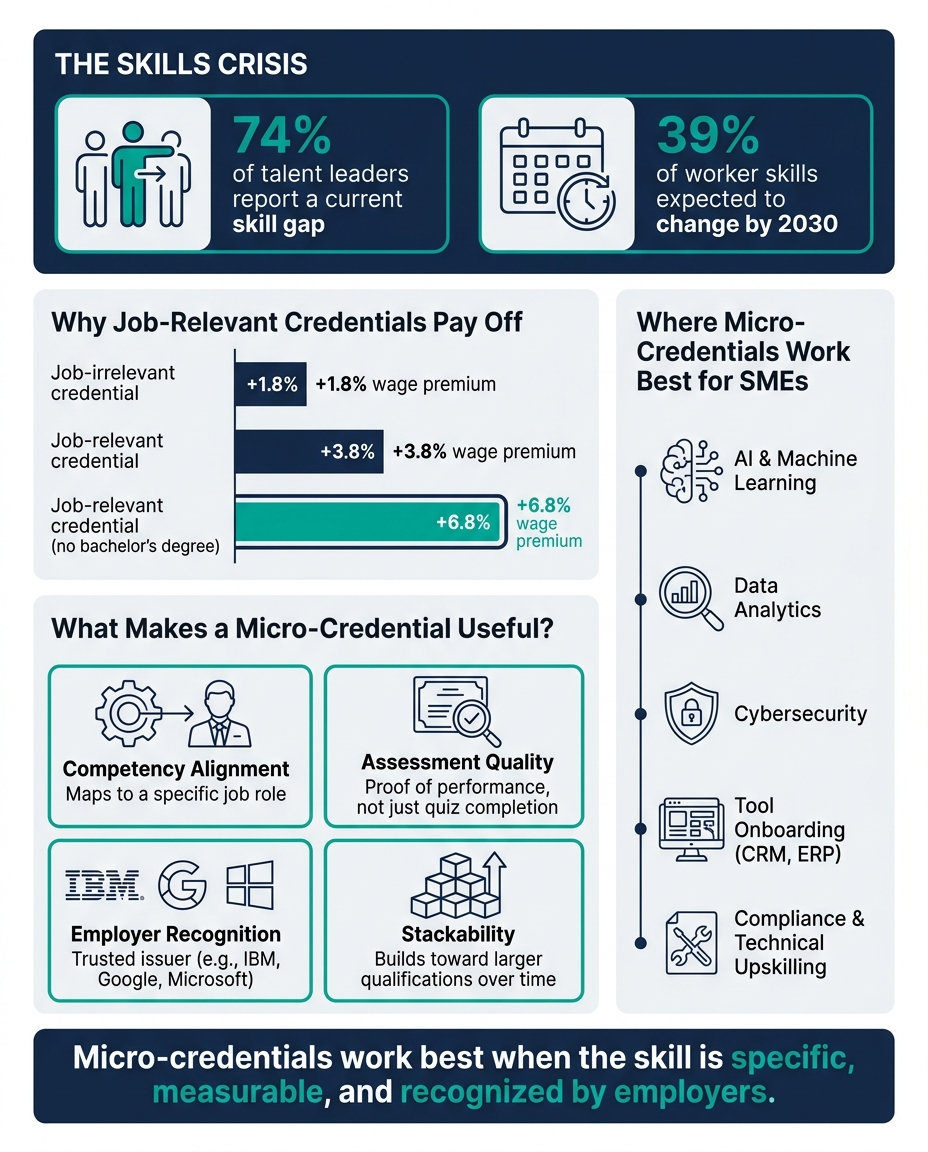
I’d sum up the research like this: companies are dealing with a fast skills shift, with 74% of talent leaders reporting a current gap and 39% of worker skills expected to change by 2030. Micro-credentials give you a more exact way to check who can do what, because they focus on one skill at a time instead of broad training or degrees.
Here’s the article in plain English:
- I explain what skill gap analysis is in a business setting
- I show how micro-credentials differ from competencies, learning outcomes, and qualifications
- I point out the four checks that matter most: alignment to the role, assessment quality, employer acceptance, and stackability
- I cover how firms use them to map role needs to verified employee skills
- I look at AI’s role in sorting skill data and spotting gaps
- I sum up what research says about payoffs, weak spots, and rollout needs
- I end with where this works best for SMEs, especially in AI, data analytics, and cybersecurity
A few findings stand out right away:
- Micro-credentials work best for specific, measurable job skills
- They are stronger for hard skills than for soft skills
- Random badges do little if they are not tied to hiring, promotion, or pay
- A job-relevant first credential is linked to a 3.8% wage premium
- For workers without a bachelor’s degree, that premium goes up to 6.8%
If I were reading this to make a business decision, my takeaway would be simple: don’t treat micro-credentials as a fancy badge system. Use them as a way to verify skill, track progress, and link learning to business needs.
| Area | What the article says |
|---|---|
| Main problem | Skills are changing fast, and broad training often misses the exact gap |
| Main use of micro-credentials | Verify one job skill at a time |
| Best fit | Technical upskilling and role-based training |
| Main limits | Low employer recognition, weak soft-skill signaling, weak governance |
| Best SME use cases | AI, data, cybersecurity, and tool onboarding |
Bottom line: I’d use micro-credentials when you need a clear record that a person can perform a specific task - not just that they finished a course.
Micro-Credentials vs. Traditional Training: Key Stats & Business Impact
Beyond the Resume: Micro-Credentials, Skills-Based Hiring & The Future of Qualifications
sbb-itb-bec6a7e
Micro-credential frameworks and the terms that matter
Micro-credentials only help with skill gap analysis when the terms behind them are clear. That line matters. If you mix up course completion with proven ability, the analysis gets shaky fast.
Micro-credential, competency, learning outcome, and qualification defined
A micro-credential is a verified record of assessed learning. A competency is the applied mastery of specific knowledge, skills, or capabilities, often tied to industry or professional standards. In workforce planning, it points to the exact capability a role needs. A learning outcome describes what a learner is expected to know and be able to do. Micro-credentials certify those measurable units. A qualification is a formal award, such as a degree or diploma, that covers a broader program of study. Micro-credentials can also stack into larger qualifications over time.
| Term | What it means in practice | Role in skill gap analysis |
|---|---|---|
| Micro-credential | Verified record of a specific skill | Shows that a specific gap has been closed |
| Competency | Applied skill or capability required for a role | Acts as the benchmark for spotting missing skills |
| Learning outcome | Specific tasks a learner can perform | Gives you the measurable unit for targeted training design |
| Qualification | Broad formal award (e.g., a degree) | Serves as a longer-term employee development goal; can be built by stacking credentials |
This is why the framework matters more than the label. A badge might look impressive on paper, but if it doesn't tie back to a defined skill, it doesn't do much for analysis.
The framework elements used in skill analysis
Once the terms are sorted out, the next step is figuring out what makes a credential useful in business analysis. Four features shape whether a micro-credential can do that job well.
Competency alignment means the credential maps straight to a job role or industry need, not just a broad topic area. If a company needs data visualization in Tableau, a general “analytics” course may not be enough.
Assessment quality means the credential requires proof of performance, such as project-based work or ePortfolios, instead of a simple quiz. Without that, the credential may show participation more than mastery.
Employer recognition refers to the labor-market value of the credential. Vendor-branded credentials from names like IBM, Google, or Microsoft often carry more weight because they line up with global industry standards.
Stackability means credentials can build toward larger qualifications over time. That gives employers a way to connect short learning efforts with longer-term staff development.
"Micro-credentials function as micro-investments in learning that yield incremental gains in human capital (knowledge, skills, and competencies), social capital (networks and industry recognition), and symbolic capital (credential-based legitimacy)." - Sharon Kerrick, Ph.D., Journal of Small Business Strategy
For SMEs, competency alignment is the main filter. It's the part that tells you whether a credential belongs in the analysis at all.
How micro-credentials support skill gap analysis
Mapping role requirements to verified employee skills
The basic idea is simple: define what a role needs, then compare that with what an employee can actually prove. Micro-credentials make that second part much more concrete. A digital badge records the competency, the assessment method, and evidence of performance. That evidence is searchable and linked to a specific competency.
That gives you a verified skills inventory. If a role calls for prompt writing or data handling, a manager can check whether an employee holds a verified credential for those skills, not just whether they showed up for training. In plain terms, it gives managers more than a résumé line or a broad degree when they need to confirm what someone can do.
Once those skills are verified, larger gaps become easier to break into smaller pieces.
Turning broad training needs into measurable learning units
This is where micro-credentials help in a very practical way. They break a broad training need into stackable units. Each unit can be completed on its own, assessed on its own terms, and put to use on the job right away. That also makes skill gaps easier to assign, track, and close. Instead of guessing whether someone is “getting there,” managers can follow actual progress.
Some frameworks use levels like Knowledge, Proficiency, and Mastery, then award a higher-level credential when the full pathway is finished. That gives managers a clear milestone, not a fuzzy training label.
Where AI tools may support the process
Managing a skills inventory across even a mid-sized team can get messy fast. AI tools may help by analyzing data from HR systems, learning platforms, recruiting databases, and project records to generate skill scores and flag gaps by role or department.
A large-scale example shows how this can work. Johnson & Johnson's Digital Talent team defined a taxonomy of 41 "future-ready" skills across 11 capabilities, then used a machine learning model to score 4,000 technologists from 0 to 5 on each skill. By March 2024, more than 90% of employees in J&J's Technology group had accessed the learning platform, and voluntary learning activity went up by 20%.
"To be relevant and future ready, you for instance need to have your commercial expertise and digital expertise. Scientific expertise and digital. You can have the best technology, but without that integrated way of thinking, it won't transform anything." - Jim Swanson, Executive Vice President and Chief Information Officer, Johnson & Johnson
Most SMEs won't work at J&J's scale. Still, the same logic holds up. AI tools can help draft competency maps, sort credential data, and show training priorities without the need for a dedicated HR analytics team.
What research says about benefits, limits, and rollout conditions
Research findings on closing business skill gaps
Once skills are mapped, the next step is simple: do micro-credentials help the business? Research suggests they can.
For skill gap analysis, micro-credentials give managers a more precise way to spot what's missing. Instead of sending people through broad training, they can focus on one missing capability at a time. That makes it easier to fix specific gaps when they show up, rather than waiting for a bigger problem later.
The research also points to labor market impact. In a nine-year study of 46,791 workers, earning a micro-credential was linked to higher earnings and higher project value. On top of that, about 95% of employers reported clear benefits from employees earning micro-credentials, especially as signals of initiative and transparent competence.
Limits the research highlights
The picture is positive, but there are clear weak spots too.
The biggest issue is recognition. If employers don't know the issuer or don't trust the standards behind the badge, its value falls fast. For SMEs, that problem can wipe out the upside of an otherwise well-built credential. And when recognition is low, adoption tends to weaken both inside the company and in the job market.
Research also shows that micro-credentials do a better job verifying hard skills than soft skills. They tend to confirm technical ability more reliably than traits like communication or reliability. For people with years of experience, they work best as an add-on to work history, not a substitute for it.
There's also a governance issue. Without review boards, scoring rubrics, and consistent taxonomies, programs can get too shallow to support dependable skill analysis. UMBC offers one clear example. The University of Maryland, Baltimore County established a Microcredential Review Board and a twelve-criterion evaluation rubric to oversee its portfolio of 195 micro-credentials.
Advantages, limitations, and best-fit use cases at a glance
These findings lead to a practical rule: micro-credentials work best when the skill is specific, measurable, and recognized by employers.
| Feature | Advantage | Limitation | Best Use Case |
|---|---|---|---|
| Skill gap analysis | High granularity; pinpoints specific competency gaps | SMEs may lack the resources for complex data systems | Onboarding for new digital tools, such as AI or CRM systems |
| Training alignment | Direct mapping to industry standards | Weak alignment if credentials are not verifiable or machine-readable | Targeted compliance or technical upskilling |
| Readiness | Faster onboarding; signals initiative | Does not effectively signal soft skills like communication or reliability | Role-specific AI or data analytics development |
| Signaling | Reduces employer uncertainty, especially for new entrants | Lower signaling power for experienced workers with established work history | Entry-level hiring in technical fields |
Conclusion: When micro-credentials make sense for SMEs
Micro-credentials can make skill gap analysis much sharper for U.S. SMEs, especially when they show job-ready skills that a degree doesn't clearly show. The research keeps pointing to the same three things: clear learning outcomes, verified badges backed by assessment evidence, and internal rules that give the credential weight in hiring, promotion, or pay. That's when the research starts to matter on the ground.
Once those pieces are in place, the upside gets easier to see. When credentials are job-relevant and verified, they show measurable labor-market value. A first job-relevant credential is linked to a 3.8% wage premium, compared with 1.8% for a job-irrelevant one. For workers without a bachelor's degree, that premium climbs to 6.8%. Put simply, stacking random credentials probably won't do much.
This matters most for SMEs hiring for roles where skills shift fast. The clearest use case is targeted upskilling for jobs in AI, data analytics, and cybersecurity. Micro-credentials work best when employers can verify them and connect them to hiring, promotion, or pay. Credentials from trusted issuers make that signal stronger.
When all of that lines up, micro-credentials become a practical, lower-cost way for SMEs to close specific skill gaps with more precision than broad training alone.
FAQs
How do I choose credible micro-credentials?
Look for micro-credentials that offer verifiable, competency-based evidence, not just a certificate that says you showed up.
Portable standards like Open Badges can help here. They often include key details such as learning outcomes, how the work was assessed, and who issued the credential. That gives you more than a badge image. It gives you proof people can check.
It also helps to look closely at the provider itself. Check its reputation, accreditation, or alignment with standards such as ISO 17024. If a credential was built with input from industry experts or employers, that’s usually a good sign. On the flip side, steer clear of programs that make unrealistic salary or job promises.
The best pick is usually the one that maps closely to your target occupation. If the credential lines up with the job you want, it’s far more likely to carry weight when it matters.
Can micro-credentials measure soft skills?
Yes. Micro-credentials can measure soft skills - often called noncognitive or twenty-first-century skills - through formal assessments, sometimes backed by psychometric analysis.
That means they can give people a way to show skills like communication, problem-solving, and creative thinking with something more concrete than a line on a résumé.
There’s still some skepticism from employers about how strict or consistent these assessments are. Even so, micro-credentials can help document both soft skills and hard skills, and they can give businesses a clearer view of where talent gaps exist and what needs work.
Where should an SME start with skill gap analysis?
Start with your business goals, not fixed job descriptions. Look at your top priorities for the next 12 to 18 months and map the skills people will need to get those jobs done.
Then sit down with business leaders and pin down the skills that matter most. That includes both technical skills and soft skills tied to those goals.