If your team still builds compliance reports by hand, you're spending too much time on work a bot can do. I’d use RPA for rules-based tasks like reconciliations, field checks, approval routing, and run logs - then keep exception review, policy calls, and final approval with people.
Here’s the short version:
- Automate the repeatable steps - data pulls, matching, validation, template filling, and routing
- Keep human control - reviewers still handle breaks, approvals, and certifications
- Build evidence from day 1 - each run should log source IDs, dates, rule versions, record counts, exceptions, and reviewer approvals
- Control the bots - lock down access, separate dev from production, track changes, and keep fallback steps ready
- Start with stable processes - if the workflow is messy, fix it before you automate it
In plain English: RPA helps finance teams cut manual reporting work from days to hours in some cases, while making audit support easier if the bot, logs, and approvals are set up the right way.
I see 4 takeaways from this article:
- Best-fit use cases are reconciliations, close support, policy checks, and recurring reports.
- Audit logs alone are not enough - compliance evidence has to tie each run to the data source, rules used, and human review.
- Bot governance matters - access, testing, change control, and failure handling need clear owners.
- Control owners still own the result - automation does the work, not the accountability.
If I were evaluating RPA for compliance reporting, I’d ask one question first: Is this step rules-based enough to automate without moving judgment away from the people who own the control? That’s the line that matters.
Automate reconciliations, policy checks, and recurring reports
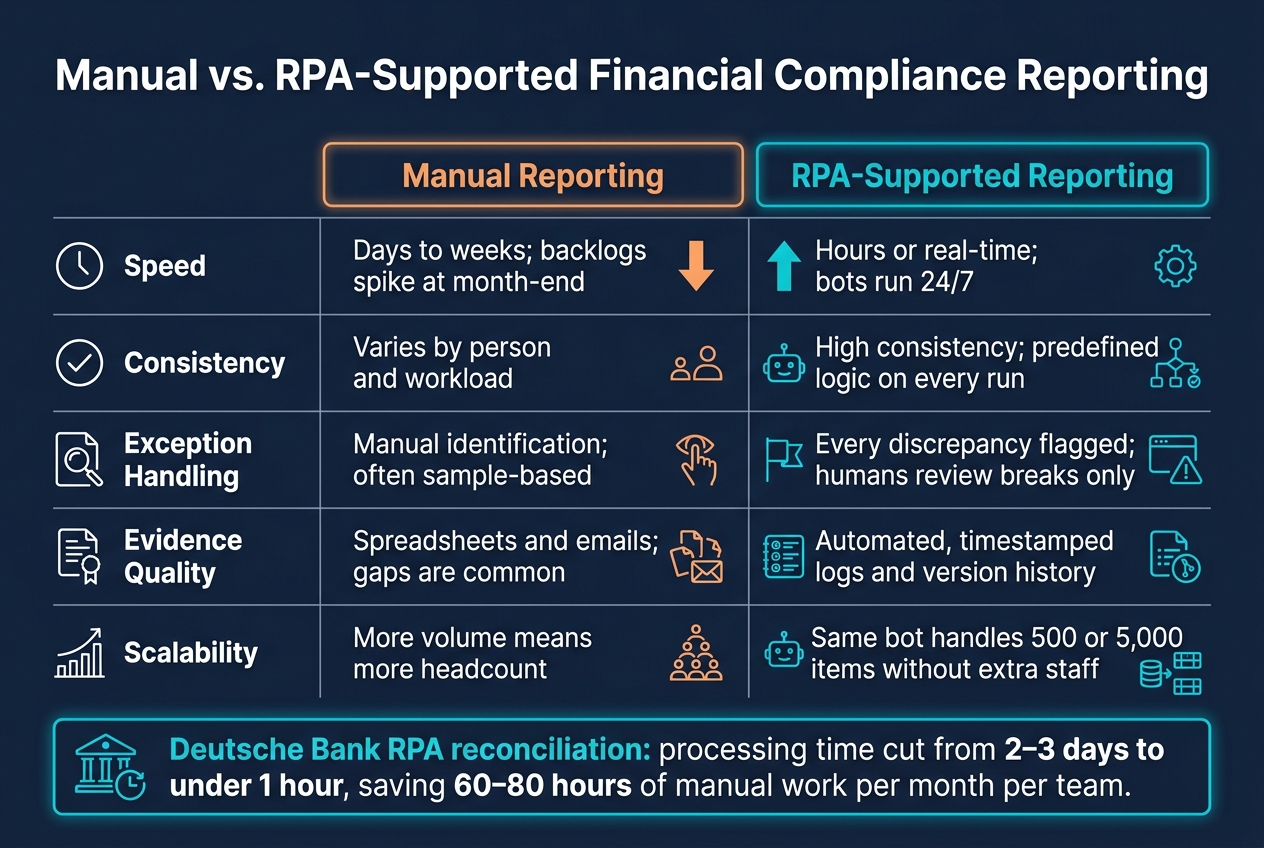
Manual vs. RPA-Supported Financial Compliance Reporting
Reconciliations and close support
Start with repeatable controls that already have clear source data and clear exception rules.
Reconciliations are a strong fit for automation because the work is rule-based, high-volume, and time-sensitive. A bot can pull bank statement data, match it to the general ledger in real time, flag unmatched items, and produce a clean exception list.
The same approach works for subledger-to-general ledger reconciliations and intercompany matching. Bots can check source and report record counts, apply the tolerance thresholds you set, and send anything outside those limits to the right reviewer. In practice, RPA can cut reconciliation time from days to hours and reduce manual effort.
Period-end close support follows the same pattern. Bots can run duplicate detection and create timestamped logs that show what ran, when it ran, and what it found.
Policy checks, approvals, and report preparation
Before a report reaches a reviewer, a bot can check that all required fields are filled in, that approval limits line up with transaction amounts, and that segregation-of-duties rules were not broken. For invoice and payment workflows, that includes three-way matching across the purchase order, receipt, and invoice against policy rules.
Bots can also flag transactions that skip normal approval routing or amounts that go over set thresholds. Version-controlled rules keep approval limits and segregation-of-duties changes logged and current. That split keeps the reportable evidence clean while leaving approval authority with people.
Manual vs. RPA-Supported Reporting
These changes show up most clearly in how teams spend time and how evidence gets recorded.
| Dimension | Manual Reporting | RPA-Supported Reporting |
|---|---|---|
| Speed | Days to weeks; backlogs spike at month-end | Hours or real-time; bots run 24/7 [1][2] |
| Consistency | Varies by person and workload | High consistency; follows predefined logic on every run |
| Exception handling | Manual identification; often sample-based | Every discrepancy flagged; humans review breaks only |
| Evidence quality | Spreadsheets and emails; gaps are common | Automated, timestamped logs and version history [3] |
| Scalability | More volume means more headcount | Same bot handles 500 or 5,000 items without extra staff [2] |
The main shift is simple: teams spend less time handling data and more time reviewing controls. RPA takes repetitive handling off the table, so reviewers can focus on exceptions and control evidence. That matters because each automated run still needs a clean evidence trail.
sbb-itb-bec6a7e
Build regulator-ready logs, workpapers, and approval records
A bot run is not an audit trail.
For reconciliations, policy checks, and approvals, the evidence file has to show what ran, when it ran, which rule version applied, and who approved it. For these workflows, the audit file needs to be complete before the close is signed off.
Minimum evidence every automated report must preserve
Every automated compliance report must capture the source system identifier, extraction timestamp (MM/DD/YYYY), bot or service-account identity, rule set version, input and output record counts, validation results, data transformations, exception dispositions, and the reviewer identity and approval timestamp tied to the final report version. Rule version also needs to be tracked per run, so the correct logic can be proven for each reporting period.
The next issue is simple: are those records protected, easy to retrieve, and immutable?
Operational logs vs. compliance evidence
This is where teams often get tripped up. Platform logs show execution. They do not show compliance proof.
System-generated logs usually track run times and success or failure status. That helps with operations, but it won't satisfy a compliance reviewer. Compliance evidence must be complete, attributable, consistently timestamped, searchable, exportable, and protected against changes.
In practice, that usually means:
- encrypted storage and Role-Based Access Control (RBAC) to protect evidence
- credential vaults instead of hardcoded access details, so bot identities stay traceable and auditable
Evidence requirements mapped to RPA controls
The table below maps the core compliance requirements to the RPA controls that satisfy them, along with what U.S. recordkeeping expectations look like in practice.
| Compliance Requirement | RPA Control | What It Covers |
|---|---|---|
| Completeness | Reconciliation checks; input/output record counts | Confirms all source data was processed without omission |
| Accuracy | Validation results; rule versioning | Shows which version of the logic was applied during each run |
| Authorization | RBAC; approval timestamps; credential vaults | Ties every outcome to a specific bot identity or named human reviewer |
| Traceability | Source system identifiers; extraction timestamps (MM/DD/YYYY) | Allows a final figure to be traced back to its source record |
| Retention | Indexed, encrypted, centralized storage | Evidence is retrievable and protected against unauthorized changes |
| Retrieval | Exportable evidence packages; searchable audit logs | Auditors can access the full evidence package without manual reconstruction |
For U.S. public companies, SOX evidence for automated controls must include documentation of bot programming, controls over source data, and documentation of automated control tests. It's far less costly to build that into the workflow from the start than to reconstruct it during an audit.
Reduce audit friction with governance, controls, and testing
An evidence trail is only half the job. The next risk is the bot itself - who can access it, how changes get approved, and what happens when something goes wrong. RPA cuts audit friction only when bots are controlled the right way. If a bot runs without access controls, change management, or exception handling, it doesn't make compliance easier. It adds risk.
Common reporting problems RPA can fix
Most audit trouble in financial compliance reporting comes from the same few problems: data spread across disconnected systems, manual entry mistakes, missing audit trails, uneven policy use, and slow reconciliations.
Bots help by pulling source data directly and applying the same rules every time. That cuts re-entry mistakes and removes judgment calls that vary from person to person. Deutsche Bank's RPA-powered reconciliation solution cut processing time from 2 to 3 days to under 1 hour, saving individual teams between 60 and 80 hours of manual work per month [2]. That kind of operating gain also tends to show up in the audit file as cleaner, easier-to-check evidence.
Preventive, detective, and corrective controls for production bots
Do not move a bot into production without preventive, detective, and corrective controls. Each control type does a different job, and you need all 3 before a compliance-critical bot goes live.
| Control Type | RPA Implementation | Owner | Evidence Produced | Review Frequency |
|---|---|---|---|---|
| Preventive | RBAC & Least Privilege | IT Security / CoE | Access logs & permission matrices | Quarterly |
| Preventive | Segregation of duties between development and production - boundaries must be documented and enforced | CoE Manager | Environment access logs | Per release |
| Detective | Activity Logging (Timestamps/Outcomes) | RPA Ops Team | Bot execution logs | Daily / Per run |
| Detective | Exception Queues & Failure Alerts | Process Owner | Exception reports & resolution logs | Real-time |
| Corrective | Restart Procedures & Manual Fallback | Operations Team | Incident reports & override logs | Per incident |
| Corrective | Version Control & Change History | CoE / DevOps | Code repository commit history | Per change |
Testing, monitoring, and audit-ready packaging
Once controls are defined, test them against actual exception paths and release changes. Don't wait for an annual review. If regulations change, bot logic should be tested against the updated requirements every time [2][3].
After the bot is in production, monitoring should track failed runs and exception rates in real time. Exception reports should also be produced in real time so a person can review them right away [2][3].
Then package the run documentation in one place: test results, exception history, approvals, and bot version details. That gives auditors one complete record for the run [3][4].
Conclusion: How to adopt RPA for compliance reporting without losing control
RPA is useful only when the process is stable and easy to audit. The best fit is a high-volume, rules-based reporting step where each automated action maps to a specific control objective. Use bots for the repeatable work. Keep judgment calls and final sign-off with people.
Governance matters just as much as the automation itself. Set up a Center of Excellence early to define standards, oversee access controls, and handle change across bots in production.
Even with strong controls in place, final accountability still sits with the control owner. Bots should prepare data, match records, and flag exceptions. People should review the output and approve it.
Each automated run should leave a clear trail: centralized logs, exception records, approvals, and bot version history. That gives auditors what they need to trace every run - and gives teams more speed without giving up auditability.
FAQs
How do we decide which reporting steps to automate first?
Start with reporting tasks that follow fixed rules, show up often, and eat up more time than they should. Good early targets include expense management, report generation, and bank reconciliations.
Before you automate anything, map the workflow. Cut duplicate steps, write down the decision rules, and test one clearly defined process first. Then compare the results to your baseline before you roll it out more broadly.
What evidence does an RPA-driven compliance report need for audit review?
An RPA-driven compliance report should include a timestamped audit trail that ties every data point back to its original source.
That audit trail should show the core evidence behind the process, including:
- Bot activity logs
- Outcomes
- Users involved
- Bot documentation and performance metrics
- Exception and manual intervention records
- Access logs
- Version histories
- Proof of compliance with frameworks such as SOX or GAAP
Without that link back to the source, a report is much harder to verify. The whole point is simple: someone reviewing the report should be able to trace what happened, when it happened, who was involved, and how the bot handled each step.
Who remains accountable when a bot supports compliance reporting?
Accountability stays with the organization and its human leadership, even when RPA bots help with compliance reporting. Bots can automate tasks and leave audit trails. But under governance frameworks such as SOX, FINRA, and BSA, human oversight is still required.
That means executives and controllers still own internal controls. They’re also responsible for making sure bots stay within defined parameters through compliance review and performance monitoring.