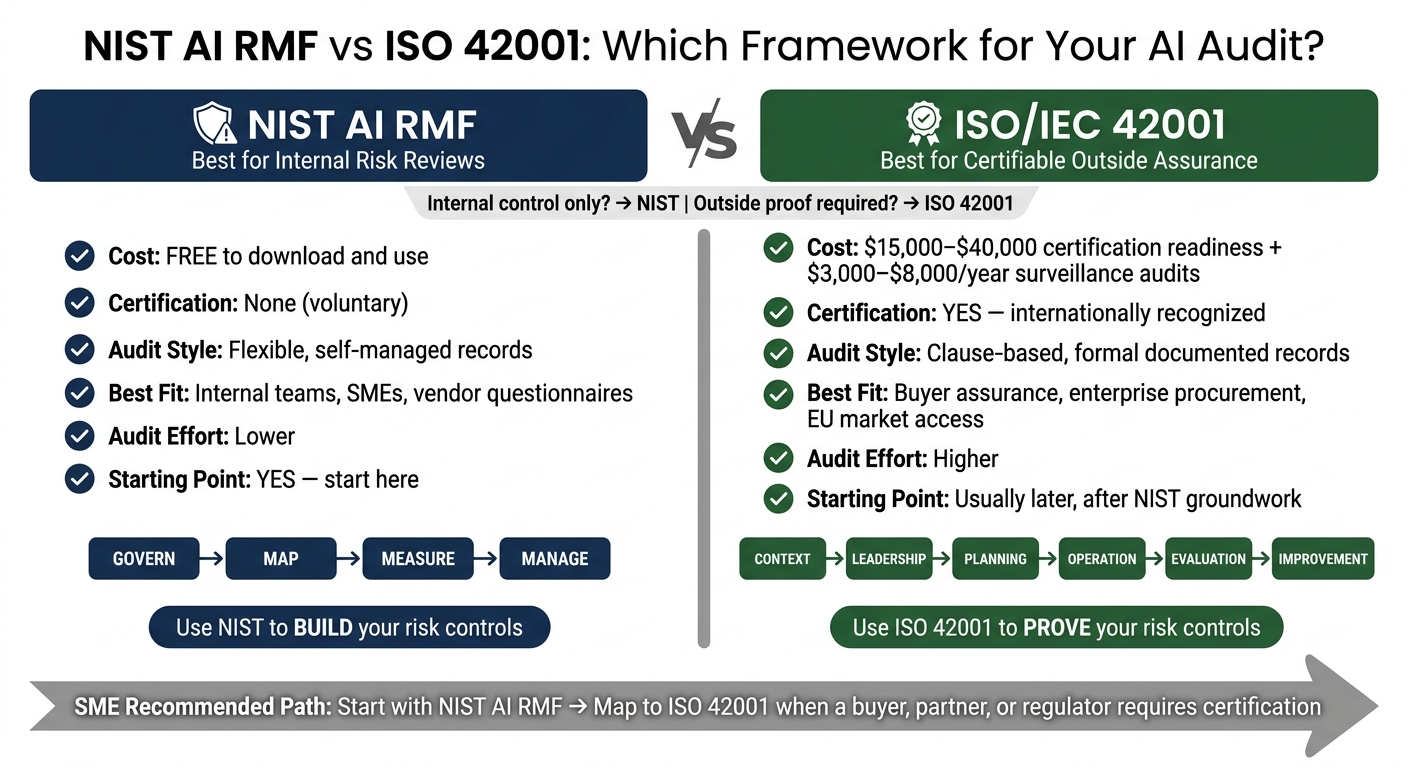
If you need internal AI audit structure, I’d start with NIST AI RMF. If you need outside proof, I’d use ISO/IEC 42001. That’s the short answer.
Here’s the simple split:
- NIST AI RMF is free, voluntary, and built for risk reviews
- ISO/IEC 42001 is built for formal audits and third-party certification
- NIST fits vendor checks, internal reviews, and early-stage AI governance
- ISO 42001 fits customer requests, procurement reviews, and certification work
- SMEs often start with NIST first, then map that work to ISO later if needed
- ISO 42001 usually costs about $15,000 to $40,000 to get ready for certification, plus $3,000 to $8,000 per year for surveillance audits
If you audit vendor AI tools, review AI systems in use, or build an AI evidence trail, this is what matters most: NIST helps you run the review. ISO helps you prove the review to someone else.
NIST AI RMF vs ISO 42001: Side-by-Side Comparison for AI Audits
ISO 42001 vs NIST AI RMF. Which one do you need?
sbb-itb-bec6a7e
Quick Comparison
| Criteria | NIST AI RMF | ISO/IEC 42001 |
|---|---|---|
| Main purpose | Internal AI risk review | Formal AI management system |
| Certification | No | Yes |
| Cost to access | Free | Paid standard and audit costs |
| Best fit | Internal teams, SMEs, vendor questionnaires | Buyer assurance, procurement, outside audit |
| Audit records | Flexible | Clause-based and formal |
| Supplier review | Risk-based | Supplier controls plus certifiable records |
| Audit effort | Lower | Higher |
| Best starting point | Yes | Usually later |
So if I were choosing fast: use NIST to set up the work, and use ISO when a buyer, partner, or regulator asks for proof.
NIST AI RMF: Best for risk-based AI reviews without certification
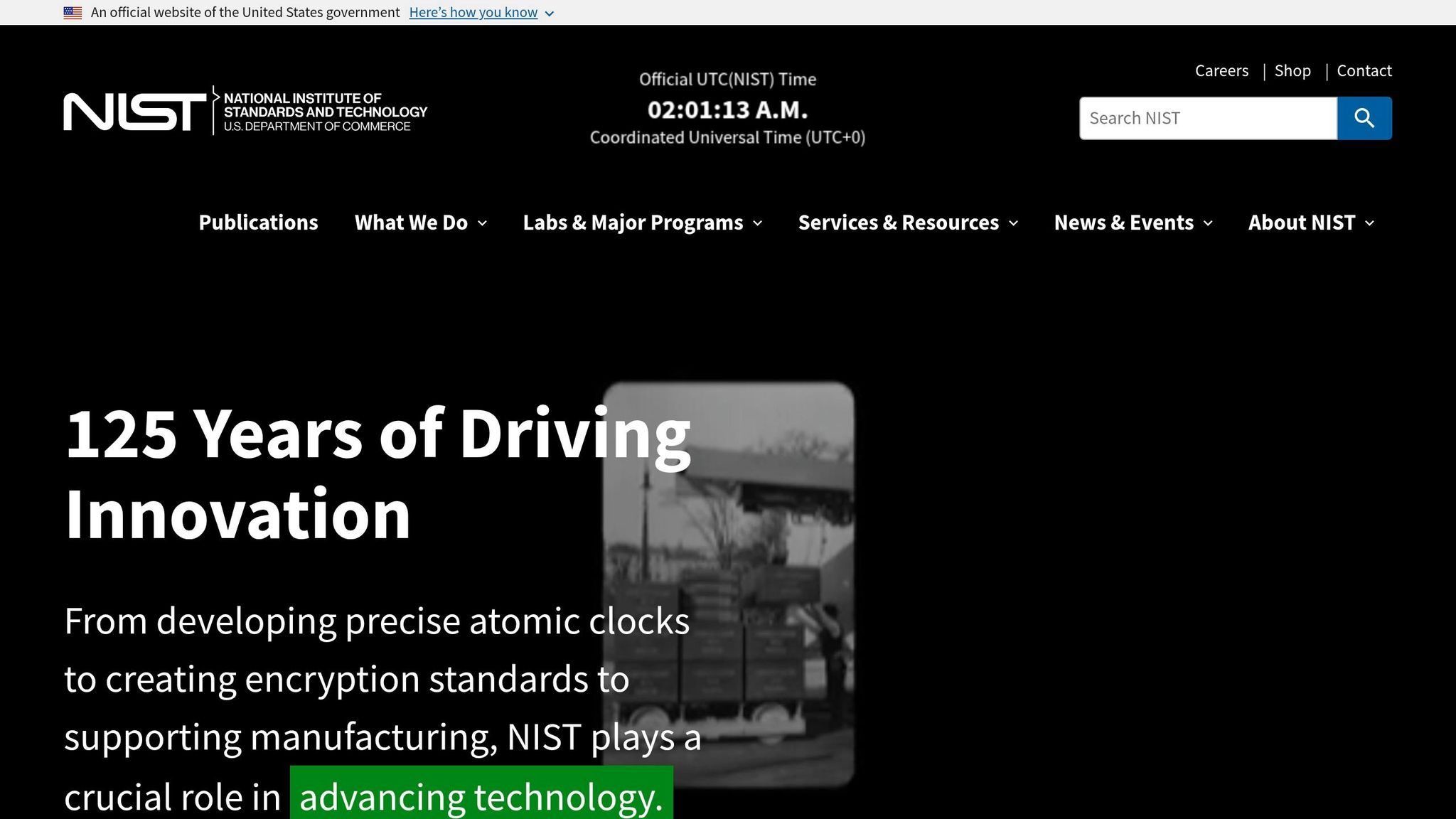
NIST AI RMF 1.0 is a voluntary, non-prescriptive framework for managing AI risk across design, development, use, and evaluation. It has 4 functions: Govern, Map, Measure, and Manage. It costs $0 to download or use.
The four NIST AI RMF functions and what auditors check
Each function lines up with a basic audit question and a matching set of records.
| NIST Function | Audit Control Questions | Typical Evidence & Records |
|---|---|---|
| Govern | Is there clear accountability? Are roles defined? | AI governance charter, signed AI policies, roles and responsibilities matrix, training records |
| Map | What is the context of the AI system? What are the potential harms? | AI system inventory, use-case register, impact assessments, risk classification records |
| Measure | Has the system been tested for bias, safety, and robustness? | Bias/fairness test results, red-teaming reports, model performance logs, robustness evaluations |
| Manage | How are risks prioritized and monitored? Is there an incident response plan? | Risk registers, incident logs, treatment plans, vendor due diligence reports, change approval records |
In audit work, this usually comes down to 4 questions: who owns the system, what can go wrong, how was it tested, and how are risks tracked? Auditors tend to follow that same path - first governance, then the system inventory, then testing, and then risk treatment and incident response.
How NIST AI RMF applies to third-party AI and vendor reviews
For third-party AI, this framework works well as a vendor review checklist. Map and Manage both touch third-party risk, so auditors can use the framework to review vendor models, AI-enabled software platforms, and outside data sources by matching vendor practices to each function.
In plain terms, teams often turn this into a risk-based vendor scorecard. The scorecard asks a few direct things: can the vendor show who is accountable, can they explain model behavior, and will they notify you when something goes wrong?
Contract review matters here too. Auditors check whether agreements include AI-specific clauses for data rights, model disclosure, and incident notification timelines. If a vendor handles its own model updates, auditors also look for records that show the model is being watched for drift over time.
Records auditors typically need under a NIST AI RMF approach
The evidence set under a NIST AI RMF approach is flexible, but auditors usually ask for the same core records:
- AI policy or governance charter
- Vendor inventory that includes third-party plug-ins and embedded AI features
- Use-case register with risk classifications
- Documented risk assessments
- Testing and evaluation outputs, including bias checks
- Approval records
- Incident logs
- Treatment plans
A simple rule helps here: keep the evidence close to the work. Store policies in shared repositories, track approvals in current ticketing systems, and link test cases to each AI system. [1][5]
ISO 42001: Best for formal AI governance and certifiable audits
ISO 42001 is the audit-ready option. If NIST AI RMF gives you room for a flexible risk review, ISO 42001 gives you a formal governance system built for certification.
ISO/IEC 42001 is the first certifiable international management system standard for AI. It was built for formal third-party audits, plus vendor and outsourced AI reviews. The main draw is external assurance: you can show AI governance through an internationally recognized certificate.[1][4]
It also uses PDCA and Annex SL, which makes it easier to fit into an existing ISO audit program, including ISO 27001.[4][2]
How ISO 42001 is structured for audit work
ISO 42001 follows the same management system pattern used across other ISO standards: scope, leadership, planning, support, operation, performance evaluation, and improvement.
For audit work, that matters a lot. Auditors don't want casual assurances or verbal updates. They want documented, repeatable records.
| ISO 42001 Clause / Area | Audit Focus Area | Typical evidence |
|---|---|---|
| Clause 4: Context | AIMS scope and boundaries | Documented scope including internal and third-party AI systems |
| Clause 5: Leadership | Governance and accountability | Signed AI policy, defined roles, resource allocation records |
| Clause 6: Planning | Risk and impact assessment | Risk assessment methodology, AI objectives, Statement of Applicability |
| Clause 7: Support | Competence and awareness | Training records, resource allocation logs |
| Clause 8: Operation | Risk treatment and suppliers | Risk treatment plans, supplier assessments, contracts |
| Clause 9: Evaluation | Monitoring and internal audit | Internal audit reports, management review minutes |
| Clause 10: Improvement | Corrective actions | Nonconformity logs, remediation tracking |
| Annex A Controls | Specific AI safeguards | Bias testing evidence, data quality records, human oversight logs |
In practice, auditors look for active governance. That means meeting minutes, signed-off risk decisions, and logged reviews - not just a nice policy sitting in a folder.
How ISO 42001 handles suppliers and outsourced AI
Supplier oversight sits mainly under Clause 8 and Annex A.10. For vendor due diligence, auditors usually want to see:
- Documented supplier controls
- Clear ownership
- AI-specific contract terms
- Ongoing monitoring of outsourced AI
That trail of control is what auditors expect to find in the documented information.[6][7]
Documented information required for ISO 42001 audits
The paperwork load under ISO 42001 is heavier than under NIST AI RMF. One of the main documents is the Statement of Applicability (SoA). Auditors use it to check which Annex A controls apply, why a control was included or left out, and whether it has been put in place.[3][5]
Beyond the SoA, auditors usually ask for the AIMS scope, AI policy, AI objectives, risk and impact assessment outputs, internal audit reports, management review records, supplier assessments, nonconformity logs, and remediation tracking.
For SMEs, certification readiness usually costs $15,000 to $40,000, with annual surveillance audits of $3,000 to $8,000.[1]
A practical move: run the internal audit at least 60 days before the certification audit. That gives you time to close gaps before the external review. The tradeoff here is simple - ISO 42001 asks for more evidence, but that's the price of being audit-ready.
NIST AI RMF vs ISO 42001: Side-by-side audit comparison
Once you understand how each framework works, the next question is simple: which one gives auditors the proof they want? NIST AI RMF helps teams build AI risk controls. ISO 42001 helps them show those controls in a certifiable audit.
| Dimension | NIST AI RMF | ISO 42001 |
|---|---|---|
| Audit Evidence | Self-managed records tied to four functions | Formal clause-linked records required at each Annex SL stage |
| Third-Party AI Coverage | Map and Manage functions (risk identification) | Annex A.10 (third-party and customer relationships) |
| SME Fit | Best starting point for internal governance | Better when external assurance is required |
| Best Use Case | Internal risk culture, self-assessment | Customer-facing proof, enterprise procurement, EU market access |
At the core, the split is about structure. NIST AI RMF is a flexible risk model. ISO 42001 is an audit-ready management system.
Scope and purpose: Risk framework vs management system standard
That structure shapes the audit load. NIST gives teams room to fit controls and records to their own setting. ISO 42001 is clause-based, so auditors review it line by line and expect documented proof at each stage.
Put plainly, NIST helps you organize risk work. ISO 42001 helps you show that work in a form an outside auditor can test.
Vendor review use: Which one works better for third-party AI due diligence
For vendor reviews, the main issue is whether you need a control framework or a certifiable proof point. ISO 42001 usually has the edge in procurement. A supplier can provide a valid certificate backed by formal supplier controls under Annex A.10. That gives buyers a concrete audit artifact.
A vendor aligned to NIST AI RMF can still share risk profiles, controls, and playbooks. That may be useful. But it is not a certifiable proof point, so there is less for a third party to verify on its own.
A practical way to use both:
- Use NIST AI RMF to shape the vendor questionnaire and risk review process
- Use ISO 42001 when the buyer wants supplier certification
Evidence burden and audit effort
NIST AI RMF is lighter and faster to put in place. ISO 42001 takes more time, more records, and more work between audits.
The difference shows up in day-to-day audit prep. With NIST, teams usually rely on self-managed periodic reviews. With ISO 42001, the Plan-Do-Check-Act cycle keeps running. That includes formal internal audits and management reviews, and both create records that external auditors will inspect.
So if your team wants a leaner setup, NIST is easier to live with. If you need outside verification, ISO asks for more discipline and more paperwork.
Where each option fits in real audit work
NIST AI RMF fits best for internal audits, early AI governance efforts, and lighter vendor reviews where no certificate is needed. ISO 42001 fits better when customers or enterprise procurement teams want something they can check on their own.
This matters in cross-border sales too. If you are entering EU markets or answering procurement requests that call for certifiable AI governance, a NIST profile will not meet that bar. A valid ISO 42001 certificate will.
Which one works better for SMEs with small risk teams
This is where the audit load hits hardest. Small and mid-sized teams usually do better starting with NIST AI RMF. It gives them a practical base for governance without forcing full certification work on day 1.
Then, if a contract, customer, or regulator asks for certification, they can map what they already have to ISO 42001. That step is a lot less painful when the groundwork is already in place.
One small move helps under either framework: assign a named AI risk owner. When one person is clearly responsible, the record trail is much easier to keep intact between audits.
How to choose between NIST AI RMF and ISO 42001
The choice is simple: pick NIST AI RMF for internal control. Pick ISO 42001 when you need outside proof. If your main goal is to guide risk reviews inside the business, NIST is the better fit. If a customer, procurement team, or regulator wants independent assurance, ISO 42001 is the one to use.
Start with a full inventory of every AI system, vendor tool, and embedded AI feature.
Choose NIST AI RMF if you need a lower-lift starting point
NIST AI RMF is the better starting point for lean internal reviews. It keeps the audit burden lower because it does not require certification. That makes it a practical way to build vendor questionnaires, risk review templates, and internal evidence trails without setting up a formal audit program behind them.
Choose ISO 42001 if you need certifiable assurance
ISO 42001 is the better fit when formal assurance is the job. It gives auditors a certifiable target and works well when a contract, questionnaire, or review calls for independent proof. That usually means supplier evidence, controls that can be tested by an outside party, and audit-ready documentation a third party can verify on its own.[1][2]
Use NIST AI RMF to manage risk. Use ISO 42001 to prove that work to outsiders. That decision shapes the audit model, the evidence burden, and the vendor review process.
Conclusion: Which framework should you use for AI audits?
For third-party AI audits, the choice comes down to internal risk control vs. outside proof.
NIST AI RMF is the best starting point for risk-based AI audits. It costs nothing to use, and it works well for SMEs that need to review vendors without going through certification.
ISO 42001 makes sense when you need certifiable outside assurance.
For vendor reviews and AI audit trails, NIST helps you build the control process. ISO shows that process to buyers, partners, regulators, or other outside parties. Use NIST AI RMF for internal governance, then move to ISO 42001 when outside assurance becomes necessary.
That’s why SMEs should start with NIST AI RMF and shift to ISO 42001 only when outside verification is required. Start with an inventory of AI tools, vendors, and embedded AI features. Then document risk reviews and keep those records in one controlled repository if you later pursue ISO 42001. [1][6]
Move toward ISO 42001 only when a buyer or regulator requires certifiable assurance - not before.
FAQs
Can I use NIST AI RMF and ISO 42001 together?
Yes. Use NIST AI RMF for day-to-day AI risk work, and use ISO/IEC 42001 to organize and document those controls for external audit and certification.
In plain English, ISO/IEC 42001 gives you the management system, the records, the internal audit process, and the third-party audit path. NIST AI RMF gives you the hands-on framework for finding, measuring, and managing AI risks, including vendor reviews.
How do I map NIST AI RMF work to ISO 42001 later?
Use the same artifact set for both frameworks. The goal is simple: map what you already keep for NIST AI RMF to the clause and control structure in ISO/IEC 42001 so an auditor can follow the trail from scope to control, review, and fix.
Start with NIST MAP. That gives you the core records for purpose, context, scope, system inventory, and risk or impact review. In practice, this usually means:
- AI use-case register
- system inventory
- stakeholder and context notes
- impact assessments
- risk assessments
- intended-use and misuse statements
From there, carry over NIST MEASURE outputs. These show how the system was checked, what was tested, what limits were found, and what performance or risk signals were recorded.
Then bring in NIST MANAGE records. These cover what the team did with the findings - risk treatment, approval paths, monitoring, incident response, and change control.
The cleanest way to do this is to build one crosswalk table. Each row should connect:
- the NIST outcome
- the matching ISO/IEC 42001 clause or Annex A control
- the artifact used as proof
- where that record lives
- who owns it
- the review date or version
That way, the same evidence can serve both your operating team and your auditor.
The auditor should be able to trace one line from AI scope, to risks found, to controls applied, to test results, to actions taken.
Here’s the basic structure.
| NIST AI RMF area | ISO/IEC 42001 alignment | Evidence record | What it shows |
|---|---|---|---|
| MAP | Clauses on context, scope, AI system inventory, risk review | Scope statement, inventory, impact assessment, risk register | Why the AI system exists, where it applies, and what risks were identified |
| MEASURE | Clauses on evaluation, monitoring, and system checks | Test results, validation reports, metrics logs, review notes | How the system was assessed and what the results were |
| MANAGE | Clauses on treatment, operation, incident handling, change, and fixes | Treatment plans, incident logs, change tickets, action tracker | What the team did in response to risk, drift, failure, or change |
A practical flow looks like this:
MAP first. Use it to define the AI system, its business purpose, its boundaries, the people affected, and the risk posture. This becomes the base layer for ISO/IEC 42001 scope and governance evidence.
MEASURE next. Attach the test and evaluation records to the mapped risks. If MAP says model output bias, explainability limits, or misuse are material issues, MEASURE should show how those issues were checked.
MANAGE after that. Show the response. If MEASURE found a gap, MANAGE should point to the treatment plan, operating guardrail, approval decision, monitoring rule, or change request.
For audit use, consistency matters more than fancy formatting. Keep names, IDs, and versioning aligned across records. If the system is called AI-102 in the inventory, it should also be AI-102 in the risk register, test report, incident log, and corrective action record. That sounds small, but it saves a lot of back-and-forth.
You’ll also want an evidence trail that covers these points:
- scope and intended use
- risks and impacts
- control selection
- evaluation results
- monitoring cadence
- incidents and changes
- corrective actions and follow-up
If you do this well, you’re not creating a second compliance stack for ISO/IEC 42001. You’re reusing the work already done under NIST AI RMF, then sorting it into the structure ISO expects. That gives operators one working set of records and gives auditors a clean line of sight into scope, controls, reviews, and fixes.
What minimum evidence should I keep for AI audits?
Keep one central repository for verifiable records - not just plans.
At a minimum, that repository should include:
- an AI system inventory or register
- a signed AI policy
- a formal AI risk assessment and its outputs
- vendor due diligence records
It should also hold governance roles, internal audit results, management review notes, nonconformities, and monitoring logs.
Where it applies, keep test results, evaluation metrics, and documented risk-based decisions or exceptions too.