Here’s the short answer: the EU AI Act tells vendors what records they must keep and when they must report. NIST AI RMF helps teams organize AI risk records, but it does not create legal filing duties or direct fines.
If I were reviewing a vendor today, I’d separate this into 2 buckets:
- EU AI Act - legal records, fixed reporting duties, and incident deadlines
- NIST AI RMF - internal proof that risk checks, testing, monitoring, and ownership exist
That matters because a vendor can say it is “NIST-aligned” and still be missing EU law items like:
- Annex IV technical documentation
- automatic logs
- 5-year log retention
- EU database registration
- FRIA
- CE marking
- serious incident reporting within 15, 10, or 2 days
For me, the buyer takeaway is simple: ask for files, logs, named owners, testing records, and incident runbooks - not slogans. NIST can help structure the proof set. But it does not replace EU AI Act reporting duties.
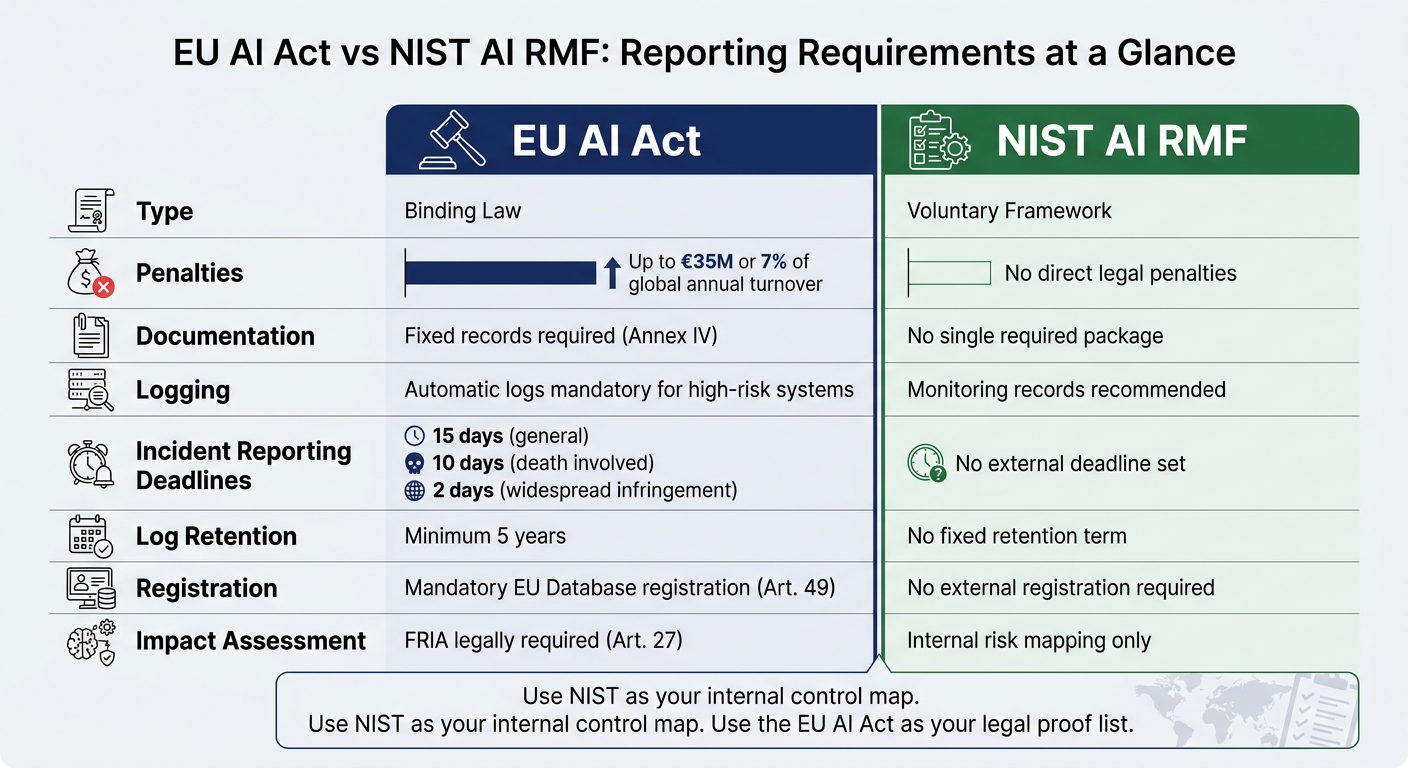
EU AI Act vs NIST AI RMF: Key Reporting Differences
NIST AI RMF vs ISO 42001 & EU AI Act: Profiles & Crosswalks | NIST AI RMF #12
Quick Comparison
| Area | EU AI Act | NIST AI RMF |
|---|---|---|
| Type | Binding law | Voluntary framework |
| Penalties | Up to €35 million or 7% of global annual turnover | No direct legal penalties |
| Documentation | Fixed records for high-risk AI, including Annex IV | No single required package |
| Logging | Automatic logs required for high-risk systems | Monitoring records recommended |
| Incident reporting | External reporting deadlines: 15 days, 10 days, 2 days | No set external deadline |
| Retention | 5 years for certain logs | No fixed retention term |
| Buyer test | Check legal proof | Check control maturity |
Bottom line: I’d use NIST as the internal control map and the EU AI Act as the legal proof list. If a vendor cannot hand over the records, the claim does not count.
EU AI Act Reporting: Required Records, Logs, and Evidence
For high-risk AI systems, the EU AI Act expects a paper trail across the full lifecycle. If you're buying one of these systems, ask for these records before deployment.
Technical documentation and testing evidence
Under Article 11 and Annex IV, providers need a technical file that explains the system's intended purpose, design specifications, training and testing data, validation results, accuracy metrics, risk management measures, and human oversight mechanisms [1][5]. That file isn't a one-and-done exercise. It needs to stay current as the system changes [1].
Data governance records belong in that same file. Under Article 10, providers need evidence that training, validation, and test datasets were examined for bias. A simple statement saying bias was considered is not enough [5][10].
Governance records and quality management
Article 17 requires a formal Quality Management System, or QMS. That means written policies, documented procedures, and a named owner for each system and each risk outcome [11][5]. The QMS also needs to cover post-market monitoring plans.
Keep these records organized so they can be produced fast if a regulator asks for them.
Automatic logging and incident records
Article 12 requires high-risk systems to log events automatically during operation [1]. Those logs need enough detail to let someone reconstruct what happened. In practice, that means recording:
- The time
- The model version in use
- The context of the interaction
- Any harmful output generated
- The severity level
- The corrective action taken
Article 73 sets the reporting deadline for incidents. Reportable incidents must go to market surveillance authorities within 15 days as the general rule, 10 days if a death is involved, and 2 days for widespread infringements [2][3][5]. That's why a generic incident response plan often falls short. Teams usually need an AI-specific runbook to meet these deadlines in practice [3][5].
If you operate third-party AI, don't rely only on the vendor's records. Buyers need their own log-retention process too. U.S. buyers integrating third-party AI must retain the logs generated by the system they operate, not just the provider [11][5].
| Article | What It Covers | Key Artifact |
|---|---|---|
| Article 9 | Risk management | Risk register, residual risk analysis |
| Article 10 | Data governance | Bias examination records, data provenance |
| Article 11 / Annex IV | Technical documentation | System design, design specs, training/testing data |
| Article 12 | Automatic logging | Event logs, log retention policies |
| Article 17 | Quality management | QMS manual, named owners, audit records |
| Article 73 | Incident reporting | Serious incident logs, notification receipts |
The next section shows which of these artifacts also appear in the NIST AI RMF, but as recommended evidence rather than legal duties.
sbb-itb-bec6a7e
NIST AI RMF Reporting: Recommended Artifacts and Monitoring Records
NIST AI RMF does not require one fixed reporting package. Instead, it groups evidence under 4 functions - Govern, Map, Measure, and Manage. That means buyers need to ask vendors for the records that show controls work in practice. Treat these artifacts as the vendor proof set during diligence.
Documentation across Govern, Map, Measure, and Manage
Each NIST function points to a different set of records. Govern is the base layer. It should include an AI governance policy that sets risk tolerance and approved use cases, a RACI matrix or named AI system owners, board-level risk reports, training completion records, and third-party risk procedures such as vendor due diligence questionnaires.
Map deals with context. Buyers should ask for a full AI system inventory, intended-purpose documentation, impact assessments for affected populations, and risk-identification records for issues such as bias, drift, and adversarial vulnerability [5].
Measure is where testing evidence should live. That includes documented fairness, accuracy, and reliability metrics with set thresholds, pre-deployment baseline evaluations, acceptance testing, and performance dashboards that show metric history and trend direction over time.
Manage is the follow-through. It should include a prioritized AI risk register, documented risk response strategies, monitoring logs with escalation thresholds, and AI-specific incident response procedures [5].
These are the records to request when a vendor says it aligns with NIST.
| NIST Function | Key Reporting Artifacts |
|---|---|
| Govern | AI Governance Policy, RACI Matrix, Vendor Due Diligence Records, Training Logs |
| Map | AI Asset Inventory, Use-Case Context Docs, Impact Assessments, Risk Taxonomy |
| Measure | Metrics Definitions, Bias/Robustness Test Reports, Performance Dashboards |
| Manage | Prioritized AI Risk Register, Incident Response Runbooks, Monitoring Logs, Human-in-the-loop Override Records |
Testing, performance monitoring, and incident response records
Measure is where a vendor has to prove the system performs as intended. Evaluation reports should cover bias and fairness testing, robustness against adversarial inputs, and runtime logs for prompt injection, PII leakage, and secret exposure [11]. Fairness and reliability metrics should be set before deployment. If a team picks metrics after the fact, the findings are hard to trust [5].
Manage requires continuous monitoring, not a once-in-a-while review. Production logs should track model drift, accuracy trends, and usage signals on a continuous basis [1][6]. AI incident response also needs its own runbook, with steps to classify events such as model drift, bias-driven discrimination, and hallucination in safety-critical settings [3][11].
When an AI incident happens, a forensic snapshot of the system state at that moment can make later root cause analysis and remediation much easier [11].
The next section compares these recommended artifacts with the EU AI Act's required records.
Direct Comparison: Where Reporting Requirements Align and Differ
Once you list the required artifacts, the next step is simple: figure out what's mandatory, what's optional, and what you can reuse across both frameworks.
The main split comes down to obligation. The EU AI Act requires specific records and reporting. NIST AI RMF suggests them.[1][2]
Required records vs recommended artifacts
The fastest way to compare the two is by artifact type, reporting path, and retention duty.
| Feature | EU AI Act (Mandatory) | NIST AI RMF (Voluntary) |
|---|---|---|
| Technical Documentation | Annex IV technical file: mandatory, standardized, and regulator-facing [2][4] | NIST artifacts are flexible in format and focused on outcomes [1][9] |
| Legal Artifacts | EU Declaration of Conformity and CE marking [2][4] | None; alignment is a maturity signal only [1][2] |
| Registration | Mandatory registration in the EU Database (Art. 49) [2][6] | No external registration requirement |
| Impact Assessments | Fundamental Rights Impact Assessment (FRIA) (Art. 27) [2] | NIST risk mapping: internal assessment only, no legal filing [4][7] |
| Retention | Minimum 5 years for automatic logs (Art. 12) [8] | Not specified; focuses on ongoing monitoring and system-of-record maintenance [5] |
Testing evidence, incident logging, and reporting paths
Both frameworks expect testing evidence. But when something goes wrong, the rules split fast.
Under the EU AI Act, serious incidents must be reported within 15 days, 10 days if a death is involved, and 2 days for widespread infringements [3][8]. NIST has no external reporting deadline. Incident response sits inside the Manage function as a recommended internal practice.
Testing follows the same pattern. The EU AI Act requires accuracy, robustness, and cybersecurity evaluations under Article 15. NIST points to similar metrics under Measure, but vendors set their own thresholds and formats. So a vendor's NIST-aligned test report may cover a lot of the same ground as an EU-required evaluation, but it does not meet the legal bar by itself.
What a U.S. buyer can reuse across both frameworks
A documented NIST program gives U.S. buyers a solid head start on EU readiness. That said, there's a hard limit to the overlap. The EU-only stack - conformity assessment, CE marking, FRIA, and EU database registration - has no NIST match and has to be built on its own.
A practical move is to use Annex IV as the master document structure, then map each artifact to the matching NIST function and EU article. That gives teams one shared evidence inventory and cuts duplicate audit work. That same mapping should feed the vendor review questions in the next section.
Buyer Checklist: How to Review Vendors and Close Reporting Gaps
Vendor review questions for records, logs, and governance
Use this checklist after the framework comparison to see whether a vendor can actually produce the records, not just talk about them. Terms like "NIST-aligned" and "EU AI Act compliant" should be treated as claims that need document-level proof. This is how you turn a framework review into a practical vendor test.
Ask these questions before signing. Each one points to a reporting gap that can stall diligence, delay deployment, or create problems during a regulator response.
| Question to Ask | Gap It Exposes | Framework Tie |
|---|---|---|
| "Can you provide Annex IV technical documentation, including the system's intended purpose and design specifications?" | Missing technical records | EU AI Act Annex IV / Art. 11 |
| "Can you show traceable data lineage and data quality records for the training and testing data?" | Weak data governance | NIST Map / EU AI Act Art. 10 |
| "Who is the named individual accountable for this system, model, and dataset?" | Vague ownership | NIST Govern / EU AI Act Art. 17 |
| "Show me your bias, accuracy, and robustness testing reports, plus any adversarial testing results." | Weak testing evidence | EU AI Act Art. 15 / NIST Measure |
| "What is your escalation path for a serious incident, and what is the reporting timeline?" | No incident escalation path | EU AI Act Art. 73 |
| "Does your logging architecture support a 5-year retention period for automatic logs?" | Retention gap | EU AI Act Art. 12 |
| "Can the human reviewer override or halt the system?" | Human oversight is ineffective | EU AI Act Art. 14 / NIST Manage |
Also ask for an AI Bill of Materials (AIBOM). Think of it as a versioned inventory of models, datasets, prompts, and third-party components. It helps you trace dependencies, ownership, and update history.
Risk assessments written after deployment are viewed as an afterthought rather than governance [1]. If the documentation predates go-live, that’s a meaningful signal.
Using AI for Businesses to shortlist vendors for deeper review
If you need a faster way to narrow the field, use a curated directory to find tools that already have audit-ready documentation. AI for Businesses is a curated directory of AI tools across marketing, sales, strategy, and management. It also has a section built for mid-market and PE-backed teams that are trying to move AI into production value.
Key takeaways for U.S. operators and investors
For U.S. teams, the plain approach is this: treat NIST as the operating layer and the EU AI Act as the legal layer. Build one evidence set, tag each artifact to both, and press vendors for logs, test reports, named owners, and incident history.
FAQs
Does NIST alignment help with EU AI Act compliance?
Yes - but NIST AI RMF alignment is not the same as EU AI Act compliance.
Here’s the plain version: NIST is voluntary guidance. The EU AI Act is binding law with penalties for noncompliance.
NIST can help with a big chunk of the work. It can support about 60% to 70% of the EU AI Act’s process requirements, especially around governance, risk identification, testing, and monitoring. That gives teams a solid starting point.
But it does not cover several EU-specific obligations. Those include:
- conformity assessments
- CE marking
- EU database registration
- incident-reporting deadlines
That gap matters. A company can be well aligned to NIST and still fall short of what the EU AI Act requires in practice.
Who must keep logs under the EU AI Act?
Under the EU AI Act, providers of high-risk AI systems are the main party responsible for keeping logs. Article 12 says these systems must support the automatic recording of events across the full lifecycle.
Those logs serve a few clear purposes. They help show how the system performs, support monitoring, flag incidents, and provide audit evidence of system behavior and human oversight.
What should buyers ask vendors to prove?
Buyers should ask vendors for proof, not just promises.
Request technical documentation that shows how the system works in practice. That includes model cards, training data summaries, and a clear list of known limits. If a vendor can't explain where the model struggles, that's a red flag.
You should also ask for evaluation reports. These should show performance results and bias testing, not vague claims. The goal is simple: see how the tool performs before it touches your team, your customers, or your data.
On the risk side, ask for:
- security attestations
- copyright and licensing policies
- incident reporting processes
- audit trails
- human-in-the-loop review details
- monitoring logs
Then get the contract right. Push for clear terms on data handling, change control notices, and audit rights. If the vendor updates the model, changes how data is used, or shifts system behavior, you need to know what changed and when.