AI-powered tools are transforming how small and medium-sized businesses (SMEs) monitor cloud data pipelines. These tools go beyond traditional methods by using machine learning to detect anomalies, automate responses, and optimize resources. Here's what you need to know:
- What They Do: AI tools track data flow metrics like latency, error rates, and costs, ensuring data quality and pipeline reliability.
- Why It Matters: Real-time monitoring reduces downtime and improves accuracy, with businesses reporting a 90% faster detection of failures.
- Key Features:
- Anomaly Detection: Automatically flags irregularities and reduces false alerts.
- Predictive Analytics: Anticipates issues and optimizes performance.
- Cost Management: Identifies inefficiencies and cuts cloud expenses by up to 63%.
Top tools include Datadog Watchdog, Dynatrace Davis AI, New Relic, and LogicMonitor. For SMEs, these solutions simplify monitoring, save resources, and enhance data reliability. Platforms like AI for Businesses help you find tools tailored to your needs.
Quick takeaway: AI monitoring tools help SMEs identify problems faster, improve data quality, and manage cloud costs more effectively.
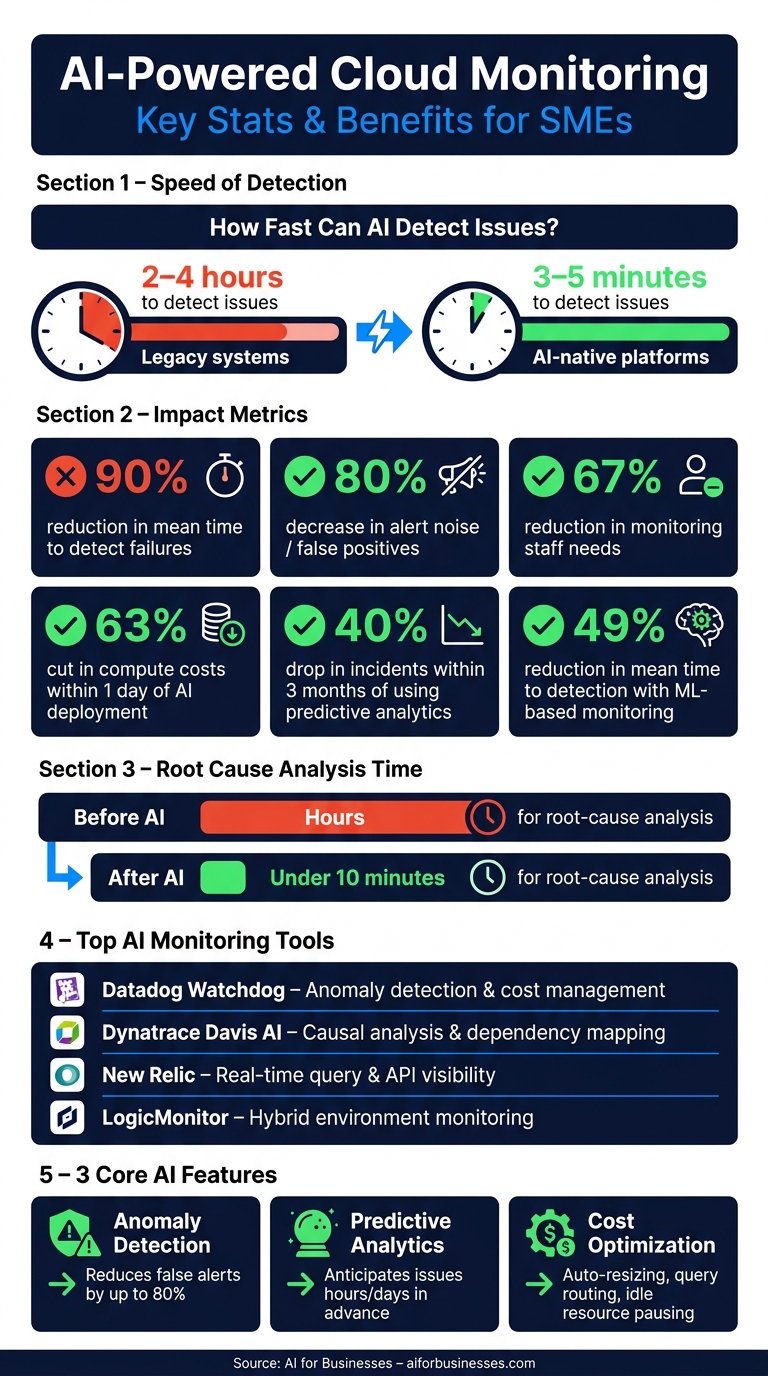
AI Cloud Monitoring Tools: Key Stats & Benefits for SMEs
Building AI Into Observability Workflows: Automating Dashboards, Alerts with MCP & Agents | Grafana
sbb-itb-bec6a7e
Core Features of AI-Powered Cloud Monitoring Tools
When selecting the right tool for your team, it’s essential to understand the core features most AI-driven cloud monitoring solutions offer. These tools are designed to address common challenges small and medium-sized enterprises (SMEs) face in managing cloud data integration. Here are three key capabilities that stand out.
Anomaly Detection and Root-Cause Analysis
AI-powered tools excel at identifying irregularities by learning what “normal” performance looks like through behavioral baselining. They automatically flag deviations, cutting through the noise of false positives - reducing unnecessary alerts by as much as 80% [3][4]. This is a game-changer for small teams that can’t spend their day chasing irrelevant notifications.
When problems do occur, these tools leverage causal inference and unsupervised knowledge graphs to trace fault propagation. This approach slashes the time needed for root-cause analysis from hours to under 10 minutes [3][5][6].
"RPI gave us a single source of truth for reliability. We went from reactive firefighting to proactive prevention." - James C., VP of Engineering, Enterprise Technology Provider [3]
In addition to flagging anomalies, these tools can forecast potential issues and fine-tune resource usage to prevent future disruptions.
Predictive Analytics for Performance Optimization
Predictive analytics helps you address problems before they affect users. By analyzing historical telemetry data, these tools can detect subtle shifts in application and infrastructure behavior - often hours or even days ahead of a potential issue [4].
For SMEs, this means they can anticipate risks to service level agreements (SLAs) and take action proactively. Companies using predictive anomaly detection have reported a 40% drop in incidents within just three months [4].
"For the first time, our SLA reporting reflects prevention, not just reaction. That's real operational maturity." - PN, Business and Service Management Team [4]
These tools also aid in capacity planning by forecasting stress on workloads across microservices and cloud tiers, allowing teams to allocate resources efficiently before demand spikes [4].
Cost Optimization and Resource Management
Cloud costs can spiral out of control without efficient management. AI monitoring tools continuously analyze compute and storage usage, identifying inefficiencies and acting to curb waste.
Some standout capabilities include:
- Real-time query routing: Directing workloads to the most cost-effective compute resources [10].
- Automated warehouse resizing: Dynamically optimizing compute resource allocation [7][8].
- Auto-suspend for idle resources: Minimizing costs by pausing unused capacity [8][9].
These optimizations can lead to dramatic savings. For instance, AI agents have been shown to cut compute costs by 63% within a day of deployment [10].
| Cost Driver | AI Optimization Action |
|---|---|
| Compute Consumption | Auto-resizing warehouses and real-time query routing [8][10] |
| Storage Growth | Smart retention policies and automatic archival to low-cost tiers [8] |
| Query Inefficiencies | Gen-AI SQL optimization and flagging redundant tasks [8][9] |
| Idle Resources | Auto-suspend and pausing test environments [8][9] |
Top AI Tools for Cloud Data Monitoring
With features like anomaly detection and predictive analytics, these tools offer precise performance monitoring for cloud data integration. Small and medium-sized enterprises (SMEs) can benefit from AI tools specifically designed for this purpose. Here are four standout tools, each addressing key challenges in prediction, analysis, and cost management.
Datadog Watchdog
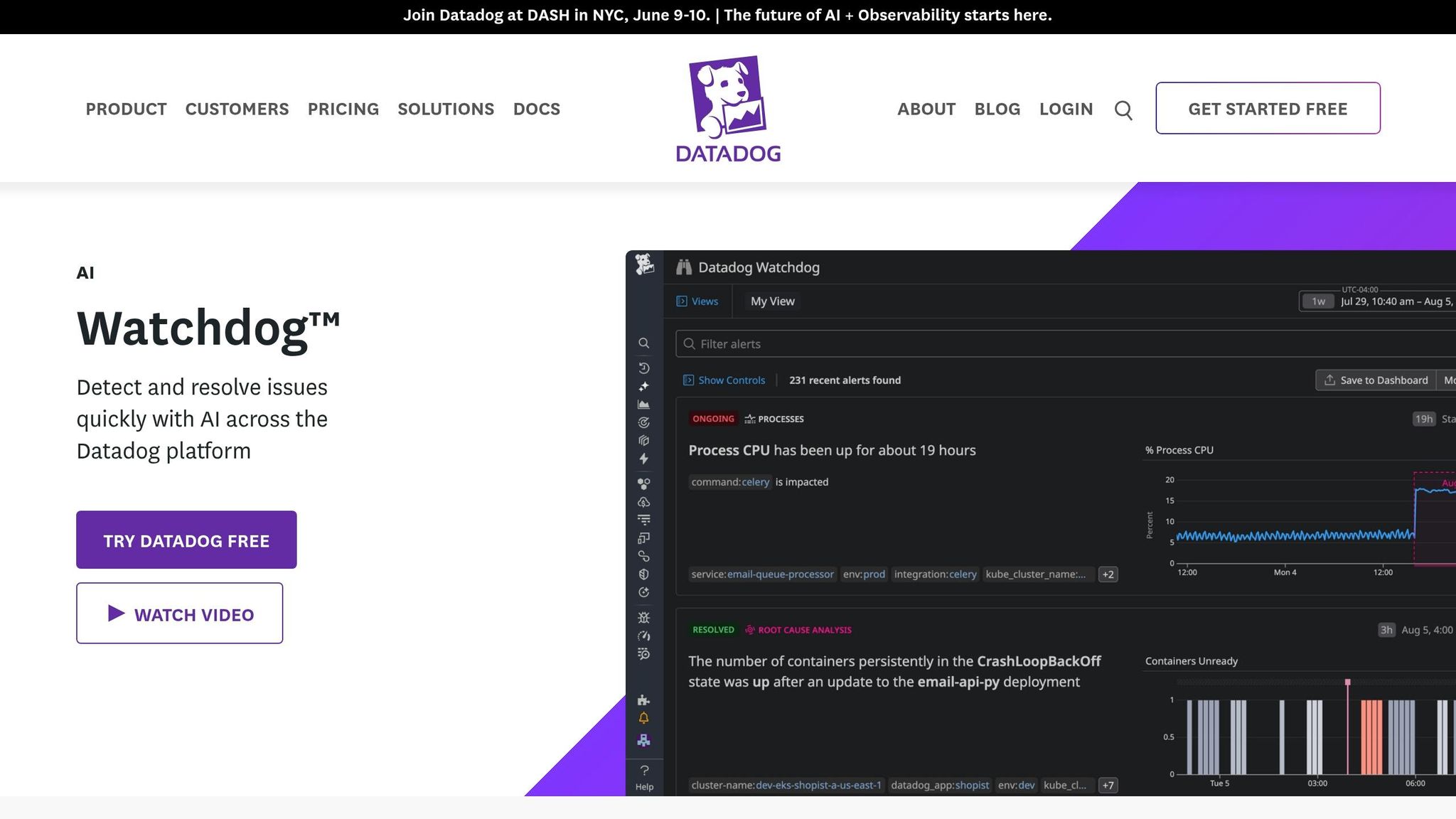
Datadog Watchdog is an automated engine that identifies performance issues without requiring manual setup. By learning from historical trends and seasonality, it detects anomalies in metrics like hits, error rates, and latency. It also provides end-to-end data lineage, quickly identifying pipeline failures from ingestion to BI tools. Its Data Observability feature tracks up to 5,000 tables, views, or columns, extracting metadata like row count and freshness from warehouse systems - avoiding the need for expensive queries [14].
"Watchdog is giving us faster incident response. It's showing us where the problems are in our system that we wouldn't have otherwise seen." - Joe Sadowski, Engineering Manager, Square [18]
The tool's effectiveness is evident in real-world use cases. For instance, in 2026, Salling Group used Datadog Cloud Cost Management to link performance with spending, saving over $250,000 annually across its multi-cloud infrastructure. Similarly, project44 cut its mean time to resolution by about 60% in its Google Cloud environment through Datadog's automated troubleshooting and telemetry correlation [17].
| Feature | Details |
|---|---|
| Anomaly Detection | Learns from historical data and user feedback to account for seasonality [12]. |
| Data Quality Monitoring | Tracks freshness, row counts, schema changes, and incomplete loads [13]. |
| Pipeline Integrations | Works with Airflow, dbt, Spark, and Kafka [15]. |
| Cost Management | Provides real-time cost anomaly detection with optimization suggestions [11]. |
| Vendor Integrations | Supports over 1,000 integrations, including AWS, Azure, and Google Cloud [16]. |
Note: Watchdog's models need three to seven days of historical data, including a weekend, to capture weekly seasonality [14].
Dynatrace Davis AI
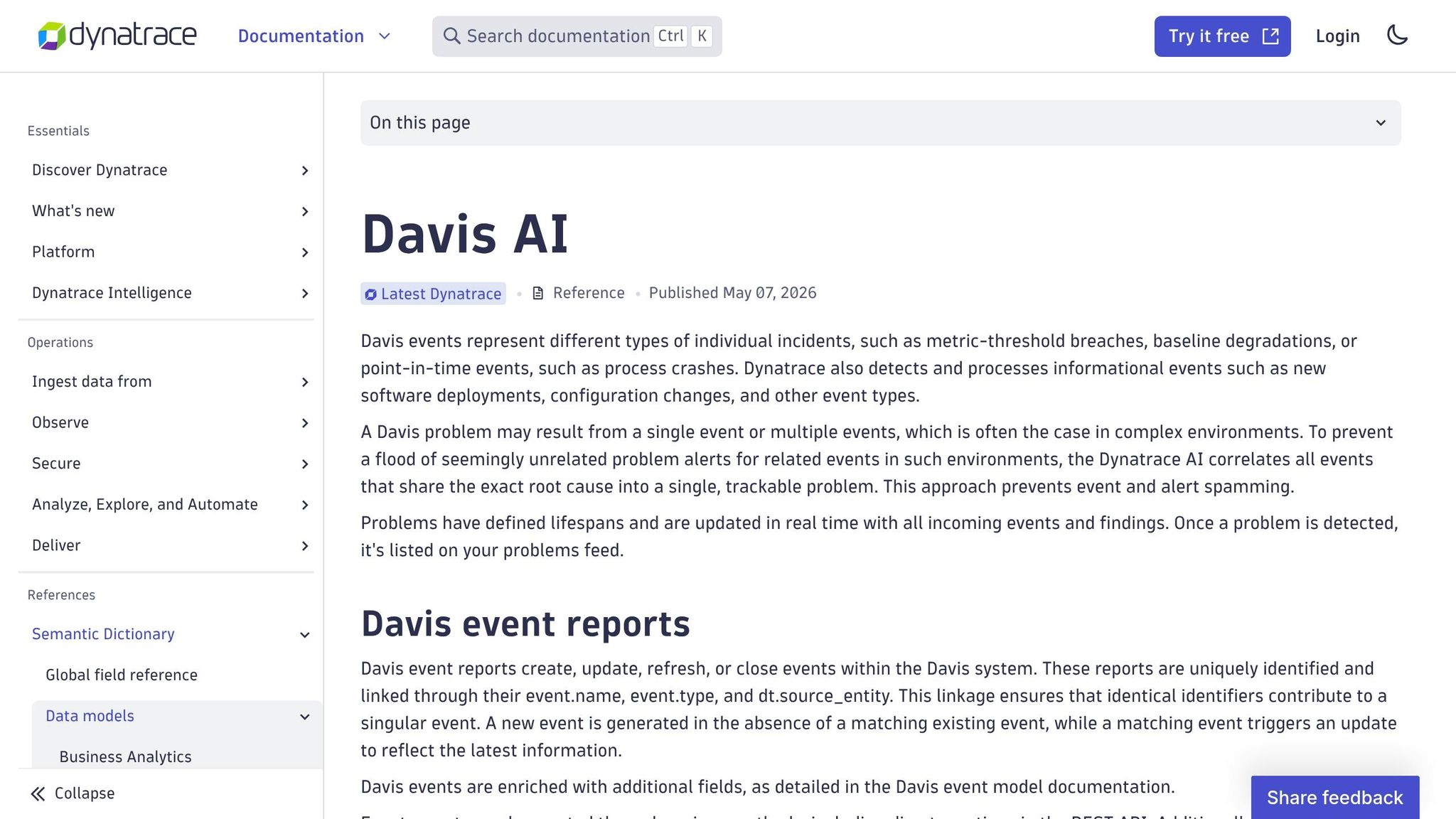
Dynatrace's Davis AI uses causal analysis to automatically map dependencies across environments, helping teams quickly identify the root causes of performance issues. By automating root-cause analysis and mapping dependencies, it simplifies incident resolution and reduces downtime.
New Relic AI Monitoring
New Relic excels in providing real-time visibility into data services like databases, queries, and API calls. Its AI-powered insights analyze query execution patterns to identify inefficiencies, allowing developers to optimize slow queries before they affect user experience. The tool also traces slow transactions back to individual queries, significantly reducing investigation time.
LogicMonitor for Hybrid Environments
LogicMonitor is ideal for organizations operating in hybrid environments, offering robust monitoring across on-premises servers, private data centers, and public cloud services. Its AI-driven monitoring unifies data from these sources, while its capacity forecasting feature predicts resource limits, enabling proactive scaling. This makes it a practical option for SMEs transitioning to the cloud in phases.
How AI for Businesses Helps You Find the Right Tools
Choosing the right cloud monitoring tool can feel overwhelming, especially for small and medium-sized enterprises (SMEs) with limited IT resources. That’s where AI for Businesses steps in. This curated directory is designed to help SMEs and scale-ups identify AI tools that align with their unique needs.
Curated AI Tools for SMEs
The platform organizes tools by business function, making it simple to find solutions for tasks like cloud data monitoring, automation, and infrastructure management. It caters to different technical skill levels, offering tools such as:
- DataSquirrel: Perfect for non-technical users needing straightforward data analysis.
- Lume AI: Ideal for automated data mapping and schema adjustments.
- Continual: Focused on predictive analytics for cloud data warehouses [19].
One standout feature is its emphasis on no-code and low-code tools, which are game-changers for SMEs. Options like Akkio for predictive modeling and AirOps for data automation empower businesses to implement advanced monitoring without the need for additional engineering staff [19]. By aligning tools with both technical and operational needs, the directory simplifies the process of finding practical solutions.
Simplifying the Decision-Making Process
AI for Businesses includes both free and premium tools, letting you explore options without immediately committing your budget. Many tools come with free tiers or trials, giving SMEs a chance to evaluate return on investment (ROI) with minimal risk. Each tool is accompanied by a concise description of its core features, making it easier to identify which one fits your specific operational requirements [19]. Following an AI integration checklist can further streamline this transition.
The directory is designed to grow with your business. For instance, it highlights Bizway for solopreneurs managing lightweight workflows, while recommending more robust platforms for enterprises with complex cloud infrastructures. Whether you’re working with a single pipeline or navigating multi-cloud setups, this resource helps you make informed decisions at every stage of growth.
Best Practices for Rolling Out AI Monitoring Solutions
Rolling out AI monitoring solutions requires a structured approach to safeguard your data pipelines effectively.
Focus on Business-Critical Metrics First
Start by prioritizing metrics across four key layers: operational (e.g., job failures, sync duration), data quality (e.g., freshness, schema drift), resources (e.g., compute usage, API limits), and business/SLA (e.g., latency, record consistency). Focus on metrics that directly impact revenue and customer experience.
Incomplete or delayed data flows can disrupt downstream reports, so it’s critical to identify and monitor pipelines that feed executive dashboards or customer-facing AI models. Data lineage tools can help pinpoint these crucial flows. As highlighted in the Airbyte Monitoring Framework Guide:
"A 'green' Airbyte job does not guarantee good data. Build unified dashboards showing job success, data quality status, and freshness." [22]
Establish clear Service Level Objectives (SLOs) to provide a concrete baseline for monitoring. For example, you could set an SLO like: "The Orders table must update within 15 minutes of source changes 99% of the time." Specific metrics like this help AI tools focus on meaningful signals rather than noise, laying the groundwork for a scalable rollout.
Start Small, Then Scale
Once your priorities are clear, begin by monitoring two to three critical data flows using native connectors such as Airflow, Kafka, or Snowflake. This "canary" approach allows the AI tool to establish statistical baselines for metrics like volume, freshness, and latency, helping to catch configuration issues early, before they escalate.
After baselines are in place, adopt a "Detect → Explain → Resolve" workflow. This approach consolidates related anomalies into prioritized issues with root-cause hypotheses, reducing alert fatigue. The benefits are significant: machine learning-based detection can cut mean time to detection by 49% and reduce false positives by up to 42% [20].
Stay Compliant and Maintain Data Governance
Compliance should be a priority from the outset. For U.S.-based small and medium enterprises, choose tools that process metadata (like job status and schema updates) rather than actual data, ensuring sensitive information stays secure [2]. If you’re using cloud providers like AWS, Azure, or GCP, deploying AI monitoring agents within your Virtual Private Cloud (VPC) adds an extra layer of security.
Two governance practices to implement immediately include:
- Least-privilege access: Ensure AI agents only access the datasets they need.
- Consistent tagging systems: Tag by environment, team, and cost center to simplify cost attribution and create clear audit trails.
Gartner research underscores the importance of internal governance, noting:
"Through 2026, at least 80% of unauthorized AI transactions will be caused by internal violations of enterprise policies concerning information oversharing, unacceptable use or misguided AI behavior rather than malicious attacks." - Gartner [23]
Modern AI monitoring platforms can help mitigate these risks with features like automated policy checks, continuous compliance scoring, and audit-ready reporting - all essential tools to consider when evaluating your options [21].
Conclusion: Getting More from Cloud Data Monitoring with AI
The case for AI-powered cloud data monitoring is clear: traditional tools often fall short when speed matters most. While legacy systems might take 2–4 hours to detect issues, AI-native platforms can identify them in just 3–5 minutes [3]. That time difference can mean the loss - or preservation - of revenue, customer trust, and valuable engineering hours. This is why more organizations are turning to AI-driven observability.
Some companies have seen dramatic results: a 90% reduction in mean time to detect failures [1], a 67% reduction in monitoring staff needs [24], and an 80% decrease in alert noise [3]. For small and medium-sized enterprises (SMEs) with limited engineering resources, these kinds of improvements can shift the focus from constant problem-solving to proactive system management.
"We've virtually eliminated silent data pipeline failures and the 3 AM pages that came with them. Our mean time to detection is down by 90%." - VP, DataOps, Global Financial Services [1]
These results underscore the importance of choosing the right monitoring tool. Platforms like Datadog Watchdog and Dynatrace Davis AI each tackle specific challenges in cloud monitoring. The best choice will depend on factors like your existing tech stack, team size, and the metrics you prioritize. Not sure where to start? AI for Businesses provides a curated list of AI tools tailored for SMEs and growing companies, making it easier to find a solution that fits your needs and budget.
Keep your focus on critical metrics, establish strong baselines, and let AI cut through the noise.
FAQs
What should I monitor first in my cloud data pipelines?
To keep your data pipelines in good shape, begin by monitoring essential health metrics: freshness, volume, and schema integrity. These metrics help ensure that your data aligns with service-level agreements (SLAs), follows established historical trends, and catches upstream schema changes before they cause silent breakdowns.
It's also important to keep an eye on data completeness and any unusual shifts, such as unexpected null values or anomalies. For pipelines powered by AI, prioritize correctness signals - like evaluation scores and data-layer assertions - over more basic metrics such as latency or throughput. This ensures the focus remains on the quality and accuracy of your data.
How do AI tools learn what “normal” looks like in my data?
AI tools take your historical time-series data and use it to build a baseline model of what "normal" behavior looks like. They rely on algorithms such as Random Cut Forests, k-means clustering, or statistical forecasting to identify patterns, trends, and recurring cycles - like hourly or weekly fluctuations. As new data comes in, it's measured against these models. If a value falls outside the expected range, it's flagged as an anomaly. What's even better? Many of these tools adjust over time, retraining themselves as your data changes to stay accurate.
Will AI monitoring tools access my actual data or just metadata?
These tools focus on analyzing metadata and telemetry rather than the actual content of your data. They keep an eye on things like data flows, volume, schema, and performance metrics to spot any irregularities and ensure pipelines stay intact. Most are built to operate securely within your own environment, protecting your sensitive data while still supporting efficient infrastructure management.