AI is transforming how businesses and government agencies manage budgets by identifying hidden errors, fraud, and cost inefficiencies. This article explores three real-world examples of AI-driven anomaly detection in corporate, SaaS, and government budgeting. Key takeaways include:
- Corporate Budgets: AI reduced month-end close times by up to 50%, flagged errors like duplicate vendor payments, and improved policy compliance.
- SaaS Cloud Costs: AI cut cloud spending by millions annually, improved forecast accuracy to 94%, and reduced anomaly detection time from 48 hours to 15 minutes.
- Government Budgets: AI saved billions by detecting fraud, duplicate payments, and irregular transactions in agencies like CMS and the U.S. Treasury.
AI’s ability to analyze large datasets in real time helps organizations save time, reduce costs, and improve financial accuracy. Whether it’s spotting vendor cost creep or preventing fraud, AI is a game-changer for modern budgeting.
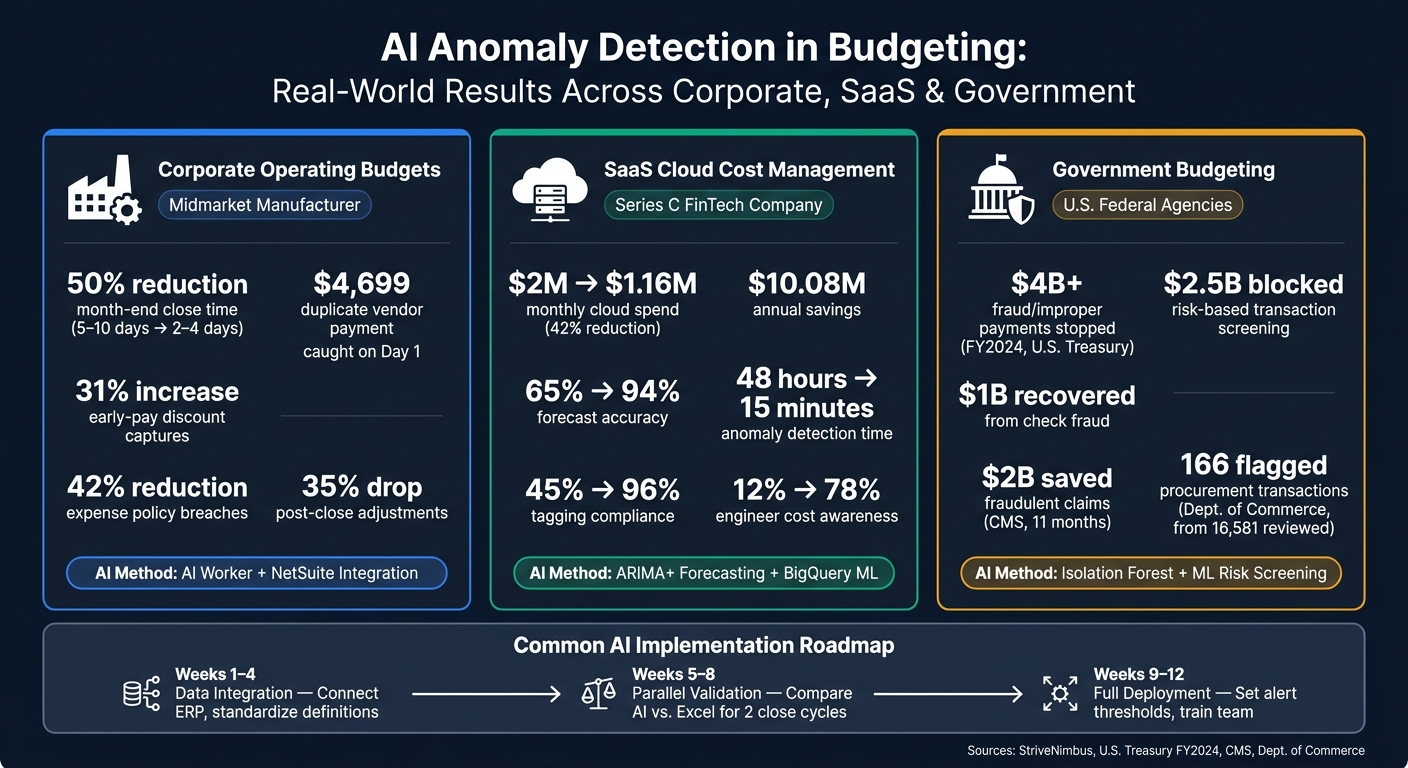
AI Anomaly Detection in Budgeting: Key Results Across 3 Sectors
How AI Detects Budget Anomalies
Data Sources Used in Anomaly Detection
The effectiveness of AI in spotting budget anomalies hinges on the quality of the data it analyzes. Most systems rely on core financial inputs like General Ledger actuals, accounts payable records, invoices, and budget data from tools such as Anaplan or Workday. They also incorporate operational metrics, including headcount figures, CRM pipeline data from platforms like Salesforce, and capacity metrics.
To establish a reliable baseline, at least 12 months of historical data is required. Without this, it becomes difficult to differentiate between true anomalies and normal seasonal fluctuations.
Before analysis begins, the data undergoes preparation. Categorical fields like vendor names, GL codes, and currencies are transformed using one-hot encoding, making them easier for neural networks to process. Schema validation is also performed to catch discrepancies, such as budget data rows missing corresponding actuals, ensuring critical records aren't lost. Interestingly, about 76% of global transaction revenue flows through SAP ERP systems, making ERP data a cornerstone for many AI-driven accounting solutions.
This thorough preparation ensures AI can identify even the most subtle irregularities.
AI Methods Applied to Budgeting
AI approaches anomaly detection differently than traditional fixed-threshold methods. It examines historical patterns, disrupted correlations, and contextual factors to identify irregularities.
One commonly used algorithm is the Isolation Forest, an unsupervised machine learning model that excels at identifying statistically unusual data points in large datasets. Additionally, modern platforms employ Large Language Models (LLMs) to analyze transaction descriptions and memos. This allows them to catch classification errors, such as a laptop purchase mistakenly categorized as "software subscriptions". Some advanced systems use an "Agent Critic" workflow: the primary AI flags potential anomalies, which are then reviewed by an independent LLM to reduce false positives.
"AI is not magic, but it is very good at one thing finance teams rarely have time to do: compare every entry to historical and peer patterns and quantify 'how unusual' it is." - Ameya Deshmukh, EverWorker
Anomalies are scored on a scale from 0 to 1, factoring in elements like the magnitude of variance, historical deviations, broken correlations (e.g., a sudden spike in travel costs while entertainment expenses stay flat), and unexpected timing.
These scores lay the groundwork for actionable insights during deployment.
Deployment and Ongoing Monitoring
With refined data and advanced methods in place, AI systems are deployed to deliver real-time budget oversight. They integrate seamlessly with ERPs like NetSuite, SAP, or Oracle, as well as planning tools and data warehouses such as Snowflake or Databricks. This eliminates the need for manual data exports. A typical rollout spans 12 weeks, starting with data integration, followed by parallel testing with Excel, and culminating in full deployment with user training. Running AI alongside existing systems for two to three close cycles helps identify and resolve any configuration issues.
Once operational, AI continuously monitors budgets, flagging issues mid-month rather than waiting for the month-end close. Chris Walker, Head of Product Marketing at Tellius, highlights this shift:
"AI-powered variance analysis doesn't just make this process faster. It reflects broader technology trends... from waiting for someone to notice a problem to surfacing issues mid-month."
Over time, as users review flagged items and mark them as "expected" or "not an anomaly", the AI refines its baseline. This iterative process reduces false positives with each cycle. By combining AI's analytical power with human judgment, the system ensures potential issues are surfaced while leaving critical decisions in human hands.
Case Study 1: AI in Corporate Operating Budgets
Business Background and Challenges
Picture a midmarket manufacturer handling 12,000 invoices every month. Despite the high volume, their manual processes for extracting and reconciling data caused major delays. The finance team spent the first 5–7 days of every close cycle pulling data from their ERP system into Excel, aligning line items, and resolving discrepancies. By the time the analysis was ready, it was already outdated.
The biggest hurdle? Inconsistency and lack of oversight. With 50 to 200+ line items to review, manual checks were often rushed. Analysts typically tested one hypothesis at a time - whether it was a pricing issue or a volume shift - and stopped once they found a plausible explanation. This approach often overlooked other important factors hidden in the data. To make matters worse, different team members created models with varying assumptions, leading to the classic "five analysts, five different numbers" problem. Clearly, they needed a better system, and AI provided the answer.
How AI Was Deployed and What It Achieved
The company introduced an AI Worker directly integrated with NetSuite, which eliminated the need for manual CSV exports and ensured real-time access to live data. The deployment was phased over 12 weeks: weeks 1–4 focused on data integration, weeks 5–8 involved Excel-based parallel validation, and weeks 9–12 covered full deployment along with user training.
The results were impressive right from the start. On its first day, the AI identified a $4,699 duplicate vendor payment caused by a coding error - something the manual process had completely missed. Over the next few months, the company achieved a 31% increase in early-pay discount captures and reduced expense policy breaches by 42%. The month-end close process, which previously took 5–10 days, was cut down to just 2–4 days. Additionally, post-close adjustments dropped by 35% thanks to continuous AI reconciliations.
"Gone are the days of scrambling to chase receipts, manually coding really large data sets. All of that has been automatically addressed throughout the month in real time." - Lauren Feeney, Controller, Perplexity
Key Lessons for U.S. SMEs
This case study highlights some important takeaways for small and mid-sized enterprises. The most critical? Starting in the right place. Phased rollouts, beginning with high-impact, high-volume areas like invoice processing or close and consolidation, can deliver quick wins. These early successes help build confidence and pave the way for expanding into other areas, such as planning or forecasting.
Another key lesson is the importance of data quality. The AI wasn’t necessarily smarter; it excelled because it had access to clean, consistently labeled data. For smaller teams with limited resources, establishing strong tagging practices and standardizing definitions upfront is essential. This preparation can mean the difference between a smooth implementation and a frustrating one.
Case Study 2: AI for Cloud Cost Anomaly Detection
Cloud Cost Challenges for SaaS Businesses
For many SaaS companies, managing cloud costs can feel like navigating a minefield. Sudden cost spikes - often caused by misconfigured scaling rules - can appear overnight, leaving teams scrambling to address them. The delay in receiving cloud billing data (usually 24–48 hours) only adds to the challenge, forcing businesses to react to problems after the damage is done. Static alerts, while intended to help, often overwhelm teams with noise, making it easy to miss actual anomalies. On top of that, relying on a patchwork of tools has fragmented visibility, making it hard to pinpoint where costs originate. These hurdles created a clear need for a smarter, more proactive solution.
The AI Solution and How It Was Integrated
To tackle these problems, Palo Alto Networks - a cybersecurity leader supporting over 70,000 organizations worldwide - rolled out an AI-based anomaly detection system in December 2024. Built on Google Cloud's BigQuery ML and powered by the ARIMA+ forecasting model, this solution was trained on 13 months of billing data. It accounted for key variables like seasonal trends, migration activity, and usage fluctuations, ensuring accurate anomaly detection.
Here’s how it worked: billing data was streamed continuously into BigQuery, while Looker provided real-time visualizations comparing "expected" and "actual" spending. Whenever spending exceeded predefined thresholds (either in dollar amounts or percentages), automated alerts were sent directly to product owners via Slack, complete with SKU-level details.
One example shows the system in action. A new region’s setup triggered a misconfiguration, defaulting BigQuery to on-demand pricing - leading to a sharp cost increase. Thanks to the AI tool, the anomaly was flagged immediately. The team quickly responded, purchasing 100 baseline slots with a 3-year commitment and enabling autoscaling to prevent future issues.
"By removing the worry of unexpected costs, Palo Alto Networks can now confidently embrace new cloud and AI workloads, accelerating its digital transformation journey." - Kuntal Patel, Manager, Cloud FinOps, Palo Alto Networks
Results and Practical Insights
The results speak for themselves. By October 2025, a Series C FinTech company using StriveNimbus slashed its monthly cloud spend from $2,000,000 to $1,160,000, achieving an annual savings of $10.08 million. They also boosted budget forecast accuracy from 65% to 94% and reduced anomaly detection time from 48 hours to just 15 minutes.
| Metric | Before AI | After AI |
|---|---|---|
| Monthly Cloud Spend | $2,000,000 | $1,160,000 |
| Forecast Accuracy | 65% | 94% |
| Anomaly Detection Time | 48 hours | 15 minutes |
| Tagging Compliance | 45% | 96% |
| Investigation Effort | High (manual) | 70% reduction |
Beyond the numbers, the cultural shift within the FinTech company was striking. Cost awareness among engineers jumped from 12% to 78% after introducing AI-powered visibility tools. Engineers could now pinpoint the exact code commits that caused cost spikes and resolve them promptly. Larry Advey, Director of Cloud Platform & FinOps at CloudZero, shared an example where his team traced an S3 cost anomaly - rising from $1/day to $100/day (about $30,000 annually) - back to a single February 2026 code change:
"Context converts recommendations into actions. When you send an engineer a recommendation that says 'This commit you pushed on February 16th changed how this job aggregates data, and it's been costing $100/day ever since,' the answer is 'Oh, yeah, I can fix that.'" - Larry Advey, Director, Cloud Platform & FinOps, CloudZero
One crucial lesson from these experiences: start with a strong tagging strategy. Properly labeling resources, environments, and departments ensures accurate tracking and attribution of cost anomalies. This simple practice lays the groundwork for effective cost management.
sbb-itb-bec6a7e
Case Study 3: AI in Government Budgeting
Challenges in Government Budgeting
Government budgeting is a complex arena, filled with multi-year appropriations, strict compliance rules, and the ever-present challenge of identifying irregularities. Traditional sampling methods often fall short, leaving room for anomalies like "use it or lose it" spending or round-number clustering. For instance, invoices just below approval thresholds - like $4,999 - can easily slip through manual audits. These patterns only become clear when entire datasets are analyzed at scale, making AI an essential tool in this space.
"The current techniques are generally sampling techniques. The metadata applies to all information in a data set... if you applied AI, what types of fraud could you find, and found that there was a lot to be gained." - Dan Chenok, Executive Director, IBM Center for the Business of Government
Applying AI to Public Sector Budgets
U.S. agencies are now turning to AI to shift from reactive audits to proactive financial oversight.
The Centers for Medicare and Medicaid Services (CMS), for example, implemented a "Netflix-type algorithm" to risk-score claim applicants. This system flags high-risk applicants before payments are made and uses internal AI tools to identify potential contract duplications. Between March 2025 and February 2026, these measures saved the agency $2 billion in fraudulent claims and hundreds of millions more by spotting duplicate contracts.
The U.S. Department of the Treasury took a similar approach during Fiscal Year 2024 (October 2023–September 2024). By expanding machine learning-based risk screening across payment workflows, the department achieved remarkable results:
- $500 million prevented through risk-based screening.
- $2.5 billion blocked by prioritizing high-risk transactions.
- $1 billion recovered from Treasury check fraud.
Altogether, these efforts stopped over $4 billion in fraud and improper payments during FY2024, a significant increase from $652.7 million in FY2023.
On the procurement side, the U.S. Department of Commerce applied an Isolation Forest algorithm to analyze 16,581 procurement transactions from FY2025. This approach flagged 166 atypical transactions - about 1% of the total - for further review. Many of these flagged transactions involved extreme award ceilings, with a median value around $8 billion.
These examples highlight how AI is driving measurable improvements in government financial management.
Outcomes and Implementation Lessons
AI's ability to detect anomalies quickly and effectively is reshaping how government agencies manage budgets. Here's a summary of key results:
| AI Application | Measurable Outcome | Agency |
|---|---|---|
| Machine learning for check fraud | $1 billion recovered (FY2024) | U.S. Treasury |
| Risk-based transaction screening | $2.5 billion prevented (FY2024) | U.S. Treasury |
| "Netflix-style" risk labeling | $2 billion saved (11 months) | CMS |
| Contract duplication detection | Saved several hundred million dollars | CMS |
| Isolation Forest on procurement data | 166 flagged transactions | Dept. of Commerce |
However, these tools work best when paired with human expertise. For example, CMS established a "Fraud Detection Operations Center", where specialists review AI-flagged cases before taking action. As Kim Brandt, Deputy Administrator and COO of CMS, explains:
"We're in the trust but verify stage. We're using AI and really trying to optimize it however possible, but fact is, you still want to make sure that you've got a human." - Kim Brandt, Deputy Administrator and COO, CMS
For agencies with limited resources, focusing on anomalies with the highest dollar exposure is critical. By targeting high-value outliers and integrating pre-payment screening workflows, organizations can maximize the impact of AI while reducing reliance on post-payment recovery methods. This approach transforms AI into a powerful tool for safeguarding public funds.
Key Takeaways and a Roadmap for Implementation
Comparing the Three Case Studies
The case studies highlight how AI can address diverse challenges in budgeting, regardless of the organization’s size or sector.
| Case Study | Core Challenge | AI Method Used | Key Result |
|---|---|---|---|
| Corporate Operating Budgets | Slow, reactive variance analysis | Automated analysis to decompose variances | 10x faster investigation; 40% FP&A capacity freed |
| SaaS Cloud Cost Management | Undetected "cost creep" in spending | Contextual anomaly detection with ERP integration | $27K SaaS overage flagged; runway recalculated from 8.1 to 6.3 months |
| Government Budgeting | Sampling gaps, fraud, duplicate payments | Isolation Forest | Enhanced oversight with better detection of high-risk transactions |
From small agencies to large federal departments, AI consistently shifts budgeting from a static, reactive process to a more dynamic and proactive one.
Steps to Adopt AI in Budgeting
If you’re ready to integrate AI into your budgeting process, consider following this 8–12 week plan:
- Weeks 1–4: Start by connecting your data. Integrate your ERP system (e.g., QuickBooks, NetSuite, SAP) with the AI tool and standardize critical definitions like "Net Revenue" or "EBITDA." Misaligned definitions are a frequent cause of discrepancies between AI outputs and traditional manual reports.
- Weeks 5–8: Conduct parallel validation. For two close cycles, compare the AI outputs with your existing Excel models. Document any differences to identify data quality issues and build trust in the AI system.
- Weeks 9–12: Roll out monitoring tools and train your team. Establish tiered thresholds (e.g., >5% or >$50,000) to minimize unnecessary alerts and focus on actionable insights.
For small and medium-sized enterprises, tools listed on AI for Businesses can help you find solutions tailored to your specific needs.
Governance and Risk Management
Even with a successful AI rollout, ongoing governance is essential to manage risks like unresolved false positives. Without a clear structure in place, anomalies flagged by AI may go unaddressed, leading to what’s often referred to as "pilot purgatory".
To avoid this, establish a clear RACI (Responsible, Accountable, Consulted, and Informed) framework:
- Cost center managers explain root causes of anomalies.
- FP&A analysts categorize variances.
- CFOs approve necessary adjustments.
Effective governance also requires two key practices:
- Ensure every AI-generated alert provides a plain-language explanation linked to specific source data, such as a general ledger entry, contract, or HRIS record. This transparency is crucial for audit readiness.
- Feed every resolved alert - whether confirmed or dismissed - back into the AI model to improve its accuracy over time.
"Governance is not bureaucracy - it's credibility." - Ameya Deshmukh, EverWorker
Members 1st FCU boosted budget efficiency by 27% using CCH® Tagetik Predictive Analytics and AI

FAQs
What data do I need to start AI anomaly detection for budgeting?
To kick off AI-driven anomaly detection in budgeting, you'll first need financial data - specifically, budget vs. actual figures. Ideally, this data should cover 12 to 24 months to provide a solid baseline for analysis.
Next, connect AI tools to your existing systems, such as ERPs (like NetSuite or SAP), data warehouses, or even spreadsheets. Make sure to include transaction-level details - things like descriptions, vendor names, account classifications, and timestamps. These details allow the AI to spot subtle irregularities that traditional rule-based systems might overlook.
How do I reduce false positives from AI budget alerts?
To avoid false positives, focus on using context-aware baselines that account for seasonality, historical patterns, and business cycles. Incorporate whitelists for predictable recurring costs, such as rent, and set up suppression windows to prevent duplicate alerts. For expenses, apply relative thresholds to track variable costs and absolute thresholds for more stable ones. Lastly, allow for human feedback - having users flag alerts as valid or benign helps the system learn and refine its accuracy over time.
How fast can an AI anomaly detection system be implemented?
The time required for implementation varies based on how complex the project is. Generally, a full rollout - from conducting a data audit to going live - takes around four weeks. That said, some tools can be deployed much faster, seamlessly integrating into existing finance workflows and dashboards almost immediately. AI for Businesses provides a carefully selected directory of AI tools designed to help SMEs and growing companies simplify these steps.