AI can do the first-pass work in export license reviews. People still have to make the final call.
If I were explaining this in plain terms, I’d put it like this: AI is good at screening products, parties, destinations, and documents. It can also sort transactions by risk and flag missing data. But it should not approve final classifications, license exception use, or license filings on its own.
Here’s the short version:
-
AI helps with front-end screening
- pulls specs from files
- checks names against restricted party lists
- flags route, end-use, and end-user risks
- reads invoices, POs, and shipping records
- sends unclear cases to a person
- People still own the high-risk decisions
-
The main failure points are simple
- bad product data
- stale rules and list updates
- weak ownership screening
- tools that screen only part of the rule set
-
The control points are clear
- human sign-off for flagged or low-confidence cases
- rule and list updates on a set schedule
- records kept for 5 years
- audit trails that show the rule basis, model version, and reviewer
A few numbers make the stakes clear. The article notes that 52% of FY2024 export control violations came from classification errors and that civil penalties can reach $1,271,078 per ITAR violation as of 2025. It also notes that a hard review can take 2 to 8 hours by hand.
So my takeaway is simple: use AI to screen and sort the work, not to own the decision. That split is where most teams get the best result with less review time and better records.
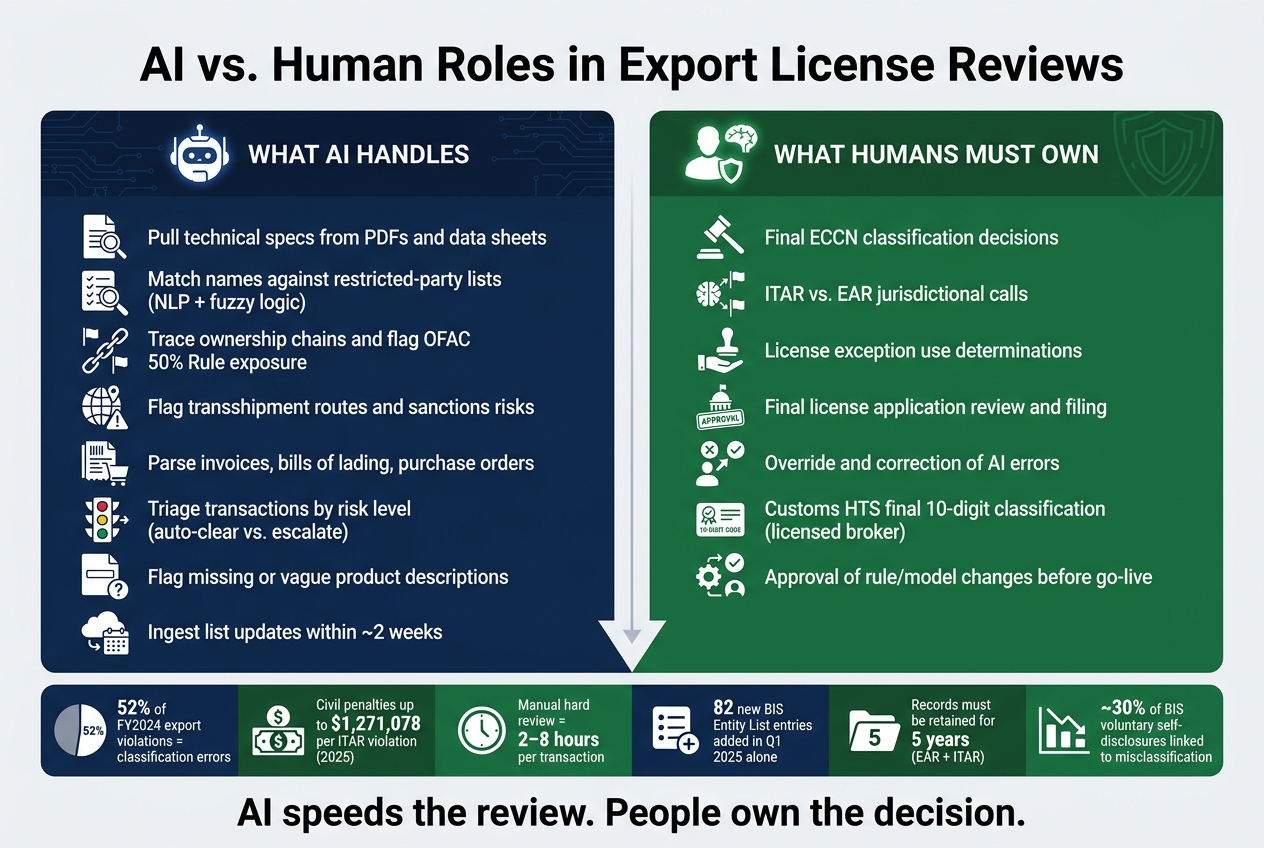
AI vs. Human Roles in Export License Reviews
What AI Can Review in Export License Workflows
Product, Party, and Destination Checks
AI is best at the heavy, rules-based work that eats up review time.
It can pull technical specs from PDFs and data sheets, compare them with the Commerce Control List (CCL) and U.S. Munitions List (USML), and surface possible ECCN matches.
For party screening, AI uses NLP and fuzzy logic to match names against restricted-party lists. That helps catch transliterations, misspellings, and deliberate obfuscation. It can also trace ownership chains and flag entities that are not named on a list but are still blocked under OFAC's 50 Percent Rule [2].
On the destination side, AI can flag transshipment routes and sanctions exposure. It also spots end-use, end-user, or commodity mismatches, along with vague end-use descriptions.
Document Parsing and Transaction Triage
After the first-pass screen, AI can read the documents that support the transaction and route unclear cases.
It can parse commercial invoices, bills of materials, purchase orders, and shipping instructions, then flag missing or vague details. So if a description says "electronic parts", the system can route it for more technical detail before the review moves ahead.
Once that parsing is done, AI can triage transactions by risk level. Low-risk shipments can move faster. Higher-risk cases - like those with unusual routes, incomplete records, or flagged parties - can be escalated to specialist review with a short rationale.
What AI Should Not Be Expected to Decide Alone
AI screening is not the same as a final licensing decision.
It can flag issues, but compliance still makes the final call on ECCN classification, license exception use, and jurisdictional questions.
This part matters: watch for tools that rely on catalog values instead of measured engineering data. If a product's actual performance is above a regulatory threshold, it is controlled even if the catalog value says otherwise [4]. Your team still has to confirm that the AI pulled the right data before signing off on any determination.
Those escalations move to compliance for final review.
sbb-itb-bec6a7e
Where Human Sign-Off Still Applies
Decisions That Require Expert Review
AI can screen a transaction and send it to the right queue. It should not make the final call on its own.
A human still has to approve the end decision. For export controls, that means a trained export control officer must approve the final classification and any license application. For customs classification, a licensed customs broker must assign the final HTS code or oversee that work. CBP's January 2026 H350722 ruling made this point plain: AI can suggest HTS subheadings, but a licensed customs broker must perform or oversee the final 10-digit classification [6].
The line is pretty clear:
- Export controls need compliance sign-off
- Customs classifications need licensed broker oversight
Some cases should always go to a person. That includes military or dual-use end uses, unclear license exception eligibility, and cases where the stated end use does not match the customer's business profile. In those situations, documented human judgment matters more than automated speed. Hard calls need a written basis, not a machine-only approval.
How to Set Up Approval Workflows
A tiered workflow usually works best. Let AI clear low-risk repeat cases. Send anything flagged, unusual, or low-confidence to a human reviewer.
Common triggers for review include low confidence, restricted-party hits, vague end use, unusual payment terms, and transshipment risk. Sensitive exports and any AI override should also go through a separate reviewer. That extra check may feel like a small slowdown, but it helps keep bad calls from slipping through.
| Approval Level | Who Reviews | When It Applies |
|---|---|---|
| Auto-clear | AI system | Low-risk, repeat cases with no flags |
| Compliance staff | Export control officer | Routine escalations, technical spec verification |
| Compliance manager | Compliance manager | Sensitive destinations, dual-use items, red flags |
| Export counsel | Export counsel | Ambiguous regulations, license application filing |
Every decision should be documented, including "not controlled" calls, with the exact regulatory basis [4][6]. That record is what lets the workflow hold up under review, especially when the rules change.
BITE Export Controls Workflow | AI-Powered Export Classification & Screening
Keeping AI Rules Current and Maintaining Records
Once AI starts screening transactions, the biggest risk is simple: old rules and poor records.
Updating Rules, Lists, and Model Settings
Rules change fast, and screening systems have to keep up. In Q1 2025, BIS added 82 new entries to the Entity List in a single update [2]. AI systems can take in list updates within about 2 weeks [1][4].
That matters because one-time onboarding checks aren't enough. Teams should rescreen partner databases whenever restricted party lists change, including the OFAC SDN and BIS Entity List, instead of treating screening as a one-and-done step [2].
There also needs to be a clear owner. A named compliance lead should approve any material rule or model change before it goes live, and that review supports export compliance governance [3]. Teams should also re-evaluate items every year and after any regulatory change so classifications don't go stale [4].
The same controls that keep rules current also make each decision much easier to defend later.
Records That Support Defensible Export Decisions
A defensible decision needs a complete audit trail. A decision without a complete audit trail is hard to defend.
Track these record categories:
| Record Category | What to Capture |
|---|---|
| Classification | Product name/model, measured technical specs, control list entries checked, rationale citing the specific regulation, date, and classifier name |
| Screening | Entity names, ownership-level screening (50% rule), geographic data, past transaction patterns |
| AI Metadata | Model version, rule set used, reasoning chain, confidence scores, timestamps, and date of determination |
| Compliance | License exceptions used, KYC certifications, approver names, any manual overrides, regulator correspondence |
Under U.S. export rules - EAR (15 CFR Part 762) and ITAR (22 CFR 122.5) - records must be kept for at least 5 years [3][2]. The best setup is to make the audit trail part of the workflow itself, so teams can pull records later without having to piece everything together after the fact [3].
How Teams Can Evaluate AI Tools Before Adoption
Tool selection should come down to 3 things: can it stay current, can it keep records, and can it explain itself.
Before any AI tool is used in a live export review workflow, teams need to check that it fits the regulatory setting, test whether its audit trail holds up, and confirm that it produces explicit reasoning for every determination [6]. If a tool can't show how it got to an answer, that's a problem waiting to happen.
Common AI Errors in Export License Reviews and How to Reduce Them
The Most Common Failure Points
Most AI mistakes in export license reviews come down to 3 things: weak inputs, old rules, or models that aren't built for export controls.
Vague product descriptions are a big problem. If a shipment is described as "electronic parts", the system has to guess whether the item is controlled. That's where errors start. In the U.S., misclassification contributes to about 30% of voluntary self-disclosures to BIS [5].
Another common gap shows up when a tool screens only the CCL. That setup misses ITAR-only items listed on the USML [3]. In practice, that's a major hole in the review process.
Restricted party screening breaks down in a few familiar ways too. AI may miss a sanctioned party when that party operates through a shell company, uses an alias, or sits inside a layered ownership structure. Plain name-matching isn't enough. It also won't catch a subsidiary that is 50% or more owned by a sanctioned party under OFAC's rules [2]. When ownership data is missing or buried, AI often misses the link.
Controls That Reduce AI-Related Compliance Risk
The fix is pretty direct: better input data, models trained for export controls, and required human escalation.
Models tuned for EAR, ITAR, and EU Dual-Use reviews do a better job with threshold tests and can reduce false positives [5].
The tool is only part of the answer. Governance matters just as much. Teams should:
- Back-test AI outputs against past expert decisions on a regular basis
- Review auto-clear patterns and exception reports
- Build compliance checks into ERP or TMS workflows so flagged shipments are held automatically
High-risk cases should always go to a human expert. That includes sensitive classifications, unfamiliar end-users, and unusual trade routes. AI can handle research and triage. The expert has to own the call.
Conclusion: What AI Should Handle and What People Must Own
AI should handle name screening, document parsing, transaction triage, and exception flags. Human experts must own classifications, end-use judgments, rule updates, and final license decisions.
AI speeds the review. People own the decision.
FAQs
Can AI classify an item on its own?
No. AI can review technical specs, compare them with regulatory control lists, and draft classification reasoning. But it is only a decision-support tool.
A qualified export control officer or legal counsel must make the final classification and legal call. Human judgment is still required for sign-off, edge cases, and overall compliance responsibility.
When does a human reviewer need to step in?
A human reviewer must make the final classification and export filing decisions. AI is a support tool, not the decision-maker. Its role is routine matching and data analysis.
Human review matters most when the facts are not clear. That includes unclear end-use statements, unfamiliar customers, unusual trade routes, high-risk destinations, and items that may have military or dual-use applications. Human sign-off also helps check AI output and maintain records that can stand up in an audit.
What records should we keep for AI-screened exports?
Keep an audit-ready record of each export decision. Under U.S. rules such as the EAR and ITAR, hold these records for at least 5 years.
Include:
- Classification rationale and the rules reviewed
- Restricted-party and sanctions screening results
- The reasoning trail, including inclusion and exclusion logic
- Who screened it, who gave final human sign-off, and the assessment date