Managing cross-border data transfers is complex, but AI tools are making it faster, cheaper, and more accurate.
Organizations face strict regulations like GDPR, PIPL, and India's DPDP Act, with fines reaching millions. Traditional compliance methods are slow and costly, taking months to complete and leaving room for errors. AI tools, however, cut costs by 70%, reduce assessment times to weeks, and ensure compliance with evolving global laws.
Key Highlights:
- Challenges: Over 60 data laws globally, unstructured data (90%), and vendor chain blind spots.
- AI Benefits: Automates data discovery, real-time monitoring, and compliance updates.
- Top Tools:
- TrustArc: Pre-built templates, real-time regulatory updates.
- BigID: Data mapping, unexpected transfer alerts.
- Reform.app: Legal framework analysis, technical controls.
- Censinet: Healthcare-focused safeguards.
- Vendorica: DORA-compliant for financial institutions.
- Transcend: Centralized risk assessments.
- PrivacyForge: Risk scoring and compliance recommendations.
These tools help businesses save time, reduce risks, and meet global compliance standards efficiently.
Cross-Border Data Compliance Made Simple | BigID & DOJ EO 14117 Explained
sbb-itb-bec6a7e
Top AI Tools for Cross-Border Data Risk Assessment
AI continues to simplify compliance, and several tools now offer specialized features to help reduce cross-border data risks effectively.
TrustArc streamlines data flow mapping, detects shadow transfers, and speeds up Transfer Impact Assessments (TIAs) with pre-built templates. Its regulatory intelligence engine keeps track of real-time updates and automatically adjusts transfer mechanisms like Standard Contractual Clauses (SCCs) and Binding Corporate Rules (BCRs) [7].
BigID scans systems automatically to locate and map regulated data. It highlights unexpected data destinations, such as SaaS tools sending logs to unauthorized regions, and updates cross-border transfer registers. This level of visibility is crucial for managing complex data across multiple jurisdictions [10].
Reform.app focuses on technical safeguards, identifying international transfers when new processors are added. It drafts assessments based on destination legal frameworks and evaluates government surveillance laws like FISA and Executive Order 12333. Using insights from post-Schrems II case law, it suggests technical controls like encryption, pseudonymization, and data masking. These features are critical for organizations navigating strict scrutiny over third-country data transfers [2].
Censinet addresses risk management in highly regulated industries like healthcare. It creates data flow diagrams and enforces safeguards, including Business Associate Agreements (BAAs) [11]. On the other hand, Vendorica caters to financial institutions with a DORA-compliant framework. It includes multi-jurisdictional checklists, vendor scoring, and monitoring for regulatory updates. This is vital, given that 87% of organizations have faced third-party risk incidents in the last three years, yet 46% still rely on manual spreadsheets for risk management [7][11][12].
Transcend offers attribute-based suggestions for managing TIAs, Data Protection Impact Assessments (DPIAs), and AI risk assessments. By linking evaluations to a centralized data inventory, it ensures a more comprehensive oversight [9]. Similarly, PrivacyForge classifies AI systems into risk tiers as defined by the EU AI Act. It also provides interactive data flow maps with automated risk scoring and remediation recommendations. Considering Gartner's prediction that over 40% of AI-related privacy violations by 2027 will stem from unintended cross-border data exposure via generative AI tools, such governance features are becoming increasingly crucial [7][8].
Feature Comparison
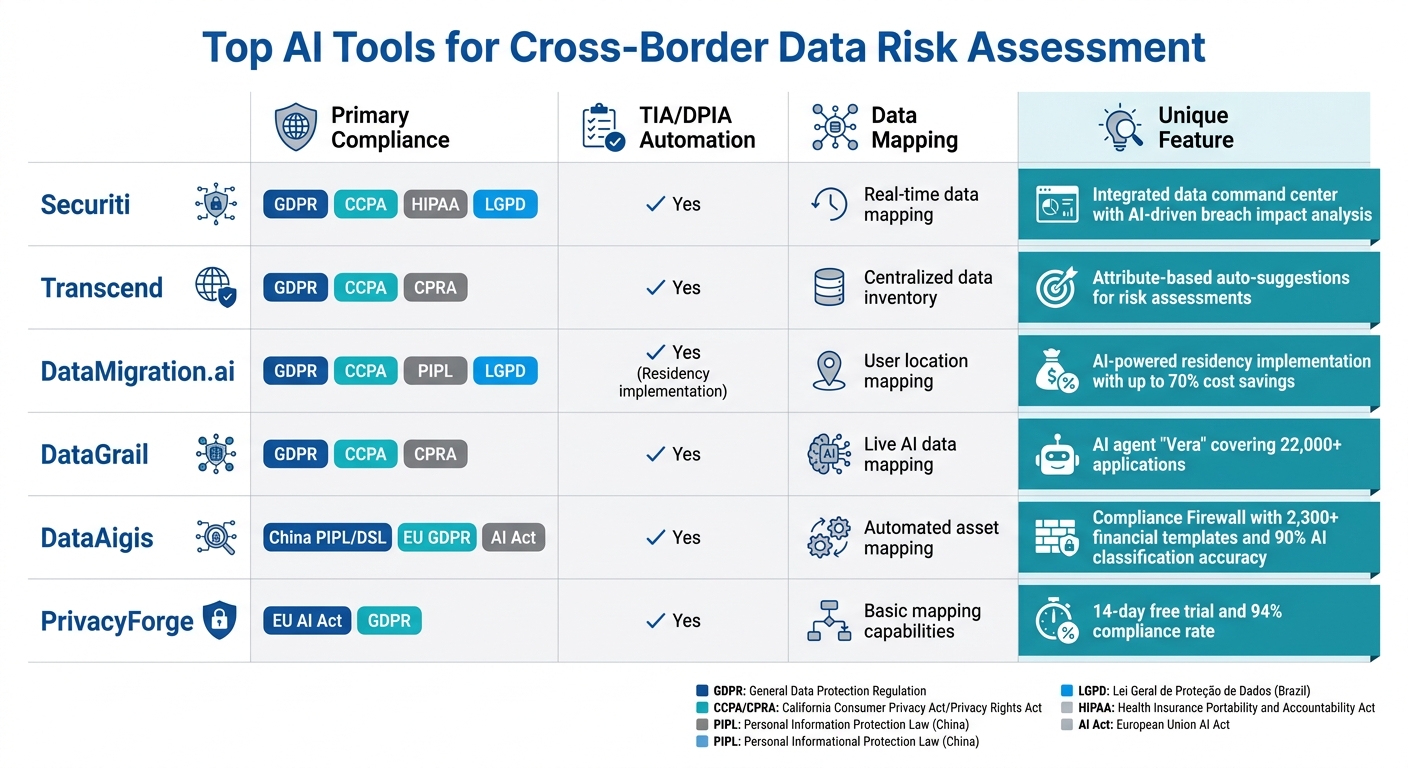
AI Tools for Cross-Border Data Risk Assessment: Feature Comparison
Feature Comparison Table
When it comes to managing cross-border data risks, the market offers a variety of tools, each with its own strengths in automation, data mapping, and compliance support. Here's a breakdown of the top AI platforms for cross-border data risk assessment:
| Tool | Primary Compliance Focus | TIA/DPIA Automation | Data Mapping | Unique Differentiators |
|---|---|---|---|---|
| Securiti | GDPR, CCPA, HIPAA, LGPD | Yes | Real‑time data mapping | Integrated data command center with AI‑driven breach impact analysis |
| Transcend | GDPR, CCPA, CPRA | Yes | Centralized data inventory | Attribute‑based auto‑suggestions for risk assessments [9] |
| DataMigration.ai | GDPR, CCPA, PIPL, LGPD | Yes (residency implementation) | User location mapping | AI‑powered residency implementation with up to 70% cost savings [3] |
| DataGrail | GDPR, CCPA, CPRA | Yes | Live AI data mapping | AI agent "Vera" covering 22,000+ applications [13] |
| DataAigis | China PIPL/DSL, EU GDPR, AI Act | Yes | Automated asset mapping | Compliance Firewall with over 2,300 financial templates and 90% AI classification accuracy [6] |
| PrivacyForge | EU AI Act, GDPR | Yes | Basic mapping capabilities | 14‑day free trial and 94% compliance rate [8] |
This table highlights the compliance areas, automation capabilities, and standout features of each tool, helping businesses make informed decisions about managing cross-border data risks effectively.
How to Implement Cross-Border Data Risk Tools
Steps for Tool Integration
To kick things off, map all international data flows, including routes from the EEA to non-EEA regions and any sub-processor locations involved [2]. Right now, only 72% of third-country data flows are documented across the industry, leaving plenty of gaps to address [16].
Next, integrate your tools with key systems like IAM, SIEM, and ERP for centralized management [4]. Many modern platforms come with built-in integrations for popular software. For instance, OneTrust offers specific modules for Marketo, Salesforce Marketing Cloud, and HubSpot, making it easier to streamline operations [15].
Before diving in fully, run a pilot evaluation to test usability, workflow compatibility, and overall performance [4]. This step ensures the tool fits your infrastructure and helps identify potential issues early on.
For data transfers without adequacy decisions, apply technical safeguards like encryption, pseudonymization, and data masking right away [2]. Be sure to document these measures thoroughly - they’re critical for showing regulators that you've taken proper precautions [2].
Finally, set up continuous monitoring with quarterly reviews to stay ahead of new threats [2][4][16]. On average, it takes organizations 127 days to respond to new regulations, but top-performing companies manage it in just 31 days [16].
By following these steps, you’ll have a solid foundation for tool integration. However, it’s just as important to steer clear of common mistakes that can derail your compliance efforts.
Common Mistakes to Avoid
One big misstep is relying solely on Standard Contractual Clauses (SCCs). SCCs alone cover only 61% of legitimacy requirements, whereas a multi-layered approach - including adequacy decisions and certifications - can boost coverage to 94% [16].
Another pitfall? Treating assessments like a formality. Make sure to integrate the outcomes of Data Protection Impact Assessments (DPIAs) directly into your project plans [17]. Right now, only 54% of organizations maintain complete Transfer Impact Assessments, even as enforcement actions ramp up [16].
Don’t forget to evaluate all sub-processors to close potential compliance gaps. Cross-border incidents already account for 34% of data breaches requiring multi-jurisdictional notifications [16].
Lastly, ditch static monitoring in favor of quarterly reviews. Automated compliance tools can reduce manual oversight by 60%, helping you catch security flaws or tech changes faster [16][17].
Avoiding these common mistakes will keep your compliance efforts on track and reduce your overall risk exposure.
Conclusion
Managing cross-border data transfers is becoming increasingly challenging, but AI-powered tools are transforming how compliance teams handle these complexities. These platforms drastically cut down assessment times - Transfer Impact Assessments, for example, which used to take weeks, can now be completed in just 30 minutes [5]. Similarly, Privacy Impact Assessments are seeing time reductions of up to 85% [14], allowing teams to focus on higher-level strategies.
Given that most data is unstructured [1], automated discovery is no longer optional - it’s critical. AI tools not only speed up workflows but also offer real-time tracking of global regulations, ensuring compliance efforts stay current.
Modern platforms combine efficiency with legal defensibility by leveraging a human-in-the-loop approach. While AI takes care of data scanning and analysis, human experts validate the results, ensuring reports meet regulatory standards. This is especially important when non-compliance carries steep penalties, such as fines reaching €35 million or 7% of global turnover under the EU AI Act [18].
Another key advantage is the shift toward continuous monitoring. With regulations evolving constantly, annual reviews are no longer sufficient. AI platforms that scan for updates twice daily and deliver alerts in under three seconds keep compliance teams ahead of enforcement actions [18].
FAQs
Which data transfers require a TIA or DPIA?
When personal data is transferred to regions with varying data protection laws, a Transfer Impact Assessment (TIA) or Data Protection Impact Assessment (DPIA) is often necessary. This is particularly important when legal tools like adequacy decisions, Standard Contractual Clauses (SCCs), or additional safeguards are employed to maintain compliance with data protection requirements.
What integrations should a cross-border risk tool support first?
A cross-border risk tool needs to work seamlessly with data inventory management, privacy impact assessments, and transfer impact assessments. These connections are key to spotting, evaluating, and addressing risks tied to cross-border data transfers efficiently.
How can we prove our safeguards are regulator-ready?
To show that your safeguards are ready for regulatory scrutiny, it’s important to perform detailed evaluations, such as Transfer Impact Assessments (TIAs) and GDPR readiness checks. Leveraging automated tools can simplify the creation of compliance documentation, saving time and reducing errors. Additionally, regular monitoring and audits are essential to keep up with changing regulations. These practices ensure your processes align with what regulators expect.