Strong leadership is the backbone of successful Robotic Process Automation (RPA) initiatives. Without it, automation projects risk failure, inefficiency, or resistance from employees. Effective RPA leaders align automation with business goals, secure resources, and manage change effectively. Here’s what you need to know:
- RPA leadership combines technical expertise and strategic vision to identify automation opportunities and scale efforts across an organization.
- Companies with strong RPA leadership report benefits like 75% cost reductions and 40% higher customer satisfaction.
- Leadership roles ensure automation governance, team collaboration, and smooth deployment.
Key RPA Leadership Roles:
- RPA Manager: Oversees strategy, governance, and team alignment.
- RPA Project Manager: Focuses on delivering automation projects on time and within budget.
- RPA Architect: Designs technical frameworks and ensures scalability.
Core Responsibilities:
- Planning: Identifying high-value processes for automation and setting clear goals.
- Team Management: Coordinating cross-functional teams and addressing employee concerns.
- Performance Oversight: Monitoring automation metrics like robot productivity and process throughput.
Skills and Career Path:
- Educational Background: Typically in Computer Science, IT, or related fields.
- Certifications: Credentials like Automation Business Analyst Professional or Solution Architect Professional enhance career prospects.
- Career Progression: Roles evolve from developer or analyst to leadership positions managing enterprise-wide automation.
Takeaway: RPA leaders bridge the gap between technology and business strategy, ensuring automation delivers measurable results. Their expertise drives cost savings, efficiency, and growth.
How to Upskill Your Teams and Scale RPA with RPA Training | Automation Anywhere University

Core Responsibilities of RPA Leaders
RPA leaders juggle a variety of tasks, from strategic planning to team coordination and performance management. Their primary goal? Ensuring automation drives real business results, rather than becoming a scattered collection of bots that lack direction. As David Hickey, Principal at Baker Tilly, puts it:
"Effective RPA leadership hinges on the ability to align automation initiatives with overarching business objectives, ensuring that automation efforts contribute to strategic goals."
Planning and Goal Setting
The journey begins with identifying processes that offer the best return on automation investment. RPA leaders craft focused business cases with well-defined KPIs, prioritizing automation candidates based on factors like how often the process occurs, the effort required, and its importance to the business. They also develop a Robotic Operating Model (ROM) - a structured framework that guides how automation is assessed, designed, and rolled out across the organization.
Governance plays a key role here, as leaders establish models that bridge the gap between Business and IT teams. By creating clear communication channels and engaging senior stakeholders, they secure both buy-in and the resources needed for success. This approach ensures automation initiatives aren't just isolated experiments but become integral to achieving business goals. With the groundwork laid, the focus shifts to assembling and managing skilled teams.
Team Management and Collaboration
RPA leaders oversee cross-functional teams, bringing together Business Analysts to document processes, Developers to design automated workflows, and Operations Specialists to monitor bot performance. These teams often operate within a Center of Excellence (CoE) or Robotic Operations Center, ensuring diverse expertise aligns under a unified strategy.
Change management is another critical area. Research shows that 44% of enterprises cite poor change management as the main reason for RPA failures. To counter this, leaders prioritize open communication, explaining the purpose behind automation, involving team members early on, and addressing concerns about potential job impacts. This transparency fosters collaboration and ensures that automation efforts stay aligned with organizational goals.
Deployment and Performance Oversight
Once automation is live, RPA leaders monitor the virtual workforce to ensure robots meet operational benchmarks. Metrics such as robot productivity, process throughput, average handling time, and SLAs are closely tracked to maintain alignment between operations and business objectives. A UiPath white paper highlights the importance of this connection:
"Behind every business metric is an operational metric. Analytics tied to the operational viability of an RPA deployment - measuring factors like robot productivity, process throughput, average handling time, and SLAs - can be used to define key metrics for success and align insights from the execution of an RPA deployment directly to the impact on business outcomes."
Regular governance reviews with stakeholders help assess performance, manage capacity, and pinpoint areas for improvement. RPA leaders also maintain the process pipeline, ensuring a consistent flow of automation opportunities that deliver measurable results. By keeping a close eye on operations, they scale initial pilots into enterprise-wide automation programs without losing focus on quality. These practices lay the groundwork for more specialized leadership roles within the RPA ecosystem.
Key RPA Leadership Positions
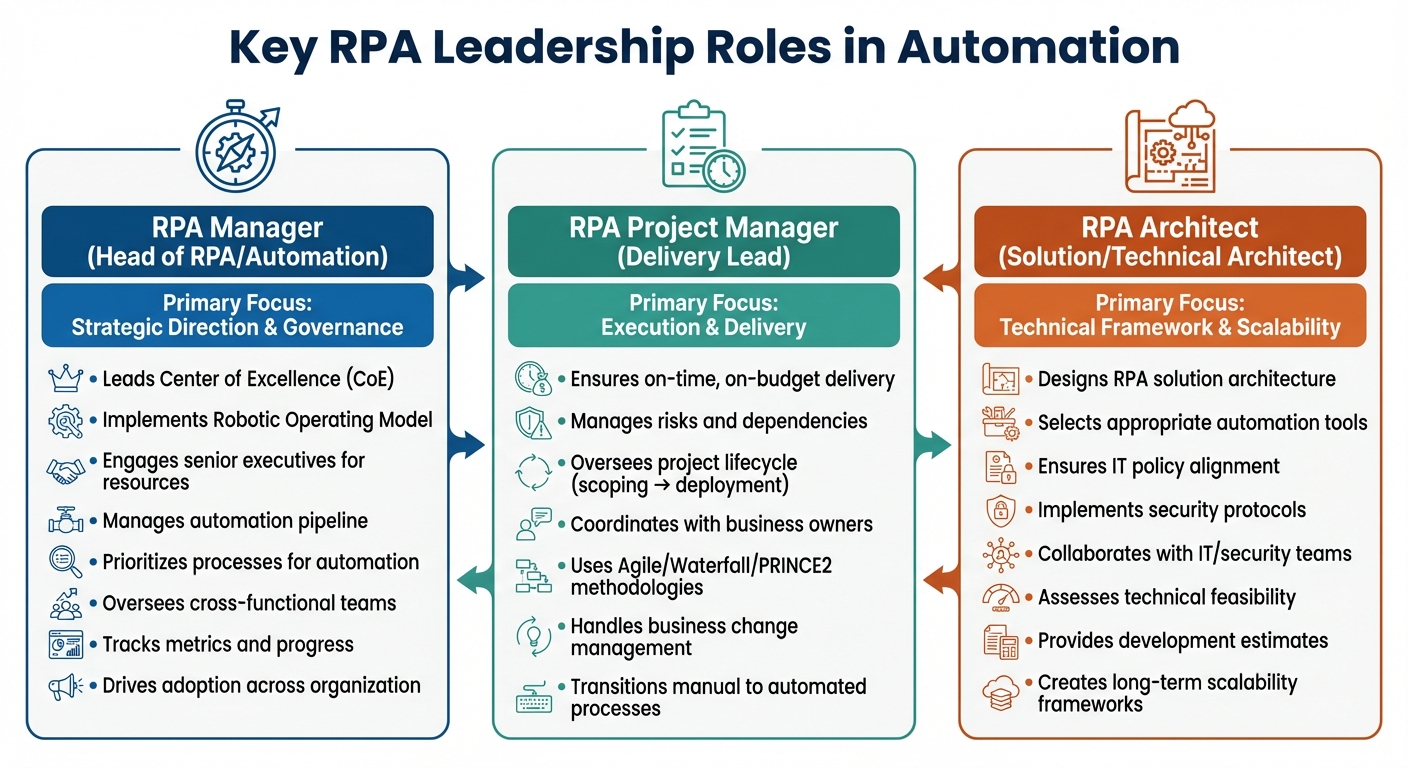
Key RPA Leadership Roles: Responsibilities and Focus Areas
As automation programs evolve, leadership roles tailored to specific aspects of Robotic Process Automation (RPA) have become essential. These positions address the technical, operational, and strategic needs of RPA initiatives, ensuring they deliver value while remaining secure and scalable. Below are some of the key roles that highlight how specialized expertise drives the success of automation efforts.
RPA Manager
The RPA Manager - sometimes referred to as the Head of RPA or Automation - plays a pivotal role in steering the organization's automation strategy. They lead the Center of Excellence (CoE) and implement the Robotic Operating Model, ensuring governance frameworks are in place. A significant part of their job is engaging senior executives to secure resources and align communication strategies.
This role involves managing the automation pipeline, identifying and prioritizing processes for automation, and overseeing cross-functional teams. Metrics tracking and progress monitoring are also key responsibilities. Acting as internal advocates, RPA Managers drive adoption and guide the organization through its digital transformation journey. Success in this role requires a mix of technical expertise, business acumen, financial investment, and collaboration with external vendors.
RPA Project Manager
The RPA Project Manager, sometimes called the Delivery Lead, is responsible for ensuring automation projects are completed on time and within budget. They manage risks, dependencies, and all stages of the project lifecycle - from initial scoping and design to configuration, testing, and deployment. Coordination with business owners and sponsors is a central part of their role.
Execution is the primary focus here, and these managers often rely on methodologies like Agile, Waterfall, or PRINCE2. They also emphasize business change management, helping organizations transition from manual processes to automated workflows. As UiPath highlights:
Leadership is crucial, as the strongest possible implementation manager must be selected.
RPA Architect
The RPA Architect - sometimes called the Solution or Technical Architect - lays the technical groundwork for automation initiatives. They design the architecture for RPA solutions, selecting the right tools and ensuring alignment with IT policies, security protocols, and scalability needs. By collaborating with IT and security teams, they help avoid infrastructure issues that could hinder automation efforts.
While Project Managers focus on timelines and delivery, RPA Architects assess technical feasibility and provide accurate development estimates to aid planning. As UiPath explains:
The [Solution Architect] defines the architecture of the RPA solution and oversees it end-to-end, assisting both in the development, and in the implementation phases.
This role demands a strong background in system engineering, platform-specific knowledge, and the ability to create frameworks that support long-term automation growth.
sbb-itb-bec6a7e
Effective Strategies for RPA Leaders
Beyond their core duties, successful RPA leaders implement strategic initiatives to drive efficiency and promote forward-thinking automation practices.
Encouraging Innovation and Adoption
Creating an environment where automation thrives requires deliberate leadership. David Hickey, Principal at Baker Tilly, highlights that "RPA leaders can foster innovation by creating platforms for idea-sharing, recognizing and rewarding innovative contributions and championing a mindset that embraces experimentation and calculated risk-taking". This involves setting up avenues for sharing ideas, celebrating innovative efforts, and encouraging thoughtful experimentation.
One major challenge is overcoming resistance to change. Open communication about RPA's benefits can help ease concerns. Engaging stakeholders early in the process and showcasing clear productivity improvements builds trust. Many organizations appoint an RPA Champion - a dedicated advocate who promotes the technology and ensures continued momentum after initial pilot programs. This role is crucial for sustaining enthusiasm and keeping automation initiatives on track.
Aligning automation efforts with broader business goals is another critical factor. Instead of treating automation as a standalone IT project, it should integrate seamlessly into the company’s overall strategy. Establishing a Center of Excellence (CoE) can support this by distributing RPA expertise and resources across teams. As organizations grow more advanced, they often shift toward empowering "citizen developers" - employees who identify and implement everyday automation opportunities without relying on centralized IT teams.
However, fostering innovation is just one piece of the puzzle. Leaders must also address skill gaps to ensure long-term success.
Addressing Skill Gaps in RPA Teams
Closing skill gaps begins with competency mapping - clearly defining the skills required for each role and setting measurable goals. Tools like self-assessments, manager evaluations, peer feedback, and 360° reviews, combined with AI-driven gap analysis, help pinpoint areas for improvement. AI tools can also forecast emerging needs, such as expertise in AI prompt engineering, and recommend tailored learning paths. With 74% of employees believing they need to upskill this year to stay relevant, robust development programs are no longer optional - they’re essential.
Training programs should cater to various experience levels, from beginner-friendly self-paced courses to advanced instructor-led sessions for technical roles. Companies that embrace a skills-based approach - prioritizing verified competencies over job titles - report up to 40% higher profitability. When internal training falls short, recruiting external talent with both technical know-how and change management skills can fill critical gaps. As Roger Camrass, Research Director at CIONET, explains, "The implementation of successful automation pilots and scale-ups relies on financial investment, strong technical and business skills, and carefully crafted partnerships with external vendors".
Using Data-Driven Decision Making
To complement innovation and skill-building, data-driven strategies bring precision to RPA leadership. Analytics turn operational metrics - like robot productivity, throughput, average handling time, and SLA compliance - into actionable insights tied to business outcomes such as ROI and profitability. David Hickey emphasizes, "Embracing data-driven decision-making equips RPA leaders with the insights needed to make informed choices regarding automation strategies, process optimization and resource allocation".
Establishing clear KPIs is key to measuring success. Leaders should document lessons learned and create a performance framework to track outcomes across the organization. Assigning an RPA Supervisor to oversee the virtual workforce ensures consistent monitoring of operational metrics through advanced reporting tools.
Regular governance meetings with all stakeholders keep everyone accountable. These sessions review performance data, assess the impact of automation, and identify areas for improvement. Data also plays a crucial role in prioritizing the automation pipeline, helping leaders focus on processes with the greatest potential impact. As a UiPath whitepaper puts it, "Behind every business metric is an operational metric", emphasizing that technical execution directly supports strategic goals. By continuously refining automated processes, leaders can ensure scalability and sustained value over time.
Qualifications and Career Path for RPA Leaders
Educational and Professional Background
RPA leaders often come from academic backgrounds in Computer Science, Software Engineering, or IT. But having technical expertise alone isn’t enough. Success in this field also requires a proven track record in driving business transformation. Ideal candidates typically have experience managing cross-functional teams and spearheading organizational changes from both operational and technical perspectives. To thrive in this role, strong stakeholder management skills are essential - particularly the ability to effectively engage with senior executives and board members. Familiarity with project management methodologies like Agile, Waterfall, and PRINCE2, as well as process improvement frameworks such as LEAN, Six Sigma, or BPR, is equally important.
“RPA leaders must exhibit a deep understanding of automation technologies, enabling them to make informed decisions and guide their teams effectively”.
Beyond technical know-how, successful RPA leaders need strategic thinking skills. This includes defining KPIs, building persuasive business cases, and ensuring automation initiatives align with broader organizational goals. Leadership in this space is about combining technical expertise with a clear strategic vision. Additionally, targeted certifications can validate and enhance these leadership skills, complementing formal education and professional experience.
Certifications for RPA Leaders
Certifications can significantly boost career prospects, with industry data showing they often lead to better job opportunities and career advancement.
For aspiring RPA leaders, the Automation Business Analyst Professional certification is a key credential. It’s particularly suited for roles like Project Manager, Centers of Excellence (CoE) Lead, and Change Manager. Meanwhile, the Automation Solution Architect Professional certification is designed for those overseeing large-scale automation projects. It validates expertise in automation architecture and enterprise technology stacks, critical for managing end-to-end business process automation.
“This credential demonstrates advanced expertise in automation architecture, enterprise technology stacks, and end-to-end business process automation”.
As AI-powered automation becomes more prevalent, the Specialized AI Professional certification is gaining traction. This credential is especially valuable for leaders handling projects involving intelligent document processing and machine learning. Additionally, earning the Automation Catalysts Badge highlights cross-functional expertise - an essential quality for top-tier leadership roles.
Career Progression in RPA Leadership
The career path for RPA leaders typically builds on a mix of formal education, certifications, and hands-on experience. Many professionals start in technical roles like Automation Developer or functional roles such as Automation Business Analyst. These entry-level positions offer competitive salaries, with significant pay increases as individuals advance to roles like Automation Solution Architect.
Career growth in RPA leadership often unfolds in three stages: launching pilot automation projects, scaling these initiatives to handle more complex processes, and eventually leading enterprise-wide digital transformations.
“The implementation of successful automation pilots and scale-ups relies on financial investment, strong technical and business skills, and carefully crafted partnerships with external vendors”.
This progression highlights the importance of blending technical expertise with managerial and strategic capabilities - qualities that define successful RPA leaders.
Conclusion
Strong leadership plays a crucial role in ensuring the success of RPA initiatives. Without aligning automation efforts with strategic business goals, establishing clear governance, and managing change effectively, these projects are likely to miss the mark. Leaders must connect the dots between the technical execution of automation and the broader objectives of the organization, ensuring every automated process contributes to long-term growth and efficiency.
The path from planning to execution requires a well-rounded approach. Setting up a Center of Excellence (CoE) provides a solid foundation for scalability and knowledge sharing. When done effectively, CoEs can lead to significant cost savings, improved process efficiency, and higher revenue in large enterprises.
David Hickey from Baker Tilly highlights the importance of continuous learning to stay ahead of industry trends, emerging technologies, and best practices in automation. Addressing skill gaps through focused training and certification ensures teams are prepared to adapt as automation evolves. With the rise of intelligent automation and citizen development, leaders must empower non-technical employees while maintaining strong governance. Early involvement of IT teams, clear communication strategies, and data-driven decisions are essential for long-term success. Developing these capabilities is key to the evolving role of RPA leaders in driving meaningful organizational change.
The future of RPA leadership lies in fostering collaboration between humans and machines while embracing continuous innovation. By focusing on these priorities, leaders can not only implement automation effectively but also transform their organizations in ways that deliver measurable and lasting results.
FAQs
What skills are essential for leading RPA initiatives?
Effective leadership in RPA calls for a blend of technical know-how, strategic foresight, and the ability to manage change effectively. Leaders need to grasp the essentials of automation technologies and integration processes to make sound decisions and ensure smooth implementation.
Just as crucial is the skill to align RPA initiatives with overarching business objectives, pinpoint areas where automation can deliver the most value, and encourage teamwork across different departments. Navigating organizational transitions, managing expectations, and paving the way for seamless adoption of automation solutions all hinge on strong change management abilities.
When technical expertise is paired with strategic thinking and organizational acumen, RPA leaders can unlock new opportunities and amplify the benefits of automation.
How can RPA leaders ensure automation aligns with business objectives?
RPA leaders ensure automation efforts are in sync with business goals through thoughtful planning and proactive change management. They focus on automating key processes that align with organizational priorities, ensuring these initiatives deliver clear, measurable benefits. Achieving this requires a solid grasp of the company’s objectives and a commitment to integrating automation in ways that support those goals.
Strong leadership in RPA also emphasizes the importance of change management. This involves building a shared vision for automation, gaining executive buy-in, and addressing any resistance within the organization. By fostering teamwork and encouraging an environment open to new ideas, leaders position automation as a tool for improving business performance. In essence, successful RPA leaders blend technical know-how with strategic thinking to achieve impactful results.
What does a Center of Excellence (CoE) do in RPA initiatives?
A Center of Excellence (CoE) serves as the backbone for successful RPA (Robotic Process Automation) initiatives, offering a structured approach to managing and expanding automation across an organization. It creates a centralized hub for setting best practices, defining governance policies, and ensuring that automation efforts align seamlessly with the company's overarching goals. This not only boosts efficiency but also helps reduce potential risks.
Beyond governance, the CoE empowers teams by providing training, expert advice, and access to tools that encourage innovation. It plays a critical role in prioritizing automation projects, fostering collaboration between teams, and ensuring adherence to both regulatory and internal standards. By consolidating these responsibilities, a CoE helps businesses scale their automation efforts while integrating RPA into their larger digital transformation plans.