If you run AI on live data, compliance has to happen at the output level - not just in policy docs. I’d boil this down to 5 control points: data entry rules, live audit logs, human review for high-risk decisions, vendor and cross-border checks, and clear ownership across teams.
Here’s the short version:
- Before data enters the pipeline, I need a legal basis, notice, data minimization, retention rules, and a tested rights process.
- In production, I need logs that show what the system did, which data it used, which model version ran, and who reviewed high-risk outputs.
- For automated decisions, I need a real human review path when outcomes affect people in serious ways.
- For vendors and transfers, I need to map every processing path - including inference calls, embeddings, and observability tools.
- For execution, I need legal, security, data, product, and leadership to each own a specific part of the control stack.
A few numbers make the risk plain: GDPR penalties can reach $23.6 million at current exchange rates or 4% of global annual revenue, Uber was fined $341.5 million in the Netherlands over data transfers, and 33% of firms have no AI audit logs at all.
If I were setting this up, I’d treat AI compliance as a live systems problem: control what goes in, log what comes out, review risky decisions, and lock down every vendor path.
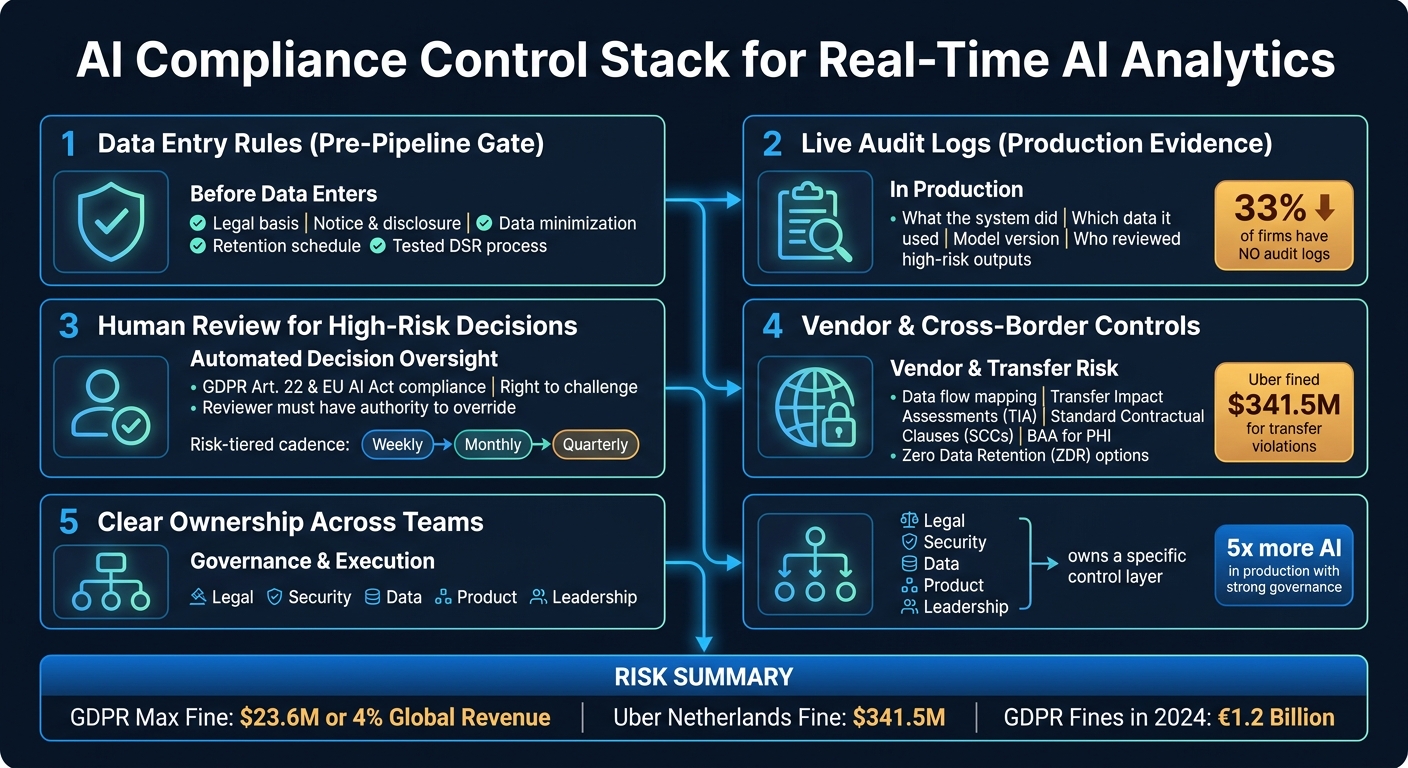
AI Compliance Control Stack: 5 Key Gates for Real-Time Analytics
How AI Is Making Compliance Real-Time
sbb-itb-bec6a7e
Privacy Law Basics Before Data Enters the Pipeline
Before data enters a real-time pipeline, the legal basis, notices, retention, and rights process must already be set. The first control gate is simple: decide what data is allowed into the stream.
Lawful Basis, Notice, Minimization, Retention, and Rights Handling
Every personal data field needs a legal basis - consent, contract performance, or legitimate interest. That said, legitimate interest is tougher to defend for AI training [3].
Generic privacy policies are not enough for notice duties. Laws such as California's AI Transparency Act (SB 942) call for clear, upfront disclosure about what is collected and what the AI does with it [9].
Data minimization means collecting only what the model needs. In practice, that usually means pre-prompt redaction - removing PII before the prompt reaches the model [4][3].
Retention needs the same level of discipline. Each data category should have a documented expiration date in a Record of Processing Activities (ROPA), along with any vendor storage terms. If the system supports significant automated decisions, there also needs to be a documented human review path.
Once those rules are in place, the pipeline can be tested against them before launch.
What Must Be True Before Streaming or Prediction Starts
Before any data flows into a real-time pipeline, 5 things need to be confirmed:
- Approved purpose - a documented use case that matches the collection context
- Data inventory and classification - every field in the stream labeled by sensitivity, such as PHI, financial data, or children's data
- Consent or preference state - suppression or consent-check logic is active and tested
- Retention schedule - data expiration rules are set at ingestion
- Tested DSR process - the pipeline can respond to a data subject request within the required timeframes
Aligning documentation with the NIST AI RMF or ISO/IEC 42001 may help support an affirmative defense under some state laws [9].
U.S. State Rules, Sector Obligations, and Transfer Triggers
For multi-state pipelines, use the strictest rule that applies. After the baseline privacy rules, map the tighter state, sector, and transfer duties tied to your data.
| Regulatory Area | Key Obligation | Trigger |
|---|---|---|
| Colorado AI Act (SB 24-205) | Impact assessment before deployment; annual review | High-risk AI affecting consequential decisions |
| California CPRA | Opt-out mechanism for automated decision-making | Any ADM affecting California residents |
| NYC Local Law 144 | Annual independent bias audit | AI used in hiring or promotion decisions |
| HIPAA | Signed BAA with every AI vendor touching PHI | Any healthcare data in the pipeline |
| GLBA / NYDFS Part 500 | Encryption, access controls, audit logs | Nonpublic personal financial information |
Sector rules sit on top of state rules. For example, healthcare data needs a signed Business Associate Agreement before any AI vendor touches PHI [8]. Employment AI tools in New York City must pass an annual independent bias audit under NYC Local Law 144 [10][9].
Real-time inference can also trigger a transfer even when raw data never leaves the source system. The issue is not just where the file sits. A transfer may happen when inference or vendor processing takes place in another jurisdiction. Choosing an AWS EU region does not guarantee sovereignty if the provider is U.S.-headquartered, because the U.S. CLOUD Act can still compel access [7].
In 2024, Uber was fined €290 million by the Dutch Data Protection Authority for transferring EU driver data to the United States without adequate safeguards [7].
Audit Records, Model Oversight, and Human Review in Production
Getting compliant before launch matters. Staying compliant after launch is where teams usually slip.
The gap is clear: 33% of organizations have no AI audit logs at all, and 61% have logs that are fragmented and not usable for compliance [9].
Audit Trails and Evidence You Need to Retain
Once a system is live, compliance comes down to proof. After any output, the system should be able to show the input data, the query, the permissions in effect, and the model version that produced that result.
So logging is not just about who got into the system. It also has to show what the model used and what actions it took to generate a specific output. For teams running AI in real time, the main evidence areas look like this:
| Audit Area | Evidence to Retain | Review Frequency |
|---|---|---|
| User Access | Identity, role, row-level policy, access decision | Monthly |
| Metric Definition | Semantic metric, owner, formula, version | Quarterly |
| Source/Lineage | Tables, query, transformation path | Quarterly |
| Agent Actions | Tool logs, tool calls, SQL execution logs | Weekly (pilot) / Monthly |
| Human Review | Reviewer ID, decision, timestamp, escalation path | Monthly |
| Monitoring | Feedback, error category, remediation actions | Immediate (on incident) |
Retention rules matter too. The Colorado AI Act says impact assessments must be kept for at least 3 years [9]. In practice, documentation should come out of day-to-day system use, not a last-minute scramble before an audit [9]. That means automated logging should already be built in. Tools should continuously record logs, configuration snapshots, and policy version history [4].
Human Oversight Matched to Model Risk
Not every output needs a person to check it. High-impact decisions do.
Under GDPR Article 22 and the EU AI Act, human intervention is required when decisions are fully automated and create legal or similarly serious effects - like credit denials, employment rejections, and healthcare diagnostics [3][5]. In those cases, users must have a right to human intervention and a way to challenge the automated decision [5]. And the reviewer has to be able to say no. If a person just rubber-stamps the model’s output, that is not oversight [5].
The practical move is risk-tiered review. Put human review around outputs with the most downside, such as revenue forecasts, regulated reporting, and workflows that touch sensitive data like PII or PHI. A simple cadence works well:
- Weekly pilot checks
- Monthly reviews for high-risk outputs
- Quarterly reviews of metric definitions and access rules
If a model produces a high-variance financial forecast or touches sensitive fields, route that output to a named reviewer before it affects a decision.
Monitoring also needs to run all the time. Teams should scan prompts, outputs, and system logs for anomalies, prompt leakage, and data drift [2]. When an alert fires, the response path should classify severity, send the issue to the right owner, contain the problem, and update both the audit log and the incident record [2].
Governance Artifacts That Keep Oversight Running
Oversight falls apart when the paperwork goes stale.
At a minimum, teams should keep an AI system inventory, impact assessments, a RACI matrix, and incident response playbooks. Each of these should have a review cycle tied to risk level and system changes [9][1][2].
| Governance Artifact | Key Components | Review Frequency |
|---|---|---|
| AI System Inventory | Name, owner, risk class, data categories | Quarterly |
| Impact Assessment | Intended use, affected groups, bias test results | Annual; within 90 days after major change |
| RACI Matrix | Designated responsible persons for model/data | Semiannual |
| Incident Response | Escalation paths, notification timelines | Per incident |
Impact assessments should be updated every year or within 90 days of a major change [9]. Version-controlled change logs should also track retraining and policy updates as part of normal operations [9][4]. Those same records help with vendor review and cross-border controls.
Cross-Border Data Flows and Third-Party Risk Controls
Most teams focus on compliance at the moment data is collected. That’s the easy part. The harder issue starts after data leaves your control - through inference calls, embedding APIs, observability logs, and agent tool calls. Once data leaves your stack, compliance depends on vendor paths, not just your internal controls.
How to Assess Domestic, Vendor-Hosted, and Cross-Border Processing Paths
Start with a data flow map that covers every processing path: collection, inference, storage, and observability. Teams often miss 2 paths in particular: embedding APIs, where documents are turned into vectors by a third-party service, and observability platforms, which may store full payloads for long periods [7].
Next, classify data by sensitivity. Ordinary personal data does not carry the same transfer risk as biometrics, health data, or precise location data. In healthcare workflows, de-identify documents and get an Expert Determination report before any PHI is shared with a vendor.
For any cross-border path, use a Transfer Impact Assessment (TIA) to check whether the destination country’s legal framework weakens the protections your contract is supposed to provide. This matters a lot for U.S. transfers. The CLOUD Act can compel access to data stored abroad by U.S.-based companies, even when the servers sit in the EU [7]. In plain English: an EU region setting does not guarantee data sovereignty.
| Transfer Scenario | Required Safeguards | Evidence Artifacts |
|---|---|---|
| Domestic (U.S. to U.S.) | Standard DPA, Security Annex | SOC 2 Report, Data Map |
| Cross-Border (EU to U.S.) | SCCs + Transfer Impact Assessment (TIA) + Encryption | Signed SCCs, TIA Report, Encryption Keys Management Log |
| EU AI Act high-risk systems | FRIA + Data Governance (Art. 10) + Human Oversight | Combined DPIA/FRIA Document, Bias Testing Records, Oversight Logs |
| Healthcare (PHI) to AI Vendor | Business Associate Agreement (BAA) + De-identification | Signed BAA, Expert Determination Report |
| Cross-Border Agent Tool Calls | Tool-call policy checks + Pre-prompt Redaction | Immutable Audit Logs of Tool Calls, Redaction History |
Once the path is mapped, check that the vendor contract matches the way data actually moves.
Vendor Due Diligence for AI-Enabled Analytics Providers
When you review a vendor, ask direct questions. Does the vendor use customer data to train or fine-tune models? What is the exact retention period for prompts and completions? Does the vendor offer Zero Data Retention (ZDR) for API calls? ZDR means prompts and completions are not stored or reused, which makes Right to Erasure requests simpler [3][7].
Sub-processors are another common gap. If you use a vendor like Anthropic, then AWS, which hosts Anthropic's infrastructure, is part of your sub-processor chain. Your Data Processing Agreement should reflect that full chain, not just the main vendor [3]. Ask for the current sub-processor list and ask how change notices will be handled.
For any system that touches healthcare data, a signed Business Associate Agreement (BAA) is required before PHI reaches the vendor’s infrastructure [8]. If the vendor processes EU data, confirm whether processing can be restricted by contract to a specific region - such as AWS Frankfurt or Azure EU - instead of relying on default routing [3].
That work doesn’t just cut legal risk. It also speeds up approval for real-time use cases.
Contracts, Monitoring, and Change Management After Procurement
Signing a DPA is the start of vendor risk management, not the finish line. The agreement should include AI-specific clauses for training data and inference residency, and it should line up with SCCs and any needed Transfer Impact Assessments for cross-border processing [3][5].
Restrict processing to named regions by contract instead of accepting default settings [3]. After procurement, keep monitoring in place with automated alerts for sub-processor list changes and other vendor updates [4]. If the vendor changes its processing path, rerun the review before the new setup goes live.
Keep immutable logs of vendor reviews, tool calls, redactions, and impact assessments. Those controls cut delay, rework, and repeat reviews - which is why they belong in the operating model, not buried in a legal file.
Tying Compliance Controls to Value Creation
Compliance is a value lever. It cuts incident cost, helps teams ship faster, and keeps reporting clean. Once controls are in place, the next question is simple: what do they give back? In practice, the return shows up as faster launches, lower risk, and better evidence.
How Compliance Improves Speed, Trust, and Operating Discipline
The financial case is immediate. GDPR enforcement alone led to €1.2 billion in fines in 2024 [7]. That is not some fringe outcome. It is the baseline risk for teams running AI systems without live, structured analytics controls.
The operating case is just as direct. Set evidence requirements at the start so teams build collection into tickets and pipelines instead of scrambling later. With automated compliance tooling, a mid-sized company can move to continuous audit evidence in 90 days. Manual, spreadsheet-heavy programs usually take 6-9 months, and many start to break down within 3 months anyway [4].
For enterprise sales teams, this matters in a very practical way. Clean production evidence controls let teams answer security questionnaires in hours instead of weeks. That shortens sales cycles in a way finance teams and operators can both see [4].
A Practical Rollout Sequence for Mid-Market and PE-Backed Teams
For mid-market and PE-backed teams, the fastest path is staged adoption - not a big-bang launch.
- Days 1-30: Inventory all AI, including shadow AI and embedded vendor features, then assign risk tiers. Teams often underestimate how much AI is already in the business by 10x [4][6].
- Days 31-60: Add pre-prompt redaction to major LLM integrations and map approved definitions for high-risk metrics - revenue, forecast variance, and churn - to an approved metric layer. This is where output-level evidence starts [1][4].
- Days 61-90: Automate evidence collection for SOC 2 or ISO/IEC 42001 so evidence is available on demand. Align DPIA and FRIA evidence in one review pack [4][3]. Use NIST AI RMF or ISO/IEC 42001 alignment to move internal approval and audit review along [9]. Teams sorting out which AI tools belong in a compliant stack can use AI for Businesses, a curated directory of business AI tools that also covers AI adoption for mid-market and PE-backed companies.
Conclusion: The Minimum Viable Control System for Real-Time AI
These controls work because they stay minimal, not bloated. The minimum viable control system has 5 parts: a privacy baseline before data enters the pipeline, audit records that can stand up to regulatory review, risk-calibrated human oversight with actual authority to step in, transfer and vendor controls that match how data moves in practice, and value-linked governance that ties controls to business outcomes. Organizations with strong governance foundations are 5x more likely to have multiple AI systems in production than firms with weaker oversight [11].
"AI compliance is not a checklist - it's the operational discipline of running AI systems that meet every regulatory and contractual obligation simultaneously." - Aatish Mandelecha, Founder, Strac [4]
FAQs
What counts as a high-risk AI decision?
A high-risk AI decision has legal effects or meaningfully shapes a person’s life, rights, or access to core services. That includes decisions tied to credit, insurance, hiring, health care, housing, education, and government benefits.
In a business setting, the label can also apply when AI is used with sensitive data, or when AI-generated outputs lead to external commitments or operational actions - especially when this happens at scale or without human review.
How do I prove compliance in real time?
Proving compliance in real time starts with a simple shift: stop treating audits as point-in-time events and start collecting evidence all the time. That means your context layer should also act as an evidence layer. Every AI output should be traceable back to its lineage, source data, metric definitions, access policies, and human review status.
A setup like this makes it much easier to show what happened, who had access, what data was used, and whether the right checks were in place at the moment an output was produced.
Keep a few basics in place:
- Immutable audit logs so records can't be quietly changed later
- Real-time data redaction and policy-based access to limit exposure
- Up-to-date DPIAs and ROPAs so documentation matches current data use
- A clear incident response playbook so teams know what to do when something goes wrong
This approach turns compliance from a scramble before an audit into a day-to-day system of record.
When does AI data processing become cross-border?
AI data processing becomes cross-border when personal data is transferred, stored, or processed outside the country or region where it started.
With AI systems, that can happen at a few different points - during training data aggregation, model hosting, or real-time inference. Even apps that look local on the surface may still send data across borders if their vendors rely on sub-processors or data centers in other countries for inference or fine-tuning.