Yes - transfer learning can help you ship a new threat detector in days or weeks, not months, if the source model and target threat are close enough. If they are not, you risk negative transfer, where the reused model hurts detection instead of helping it.
Here’s the short version of how I’d think about it:
- I use transfer learning when I have limited labeled data - often 500 to 1,000 high-confidence samples
- I check source-model fit first - telemetry, schema, attack behavior, training window, and known weak points
- I keep data splits time-safe so future incidents do not leak into past training
- I fine-tune in stages - frozen model first, then top layers, then deeper only if results justify it
- I test for more than accuracy - false positives, alert volume, latency, MTTD, and MTTR matter just as much
- I watch for data drift, concept drift, and label drift after launch
- I deploy with controls - shadow mode, canary rollout, human review, and rollback ready
The main point is simple: transfer learning is a fit when speed matters, labels are scarce, and the old model already learned patterns close to the new threat. But I would not treat a good validation score as enough. If analyst-added fields leak into training, if the target data is noisy, or if the model adds too many false positives, the project can fail even with decent test metrics.
A few facts from the article stand out:
- 1,000 clean samples can beat 50,000 noisy ones
- 63% of organizations have no specific controls for AI training-data quality and consistency
- 91% of CISOs are unsure about the origin and integrity of AI training data
So if I were summarizing the article in one line, it would be this: move fast, but only with clean labels, time-safe testing, staged tuning, and hard release gates.
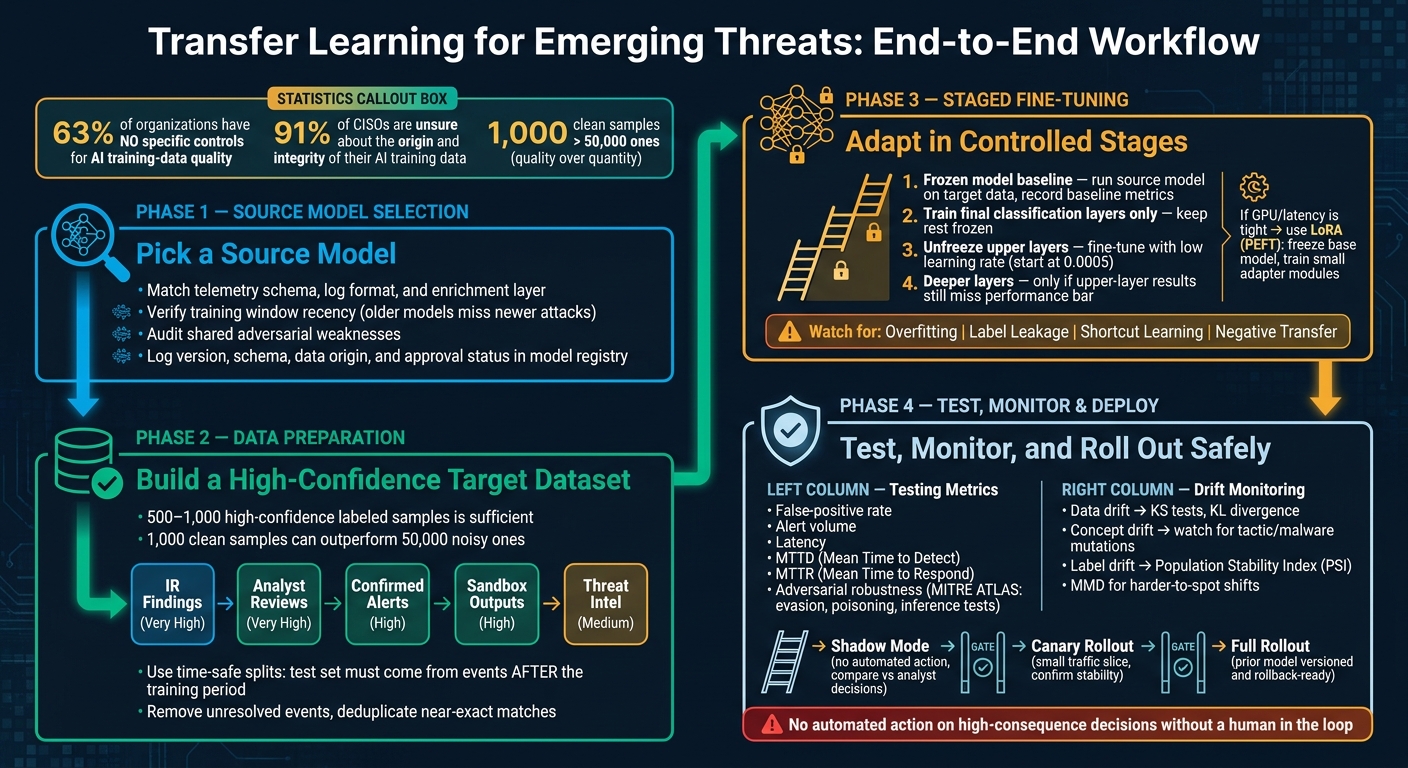
Transfer Learning for Threat Detection: Staged Fine-Tuning & Deployment Workflow
Pick a Source Model and Build a Small Target Dataset
Select a Source Model Based on Security Relevance
Start with fit. The main question is simple: does the source model’s training data look like your internal telemetry or not?
If it was trained on a different log schema, a different collection setup, or a different enrichment layer, transfer will be messy. In practice, that usually means weaker results and more cleanup work after fine-tuning.
You should also check for similar attack behavior. Transfer tends to work better when the source and target models are built for similar tasks and use similar architectures. Models in that situation can also share the same blind spots. So if one model can be fooled by a certain attack, another model that leans on the same general features may be fooled too. Training recency matters as well - older models often miss newer attack patterns.[2]
Before you fine-tune, log the source model’s version, training window, schema, data origin, dependencies, and approval status in the model registry. Then audit for shared adversarial weaknesses. If the base model is open to a specific attack, the fine-tuned model will often carry that weakness forward.[1]
If the source model fits, move to the smallest target dataset that still reflects recent attacks.
Prepare High-Confidence Target Data With Time-Safe Splits
You do not need a massive dataset to get started. Fine-tuning can work with 500 to 1,000 high-confidence examples, and 1,000 carefully curated samples often beat 50,000 noisy ones.[6]
Pull from the cleanest sources first:
- confirmed alerts
- incident response findings
- sandbox detonation outputs
- threat-intelligence indicators
- analyst-reviewed events
Train only on positive and benign labels. Leave out unresolved events and anything with conflicting labels. Deduplicate exact and near-exact matches so repeated events do not make performance look better than it is.[6]
Keep the splits time-safe. Your test set should come from events that happened after the training period, not from a random mix across the full timeline. Also watch class balance and missing fields. That tells you what the model can learn - and what it simply can’t - from the data you have.
Then rank the samples by confidence before training.
Rank Data Sources Before Training
Not all data sources are equal. With small datasets, label confidence matters more than sample count.[6] A handful of confirmed IR findings can be more useful than a large pile of unreviewed alerts.
Rank target sources before training.
| Data Source | Label Confidence | Freshness | Coverage | Latency | Privacy Constraints |
|---|---|---|---|---|---|
| Confirmed Alerts | High | High | Medium | Low | Moderate (PII risk) |
| IR Findings | Very High | Low (post-incident) | Low | High | High (sensitive) |
| Sandbox Outputs | High | Medium | Low (file-based) | Low | Low |
| Threat Intel | Medium | High | High | Medium | Low |
| Analyst Reviews | Very High | Low | Low | High | Moderate |
Use IR findings and analyst-reviewed events first when you need labels. Use threat intel to add context. Use sandbox outputs when you need fast, lower-risk samples. Start with the highest-confidence sources, and keep lower-confidence feeds in a supporting role.
sbb-itb-bec6a7e
Adapt the Model Without Overfitting
Use a Staged Fine-Tuning Workflow
With the target set ranked, adapt the model in controlled stages. Do not fine-tune everything at once. The safer move is to go step by step and show lift at each stage. Each stage should act as a check that the source model still helps detect the new attack pattern.
Start by keeping the source model fully frozen and running it on your target data to set a baseline. Then compare every later stage against both the frozen base model and your current non-fine-tuned baseline. That gives you a clean read on lift before you go deeper.[6]
Next, train only the final classification layers and keep the rest of the model frozen. If validation improves, unfreeze the upper layers and fine-tune with a low learning rate, starting at 0.0005. Only go deeper if those upper-layer results still miss your performance bar.[6]
If latency or GPU capacity is tight, use PEFT methods such as LoRA. That lets you freeze the base model and train small adapter modules instead.[6]
Control Overfitting, Leakage, and Negative Transfer
Small security datasets come with real failure risks. The big ones here are overfitting, label leakage, shortcut learning, and negative transfer.
Overfitting means the model memorizes a small set of incidents instead of learning patterns that hold up on new data. Keep validation and test sets time-separated, and do not touch them during tuning.[6]
Label leakage is easier to miss. It happens when analyst-added fields slip into the feature set, so the model learns the label rather than the threat behavior. Check features before training and remove anything that only appears after analyst review.
Shortcut learning sits close to leakage. The model finds an easy signal from incidental patterns instead of learning the threat itself. It may look good in testing, then fall apart in use.
Negative transfer means the source model’s learned features hurt the target task instead of helping it. If validation drops after fine-tuning starts, take that as a warning sign. Stop, reassess source-model fit, and do that before moving to testing.[4]
Once tuning is stable, move to security testing, drift checks, and approval gates.
Test, Check for Drift, and Approve for Production
Test for Security Outcomes and Operational Cost
A model can pass validation and still miss threats or swamp the SOC. So before you deploy anything, measure the stuff your security team actually cares about.
Track false-positive rate, alert volume, latency, MTTD, and MTTR [2].
Then compare the transfer-learned model against your current production baseline before you promote it. Don’t stop at standard validation, either. Test adversarial robustness too. Transfer-learned models come with a known risk: an adversarial example built for the source model can sometimes fool the target model as well, because attacks can carry over between similar architectures [1]. Use MITRE ATLAS to structure evasion, poisoning, and inference tests [5].
If the model beats your baseline without adding analyst load, move to drift monitoring.
Monitor Data Drift, Concept Drift, and Label Drift
Drift can quietly chip away at model performance in production. And not all drift is the same.
- Data drift means the statistical distribution of incoming features has changed.
- Concept drift means the relationship between features and the threat label has changed - which happens a lot when attackers switch tactics or use polymorphic malware that mutates its identifiable features [2].
- Label drift means the class balance in incoming data has shifted.
Use practical checks that map to each problem. KS tests and KL divergence can help you watch feature distributions. Population stability index (PSI) can flag changes in label prevalence. Maximum mean discrepancy (MMD) can help catch shifts that are harder to spot. Your review thresholds should match your team’s traffic volume and risk tolerance. There’s no one-size-fits-all cutoff.
Run this through an MLOps pipeline so you can retrain on fresh threat intel and synthetic attacks [2]. Manual review by itself won’t keep up with drift. That gap shows up in the data: 63% of organizations currently have no specific measures in place to ensure the quality and consistency of AI training data [3].
If drift crosses your threshold, send the model through governance review before any update.
Set Governance Checks Before Any Update
Any retraining or redeployment needs approval gates and rollback controls. No exceptions.
No model update should go to production without a documented approval trail. Require dataset provenance records for every training run - 91% of CISOs are unsure about the origins and integrity of the data used to train their AI models [3].
Before any update, governance checks should cover:
- signed artifacts
- access controls on training data
- dependency and container scanning
- audit logs
- human review before any automated block on a critical system [2]
Keep strict model versioning in place, and always have the prior production version ready for immediate rollback. If performance drops after an update, rollback should take minutes, not days [6].
Roll Out With Guardrails and a Final Implementation Checklist
Deploy in Shadow Mode, Then Canary, Then Full Rollout
After testing, drift checks, and governance approval, move into a controlled release.
Start with shadow mode. Run the new detector alongside the current one, but don’t let it take automated action yet. Compare its outputs with analyst decisions and later-confirmed ground truth. That gives you a clean view of false positives and missed detections without touching production traffic [2][6].
If the shadow results stay in line, move to a limited canary. Send a small traffic slice or asset group through the new model [7]. Before launch, set release gates. Be clear about the thresholds for accuracy, latency, and regression risk. Also, test rollback readiness before the canary goes live and confirm that it works [6].
Only move to full rollout after the canary clears every gate. Keep the prior model version ready for immediate rollback. If production breaks, recovery should take minutes, not hours.
Final Checklist and Key Takeaways
Use this checklist as the last go-or-no-go review.
| Stage | What to Confirm |
|---|---|
| Readiness | Source fit, data quality, fine-tuning, production testing, drift monitoring, and governance are signed off |
| Shadow mode | Outputs are compared against analyst decisions and later-confirmed ground truth |
| Canary | A small traffic slice or asset group has been confirmed stable |
| Rollback ready | Prior model versions are versioned and ready for immediate revert |
The rule that runs through every stage is simple: no automated action on a high-consequence decision without a human in the loop [2]. That applies to retraining, redeployment, and any automated block on a critical system. Skip that step, and you can end up blocking legitimate business traffic or missing a real attack.
Enhancing Generalizability in DDoS Attack Detection Systems through Transfer Learning and ...
FAQs
How do I know if a source model is close enough to reuse?
Reuse a source model only when its job or domain is close to your target threat-detection task. That’s the main rule. Transfer tends to work best when there’s strong overlap between what the model learned before and what you need it to spot now.
How do you check that fit? Put the pre-trained model in front of the new attack patterns and see how it behaves. You want high-confidence threat matches - not a stream of low-confidence guesses or plain wrong outputs. If the model struggles there, the gap is probably too wide.
It also helps to run drift checks on a regular basis. As your environment changes or the data starts to shift, model accuracy can slip. Drift checks help you catch that drop early instead of finding out after detections start going sideways.
What is negative transfer, and how can I catch it early?
Negative transfer means the model brings over prior knowledge that doesn't fit your target domain. When that happens, fine-tuning can backfire, and the model may do worse than one trained from scratch.
The main job is to spot it early.
You can do that by comparing fine-tuned results against a baseline and watching for clear performance drops or odd decisions. It also helps to track analyst override rates and keep audit logs, so you can see if problems started right after fine-tuning.
When should a security team retrain or roll back the model?
Retrain the model when drift detection shows that accuracy or system performance has fallen below your accepted threshold. Use fresh data that matches current operations, plus confirmed new attack types and verified false positives.
Only roll back if the new version fails validation or makes monitored metrics worse, such as accuracy, false positive rate, or override rate. Put simply: drift or decay should trigger retraining, while failed testing or weaker live results should trigger rollback.