Refrigeration is a huge energy drain, consuming 40–70% of electricity in cold storage facilities. This means high operating costs for businesses. Traditional methods rely on fixed controls, manual monitoring, and scheduled maintenance, but they leave energy savings untapped. When comparing AI vs manual processes, the cost differences become even more apparent. AI systems, on the other hand, use real-time data and predictive analytics to optimize energy use, cutting electricity consumption by 20–40%.
Key points:
- Traditional methods: Fixed temperature settings, manual checks, static delivery routes, and time-based maintenance. These approaches often waste energy and increase risks of spoilage or equipment failure.
- AI-driven methods: Predictive maintenance, dynamic temperature control, real-time monitoring, and optimized delivery routes. These tools lower energy use, reduce spoilage, and improve efficiency.
Quick Comparison:
| Feature | Traditional Methods | AI-Driven Methods |
|---|---|---|
| Energy Efficiency | High energy use | 20–40% savings |
| Maintenance Approach | Scheduled | Predictive |
| Temperature Control | Fixed settings | Real-time adjustments |
| Delivery Routes | Static | Dynamic |
| Spoilage Risk | Higher | Lower |
AI offers businesses a smarter way to manage energy, especially in energy-heavy industries like cold storage. For smaller companies, starting with IoT sensors and simple AI tools can deliver quick wins without overhauling existing systems. Following an AI integration checklist can help ensure a smooth transition.
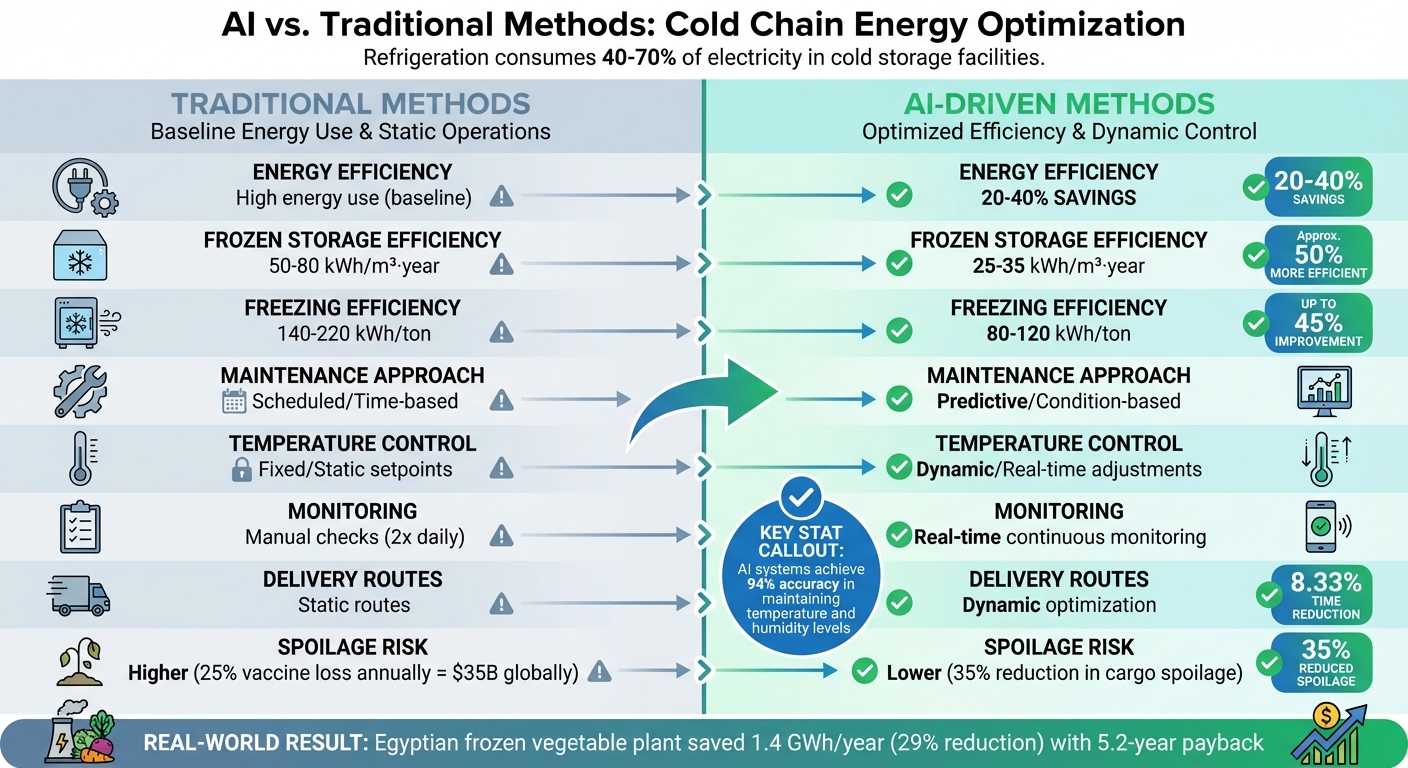
AI vs Traditional Cold Chain Energy Management: Efficiency Comparison
Fixing the Cold Chain Energy Gap: Ndustrial’s Three Million Dollar AI Lesson
sbb-itb-bec6a7e
Traditional Energy Management Methods
Cold chain facilities have long depended on established practices that focus on fixed controls, scheduled interventions, and manual oversight. However, these methods often leave a notable amount of potential energy savings untapped.
Manual Monitoring and Fixed Temperature Controls
In many cold storage warehouses, temperatures are manually checked twice a day. This provides only brief snapshots of conditions rather than continuous oversight. As the CDC explains:
"Thermostats are marked in various ways and, in general, show levels of coldness rather than temperatures. The only way to know the temperature where vaccines are stored is to measure and monitor it."
This approach comes with several limitations. Fixed temperature setpoints - commonly set at 5°F or -0.4°F - fail to account for product-specific requirements or changes in ambient conditions. Even minor adjustments, like tightening the temperature by 1–2°C, can increase energy consumption by 3–6%. Additionally, fixed-speed compressors suffer from inefficiencies caused by frequent start-stop cycles.
Manual processes also introduce risks of human error and missed issues. For example, an overnight power outage that temporarily raises storage temperatures could go unnoticed if conditions stabilize before the next scheduled check. Disruptive Technologies highlights the inefficiency of this method:
"The traditional method of manually monitoring refrigeration units is inefficient and inaccurate. Factoring in the ongoing labor shortage, it is also becoming increasingly unsustainable."
The consequences are significant. Roughly 25% of vaccines are lost each year due to cold chain failures, resulting in global losses of $35 billion. Beyond these errors, rigid maintenance schedules and static delivery routes further contribute to wasted energy.
Scheduled Maintenance and Static Delivery Routes
Challenges extend beyond monitoring. Static maintenance schedules and delivery routes also hinder energy efficiency. Maintenance is often performed at fixed intervals - quarterly, semi-annually, or annually - without considering the actual condition of equipment. This time-based approach can overlook real-time issues like refrigerant leaks, faulty door seals, or malfunctioning defrost timers, all of which waste energy until the next scheduled service.
Similarly, delivery routes are planned in advance and do not adjust to real-time factors such as traffic, weather, or changing delivery windows. Since refrigeration units must run continuously during transit, delays directly increase fuel consumption. In areas with aging infrastructure, this rigidity can lead to food loss rates as high as 20–30% during transportation.
These outdated practices also create fragmented data. Information is often confined to specific segments of the supply chain, preventing operators from gaining a comprehensive view of energy performance. Without integrated monitoring across storage and transit, addressing inefficiencies becomes a much harder task.
AI-Driven Energy Optimization Techniques
AI is changing the game for cold chain logistics by replacing outdated manual oversight and static controls with proactive, data-driven precision. Instead of reacting to equipment failures or temperature issues after the fact, AI systems continuously monitor and analyze sensor data to predict and address problems before they escalate. These systems also adjust operations automatically, ensuring smoother and more efficient processes.
Predictive Analytics and Real-Time Monitoring
Traditional passive data loggers are being replaced by AI-powered, real-time monitoring systems. These systems use sensors to track key metrics like temperature, humidity, and compressor performance, feeding the data into algorithms that detect early warning signs of mechanical issues.
Take the example of a North American seafood distributor that was losing 4% of its annual revenue due to spoilage. In March 2026, the company upgraded its fleet with IoT sensors and an AI-based monitoring platform. During one cross-country trip, the system identified a slow coolant leak and predicted a total refrigeration failure within three hours. The AI rerouted the driver to a partner facility just 45 minutes away, preventing spoilage. Over a year, this system cut cargo spoilage by 35% and saved the company $4.2 million.
Advanced systems using Long Short-Term Memory (LSTM) networks and Particle Swarm Optimization (PSO) take things further by forecasting energy needs and managing equipment schedules. These systems can remotely adjust settings like thermostats or trigger defrost cycles without requiring driver input, achieving 94% accuracy in maintaining temperature and humidity levels. This approach results in energy savings ranging from 20% to 36% compared to older fixed-control methods.
Dynamic Route Optimization
AI also improves efficiency through dynamic routing. Unlike static routes, which can’t adapt to real-time changes, AI-powered systems continuously calculate the quickest and most fuel-efficient paths by factoring in traffic, weather, and delivery windows. Every minute saved in transit reduces energy use and fuel consumption.
Transportation accounts for around 30% of total cold chain energy usage. AI-driven routing not only shortens travel times by an average of 8.33% but also minimizes unnecessary idling, easing the strain on refrigeration systems. In emergencies, AI can identify the closest cold storage facility and reroute vehicles to protect perishable goods.
Machine Learning for Temperature Control
Machine learning takes temperature control to a new level by replacing static settings with dynamic adjustments. Using fuzzy control algorithms, these systems fine-tune refrigeration power in real time based on factors like ambient temperature and the condition of the cargo. This eliminates the energy-wasting start-stop cycles typical of traditional systems.
The shift to active prediction is transforming cold chain operations. As Maksim Rudzenka, an AI Supply Chain Specialist, puts it:
"A fluctuation of just two degrees - known as a temperature excursion - can render an entire shipment of pharmaceuticals useless, resulting in millions of dollars in losses."
Machine learning prevents these costly temperature excursions by catching minor system issues before they escalate. With two-way IoT connectivity, AI platforms can directly adjust settings without waiting for human intervention. This precision is crucial, especially when you consider that roughly 20% of global vaccines are damaged due to failures in traditional cold chain systems.
These AI-powered techniques tackle the inefficiencies of manual monitoring, fixed controls, and static routing head-on. The result? Improved energy efficiency, reduced spoilage, and more reliable cargo protection.
AI vs. Traditional Methods: Side-by-Side Comparison
This comparison highlights how AI-driven systems outperform traditional methods in energy efficiency and operational effectiveness.
Key Metrics Comparison Table
The numbers speak for themselves when comparing AI-driven systems to traditional cold chain energy management methods. Here's a breakdown of how they measure up across essential metrics:
| Metric | Traditional Methods | AI-Driven Methods |
|---|---|---|
| Energy Savings | Baseline (High Intensity) | 20–40% reduction in electricity |
| Frozen Storage Efficiency | 50–80 kWh/m³·year | 25–35 kWh/m³·year |
| Freezing Efficiency | 140–220 kWh/ton | 80–120 kWh/ton |
| Maintenance Approach | Scheduled/Time-based | Predictive/Condition-based |
| Temperature Control | Fixed/Static setpoints | Dynamic/Real-time adjustments |
| Spoilage Risk | Higher due to manual lag | Lower due to stable, automated control |
| Adaptability | Reactive; manual rerouting | Proactive; uses digital twins for simulations |
Performance Analysis
The table above highlights how AI-driven systems deliver measurable benefits across key operational metrics.
For instance, AI systems can reduce energy consumption by 20%–40%, with some applications achieving up to 36% savings. Considering refrigeration typically accounts for 40%–70% of electricity use in cold storage facilities, these reductions translate into significant cost savings.
Real-world examples underscore these advantages. Between 2022 and 2024, a frozen vegetable plant in Egypt upgraded its 1.8 MW refrigeration system with AI tools like condenser optimization and floating head pressure controls. The result? Electricity savings of 1.4 GWh per year - a 29% reduction - with a payback period of just 5.2 years. Similarly, a dairy processing facility in Wisconsin implemented an AI-driven ammonia/CO₂ cascade system in 2024. This system cut boiler fuel use by 2.3 GWh annually and reduced electricity consumption by 18% compared to a traditional HFC setup.
Traditional systems, on the other hand, often struggle with inefficiencies. Fixed-speed compressors, for example, experience frequent start-stop cycles, leading to energy waste. Adrian Dickison explains the shift brought by AI:
"The integration of machine learning, digital twins, and smart analytics enables continuous optimisation... helping move beyond traditional time-based maintenance and advisory platforms to practical, data-driven control solutions".
AI-driven solutions also enhance supply chain performance. They can improve service levels by 65% while cutting logistics costs by 5%–20%. Additionally, AI minimizes spoilage risks through constant monitoring. This is critical when you consider that a single four-hour power outage at a major food distribution center could result in $2 million to $3 million in spoiled inventory.
Traditional systems often waste energy by maintaining overly tight temperature setpoints. For example, tightening temperature controls by just 1–2°C (2–4°F) beyond actual needs can increase energy use by 3%–6%. AI systems avoid this waste by dynamically adjusting settings based on real-time conditions instead of fixed assumptions.
These operational gains make AI-driven solutions a compelling option for small and medium-sized enterprises aiming to enhance their cold chain processes.
How SMEs Can Implement AI Solutions
For small and medium-sized enterprises (SMEs) looking to tap into AI's benefits, the journey begins with setting up the right hardware - such as sensors and edge computing devices - and pairing it with advanced software platforms. This combination can unlock real-time insights and improve energy usage during operations.
Sensor Integration and Edge Computing: The Foundation
To implement AI in cold chain logistics, start with hardware that gathers real-time data. This includes IoT sensors capable of tracking key factors like temperature, humidity, vibration, power consumption, and compressor performance. Reliable connectivity is essential, too. Using 4G/5G cellular modems or satellite telemetry ensures uninterrupted data flow, even when vehicles are on the move in remote locations.
Edge devices play a major role by enabling decisions to be made instantly on-site. For instance, AI can adjust thermostats or trigger defrost cycles locally without relying on cloud-based systems. Neuromorphic edge AI, a cutting-edge option, uses up to 99% less power than traditional AI systems, extending battery life significantly and reducing maintenance costs. This kind of localized processing not only speeds up response times but also minimizes risks like temperature fluctuations that could spoil goods.
Moving beyond basic tools like passive USB loggers, SMEs should consider cloud-connected data infrastructure. Platforms that connect temperature data with transport management systems, ERPs, and maintenance logs can eliminate information silos and streamline operations. However, before diving into AI tools, it’s crucial to assess your data readiness. As Cold Chain SA explains:
"The sophisticated data infrastructure that banking accumulated over 40 years of computerisation doesn't exist in cold chain operations that were running fax machines and carbon-copy waybills in the 1990s".
This lack of data maturity is a common hurdle. A 2025 survey revealed that 92% of operations and supply chain leaders felt their technology investments hadn’t delivered the expected results, often due to poor data foundations.
Leveraging AI Tool Directories for Simplified Adoption
Software solutions can make AI adoption easier for SMEs, especially when paired with the right guidance. Platforms like AI for Businesses (https://aiforbusinesses.com) offer curated directories of AI tools tailored for SMEs and scale-ups. These resources can help businesses find pre-vetted tools to streamline operations and drive transformation.
To start, focus on manageable applications with clear benefits, like route optimization or predictive maintenance, before moving on to more advanced systems. Opt for "plug-and-play" solutions that integrate seamlessly with your current setup instead of requiring costly infrastructure upgrades. It’s also wise to allocate 30–50% of your project budget to data integration and cleaning, as AI’s effectiveness depends heavily on data quality. For smaller businesses, a well-designed dashboard with real-time alerts can provide up to 80% of AI’s value while costing just 10% of a full-scale system.
Conclusion
AI-driven optimization addresses the inefficiencies of manual monitoring and static controls, offering a way to tackle past challenges while utilizing real-time data for better outcomes. While traditional methods like manual monitoring and fixed temperature settings have been the industry standard for years, they simply can’t match the precision and adaptability that AI brings. The numbers speak for themselves - AI-powered systems significantly outperform conventional approaches, streamlining operations and creating opportunities for small and medium-sized enterprises (SMEs) to tap into these advancements.
For SMEs, the key to success lies in careful planning and preparation. AI implementation can lead to noticeable energy and cost savings, but only if the groundwork is properly laid. This includes building a solid data infrastructure and addressing any basic physical issues before introducing advanced AI tools.
Looking ahead, the businesses that fully embrace AI in their cold chain processes will gain a competitive advantage. With refrigeration accounting for 40–70% of electricity use in cold storage facilities, even minor efficiency improvements can translate into significant savings. As Adrian Dickison, Technical Fellow at Beca Ltd., aptly puts it:
"Improving energy efficiency in these systems is not only a matter of economic necessity but also a key driver for sustainability and climate action".
The future of cold chain logistics will revolve around innovations like digital twins, continuous commissioning, and dynamic grid-responsive systems. Companies that act now will position themselves to thrive in a market that increasingly values efficiency and environmental responsibility.
FAQs
What data do I need before using AI for cold chain energy savings?
To make the most of AI for cutting energy costs in cold chain operations, start by collecting detailed data from your refrigeration and logistics systems. This includes IoT sensor readings like temperature, equipment performance stats, and operational details such as defrost cycles and door openings. Alongside this, gather information about your current energy consumption, system configurations, and historical performance records. This comprehensive dataset allows AI algorithms to identify patterns and deliver actionable insights to improve energy efficiency.
How quickly can AI pay for itself in a cold storage facility?
AI has the potential to cover its costs within 12 to 24 months in a cold storage facility. This is mainly achieved through reduced energy expenses and streamlined operations. Studies focusing on ROI in cold chain logistics and warehousing consistently show these benefits, proving AI to be a smart investment for cutting energy consumption and boosting efficiency.
Can SMEs add AI without replacing existing refrigeration equipment?
SMEs can incorporate AI into their cold chain operations without the need to replace their current refrigeration equipment. Technologies like predictive maintenance and smart analytics can improve efficiency by optimizing system performance and identifying potential issues before they escalate. These AI solutions are designed to complement existing systems, offering energy savings and operational enhancements without requiring a complete equipment upgrade.