AI is changing how businesses handle social media customer support. Here’s what you need to know:
- Faster Responses: AI tools like chatbots provide 24/7 support, answering common questions in seconds and reducing response times by up to 55%.
- Cost Savings: AI-driven interactions cost as little as $1 per conversation, compared to $6 for traditional phone support.
- Improved Customer Experience: Sentiment analysis detects issues early, while unified data ensures consistent service across platforms.
- Global Reach: AI supports over 95 languages, addressing the challenges of multilingual communication.
- Enhanced Efficiency: AI reduces agent workloads by automating repetitive tasks and offering real-time assistance.
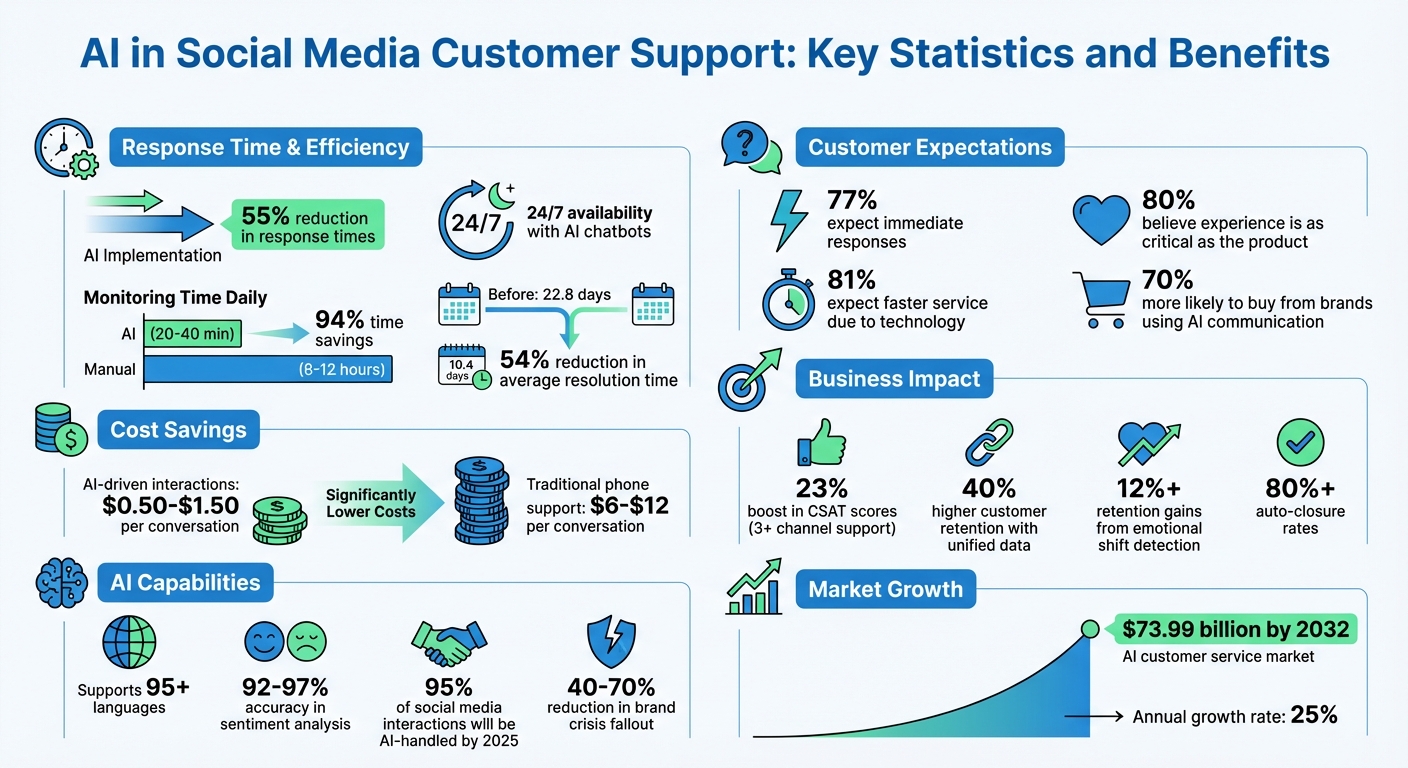
AI in Social Media Customer Support: Key Statistics and Benefits
Main Challenges in Social Media Customer Support
Social media support comes with its own set of hurdles, especially since 77% of customers expect immediate responses, and 80% believe the experience is just as critical as the product itself [3]. The public nature of these platforms only raises the stakes.
Managing High Volumes and Fast Response Expectations
Handling the sheer number of messages pouring in from various platforms can overwhelm even the most seasoned support teams. 53% of social media marketers admit they feel swamped by the need to monitor multiple platforms at once [3]. Unlike email or phone support, where interactions are private and linear, social media demands real-time attention across platforms like Facebook, Instagram, X, and WhatsApp.
The challenge is compounded by 81% of customers expecting faster service, thanks to advancements in technology [3]. A delay in response risks losing not just one customer but potentially many others observing the interaction. Companies like Bank of America tackle this by personalizing Instagram replies, including the representative's name to make the interaction feel more human, even at scale [3]. Meanwhile, Spotify uses its dedicated @SpotifyCares handle on X to proactively share updates about technical issues, reducing the influx of individual queries before they even arise [3].
Handling Multiple Languages and Maintaining Consistency
For global brands, supporting customers in their preferred language while maintaining consistent messaging is another big challenge. Different regions gravitate toward different platforms - 95% of social media users in Japan rely on LINE, while WhatsApp dominates in Europe and Latin America [3].
Relying on manual translations or makeshift glossaries often leads to inconsistent communication. Literal translations can distort the intended message, and when customers can't express themselves in their native language, details get lost. This often results in frustrating back-and-forth exchanges. Hiring native speakers for every market may seem like the ideal solution, but it’s expensive and impractical. On the other hand, manual translations are too slow to meet the expectation of responses within an hour.
Brand Damage from Slow or Poor Responses
A delayed or dismissive response - or worse, no response at all - doesn’t just affect one customer; it sends a clear message to everyone watching. The fallout can be swift and damaging, as negative publicity spreads rapidly, eroding trust across your audience.
"80% of people say the experience a brand offers is just as important as its products or services." - Salesforce [3]
Attempting to delete complaints often backfires, making brands appear defensive or untrustworthy. Every unanswered question or mishandled issue becomes a public misstep. On the flip side, when brands respond effectively and publicly, they build trust not just with the individual customer but with everyone observing the interaction.
These challenges highlight the increasing need for smarter tools and strategies to keep up with customer expectations. AI-powered tools, for instance, offer ways to streamline responses while improving the overall quality of support across diverse platforms.
sbb-itb-bec6a7e
How AI Addresses Social Media Support Problems
AI tools are transforming social media support by tackling challenges like high workloads, the need for quick responses, and maintaining consistency. These solutions help support teams manage their tasks more effectively without sacrificing quality.
AI Chatbots for Continuous Availability
AI chatbots are a game-changer when it comes to managing large volumes of inquiries quickly. They provide 24/7 support, handling routine questions like order tracking, return policies, or account resets in just seconds. This allows human agents to focus on more complex problems. During busy times - such as viral moments or peak seasons - chatbots take on the heavy lifting, ensuring human teams don’t get overwhelmed [4].
Implementing AI has been shown to cut response times by up to 55% [4]. Chatbots can even detect and respond in the customer’s language, making them ideal for global audiences. For businesses just starting with AI, simple rule-based bots on platforms like Facebook or X are a good entry point for managing basic FAQs [4].
Sentiment Analysis for Early Problem Detection
AI uses natural language processing to monitor social media posts, classifying them as positive, neutral, or negative with impressive accuracy - between 92% and 97% [5]. It can identify signs of customer frustration, purchase intent, or potential churn in real time. When frustration spikes, AI sends alerts, enabling human agents to step in before issues escalate [5][6].
This proactive approach can reduce the fallout from brand crises by 40% to 70%, compared to manual monitoring [5]. Critical alerts can reach support or PR teams in under five minutes, and systems that catch emotional shifts have been linked to retention gains of over 12% [6]. On top of that, AI monitoring slashes daily effort from 8–12 hours to just 20–40 minutes - a 94% time savings [5].
Unified Customer Data Across Channels
AI ensures consistency across platforms by unifying customer interactions from WhatsApp, Instagram, X, TikTok, email, and more. This means customers don’t have to repeat their stories, as agents can access everything from order details to CRM records instantly [7]. AI also adapts its tone to suit each platform - casual for Instagram, concise for SMS - while maintaining a consistent brand voice [7].
Brands offering support on three or more channels see a 23% boost in Customer Satisfaction (CSAT) scores. Companies that unify cross-channel data enjoy 40% higher customer retention rates [7]. The cost savings are also notable: AI agents resolve issues for just $0.50 to $1.50 per conversation, compared to $6 to $12 for human agents [7]. By 2025, AI is projected to handle 95% of all customer interactions on social media [2].
These advancements not only simplify support operations but also set the stage for improving agent efficiency, as we’ll explore next.
Using AI for Better Data and Agent Performance
AI enhances customer insights and simplifies agent workflows by analyzing social media data and offering real-time guidance.
Analyzing Patterns in Customer Interactions
AI can sift through billions of conversations to reveal recurring themes, common complaints, and emerging trends [4][1]. With natural language processing (NLP), it identifies subtle emotions and intents while filtering out spam and irrelevant content. This ensures teams can focus on the most critical signals [4][8][1]. By doing so, teams can prioritize responses based on urgency, the influence of the customer (like influencer status), and the complexity of the issue [4][8][1].
Take Sprout Social as an example. In early 2026, the company adopted a centralized AI strategy using tools like Smart Inbox and automated tagging. By training agents to use AI-assisted tagging and optimizing staffing during predicted busy periods, they achieved impressive results: a 37% increase in tag rates and a 55% reduction in average time-to-action during targeted care periods [4].
These insights help agents focus their efforts where they’re needed most, making their work more efficient and impactful.
Supporting Agents with Real-Time Assistance
AI doesn’t just analyze data - it actively supports agents by summarizing conversations, drafting compliant responses, and organizing case details. This reduces the mental strain on agents and speeds up problem resolution [10][12]. By cutting down on context switching, AI improves efficiency and minimizes errors [10]. AI-native platforms go a step further by unifying data from CRMs, billing systems, and social channels into one workspace, eliminating the need for agents to juggle multiple tools [10][11].
A great example is Descope, an authentication platform. In 2025, they managed to slash their average resolution time by 54%, dropping from 22.8 days to just 10.4 days. By integrating platforms to unify tickets, knowledge, and workflows, agents were able to quickly identify and resolve issues [11].
"AI works best as a multiplier, not a replacement. Teams get better results when AI handles first drafts, analysis, and optimization, while humans provide strategy, voice, and final review" [9].
Finding AI Tools Through AI for Businesses
Once you've improved agent performance with AI, the next step is picking the right AI writing tools for efficient social media support. With so many options out there, it can feel like a daunting task to balance features, pricing, and your team's unique needs. That’s where AI for Businesses steps in. This platform simplifies the process by offering a curated directory tailored to small and medium-sized enterprises (SMEs) and scale-ups. Instead of wading through endless choices, you get access to pre-vetted tools designed to tackle challenges like handling high volumes, managing multilingual interactions, and reducing response times. Many companies are also using AI for proactive support to anticipate customer needs before they arise.
Tools for Social Media Support
The directory showcases tools that are laser-focused on solving common social media support issues. For example:
- Writesonic: Delivers fast, high-quality text responses in over 25 languages, helping businesses maintain a consistent brand voice across the globe [19].
- Stability.ai: Generates custom visuals from text prompts, perfect for creating personalized graphics when words aren’t enough [18].
Beyond these, the directory features platforms that consolidate messages from channels like X (Twitter), Instagram, WhatsApp, and Facebook into a single inbox [13][17]. These tools come equipped with AI agents that understand slang, sarcasm, and even memes. This means they can filter out noise and focus on urgent customer concerns [13]. Advanced features include:
- Auto-routing: Instantly directs billing questions to finance or technical issues to engineering.
- Multilingual support: Handles communication in over 95 languages [13][16].
These capabilities lead to impressive results, such as 50% faster response times and auto-closure rates exceeding 80% [13].
Pricing Options for Different Business Sizes
AI for Businesses offers flexible pricing plans to suit companies of all sizes:
- Basic Plan: Free access to explore the directory and find tools that match your needs.
- Pro Plan: For $29/month, this tier unlocks full access to all features, including curated insights and priority support. It’s ideal for growing teams ready to scale their AI efforts.
- Enterprise Plan: Custom pricing for larger organizations, offering tailored integrations and dedicated support.
Individual tools in the directory also cater to varying budgets. For instance:
- BizReply: Starts at $59/month for 100-200 AI-generated replies [14][15].
- SmallForce: Offers a free-to-start plan with no credit card required [17].
This flexibility ensures that businesses can adjust their tools and costs as their support needs expand.
Conclusion
AI has reshaped social media customer support, making response times almost instantaneous, improving satisfaction levels, and driving the industry toward AI managing the majority of interactions by 2025 [2][4]. Businesses using AI-powered case management have reported a 55% drop in average response times during peak hours [4]. At the same time, 70% of consumers are more inclined to buy from brands that use AI-driven communication [2].
What makes AI stand out is more than just speed. It provides round-the-clock availability, supports multiple languages, and uses sentiment analysis to proactively detect and address issues before they escalate [4]. This approach allows support teams to focus on complex, high-stakes problems that require human judgment and empathy. The result? A hybrid system where AI manages repetitive tasks while human agents tackle challenges that demand creativity and strategic thinking [20][21].
For small and medium-sized businesses, the real hurdle isn’t deciding whether to adopt AI - it’s finding affordable AI tools that fit their budgets. Platforms like AI for Businesses simplify this process by offering a curated list of pre-approved solutions. Options range from a free Basic plan to a Pro plan at $29/month, ensuring businesses can find tools that align with their specific needs.
The market for AI in customer service is expected to hit $73.99 billion by 2032, with an annual growth rate of nearly 25% [2]. By adopting AI, companies can resolve issues faster, reduce costs, and build stronger customer loyalty. To make the most of this opportunity, businesses should follow an AI integration checklist to review workflows and select scalable tools that support long-term growth.
FAQs
Which social media support tasks should AI handle first?
AI can take on routine tasks such as answering frequently asked questions, managing initial customer inquiries, and conducting sentiment analysis. By doing so, it boosts response times and streamlines efficiency across social media platforms.
How do I keep AI replies on-brand and accurate?
To keep AI-generated responses aligned with your brand and accurate, it's essential to have human oversight. A review process allows you to fine-tune the tone, verify facts, and ensure inclusivity, all while sticking to your brand's guidelines. By setting up a clear system for reviewing content, you can maintain a consistent voice, reduce mistakes, and uphold transparency and ethical practices in data use.
When should a chatbot hand off to a human agent?
When a chatbot encounters complex, sensitive, or unclear issues, it should pass the conversation to a human agent. Examples include billing disputes, security concerns, or legal matters. A transfer is also necessary when:
- The AI's confidence level drops below 40%.
- Negative sentiment is detected in the customer's responses.
- The conversation repeatedly fails to resolve the issue.
These handoffs are key to providing effective and empathetic customer support, ensuring that users feel heard and their concerns are properly addressed.