In 2025, businesses face increasing regulatory challenges, especially in sectors like finance and healthcare. AI compliance tools are stepping in to simplify tasks like monitoring regulations, managing policies, and ensuring governance. Here’s a quick breakdown of the top tools:
- Compliance.ai: Focused on financial services, it automates regulatory updates, connects changes to internal policies, and supports audits with its "Expert in the Loop" feature.
- IONI: Limited public details; businesses must contact the vendor for specifics.
- Theta Lake: Specializes in analyzing communications (text, audio, video) for compliance risks.
- AI for Businesses: Offers a directory of various AI tools, providing flexibility for small and mid-sized businesses.
Each tool has strengths tailored to specific needs, from industry specialization to offering diverse solutions for various challenges. Choosing the right platform depends on your business size, industry, and compliance requirements.
Your guide to AI Compliance in 2025
1. Compliance.ai
Compliance.ai is a platform designed to help U.S. businesses stay on top of regulatory changes using machine learning. It focuses on three main areas: keeping track of regulatory updates, automating policy management, and simplifying governance processes.
Regulatory Monitoring
Compliance.ai takes a proactive approach, automatically scanning the regulatory landscape so businesses don't have to manually sift through countless sources. It pulls information from various regulatory agencies, filters it, and delivers actionable insights. For instance, in the past 30 days, the platform tracked 1,558 enforcement actions in the U.S., reported that the SEC issued over $37 million in enforcements, and noted a 55% decrease in FTC enforcement actions.
Policy Automation
The platform goes beyond just tracking updates. It connects regulatory changes directly to a business's internal policies, procedures, and controls. With its "Expert in the Loop" feature, Compliance.ai identifies regulatory obligations and ensures they align with company policies, making the process more efficient and accurate. The Enterprise Edition offers an integrated system where businesses can manage regulatory changes and internal documentation through user-friendly workflows that automate and standardize the process.
AI Governance
Compliance.ai includes a Regulatory Change Management (RCM) command center, which helps standardize compliance processes and provides continuous oversight. By combining AI with expert reviews, it identifies risks and compliance gaps. This feature also speeds up audits by supplying clear, auditable evidence of compliance, giving businesses a transparent view of their regulatory health.
Integration and Pricing
The platform easily integrates with existing systems via APIs, making regulatory management smoother and more cost-effective. Pricing details are available through a demo, and Compliance.ai also offers a Savings Calculator to estimate potential time and cost savings.
Next, we’ll take a look at IONI, which takes a different approach to AI compliance.
2. IONI
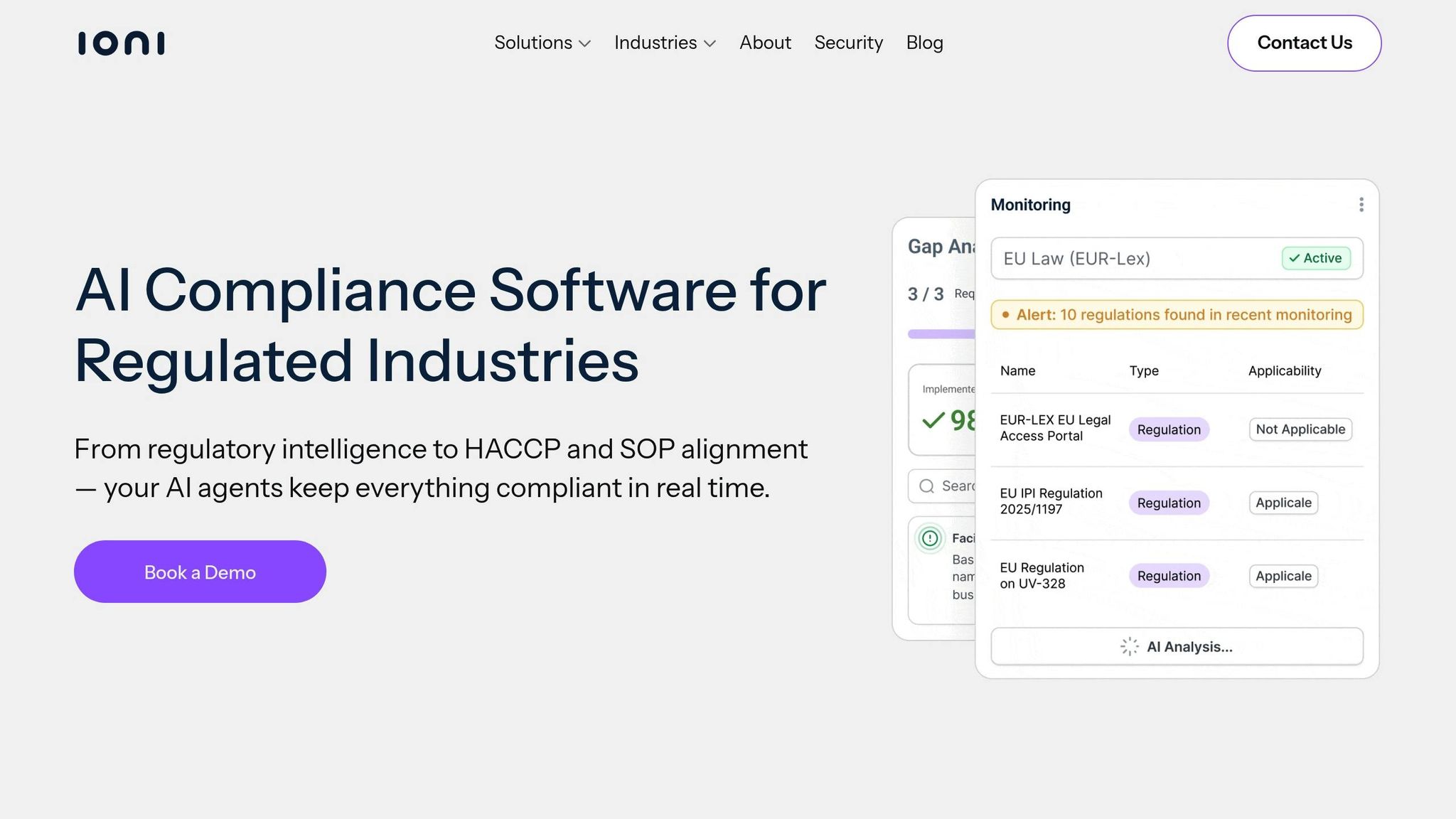
IONI is an AI-driven compliance tool, but public information about its features is sparse. Details on its ability to provide real-time regulatory monitoring or implement AI governance frameworks are not readily available. Similarly, specifics about its tracking of enforcement actions or governance structures remain undocumented. To get a clearer picture of its offerings, businesses will need to reach out to the vendor directly.
Integration and Pricing
When it comes to integration and pricing, IONI keeps things under wraps. There’s no public information about its API compatibility, implementation timelines, or pricing structure. For these details, contacting the company is the only option.
The lack of transparency surrounding IONI serves as a reminder of the importance of choosing compliance tools from vendors that offer clear and detailed information. Next, we’ll take a look at Theta Lake, a solution tailored for compliance in modern communication platforms.
3. Theta Lake
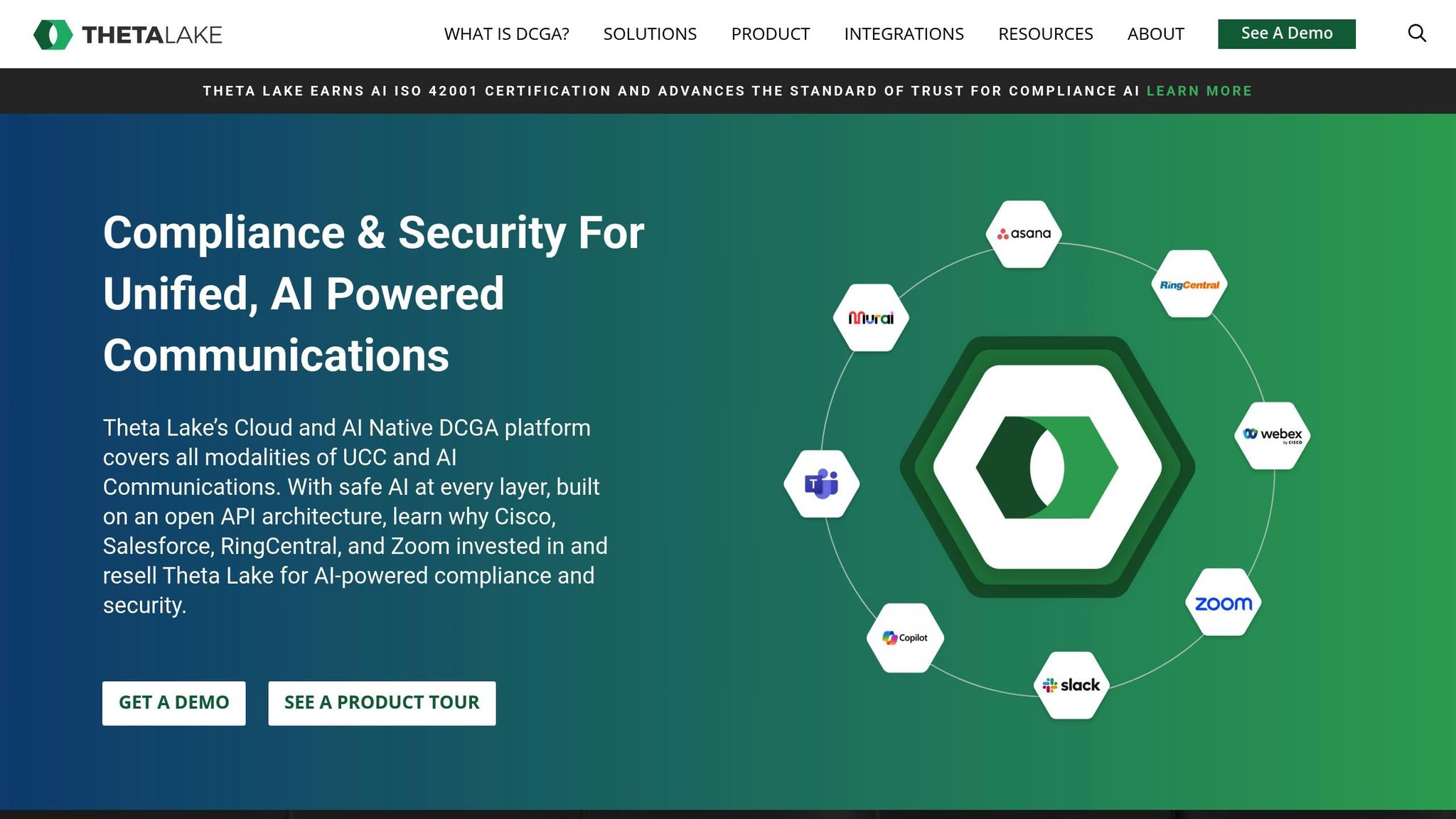
Theta Lake specializes in regulatory monitoring tailored to specific industries. It uses AI to analyze text, audio, and video communications on collaboration platforms in real time, identifying potential compliance risks quickly and efficiently.
Now, let's explore how AI for Businesses takes compliance capabilities to the next level.
sbb-itb-bec6a7e
4. AI for Businesses
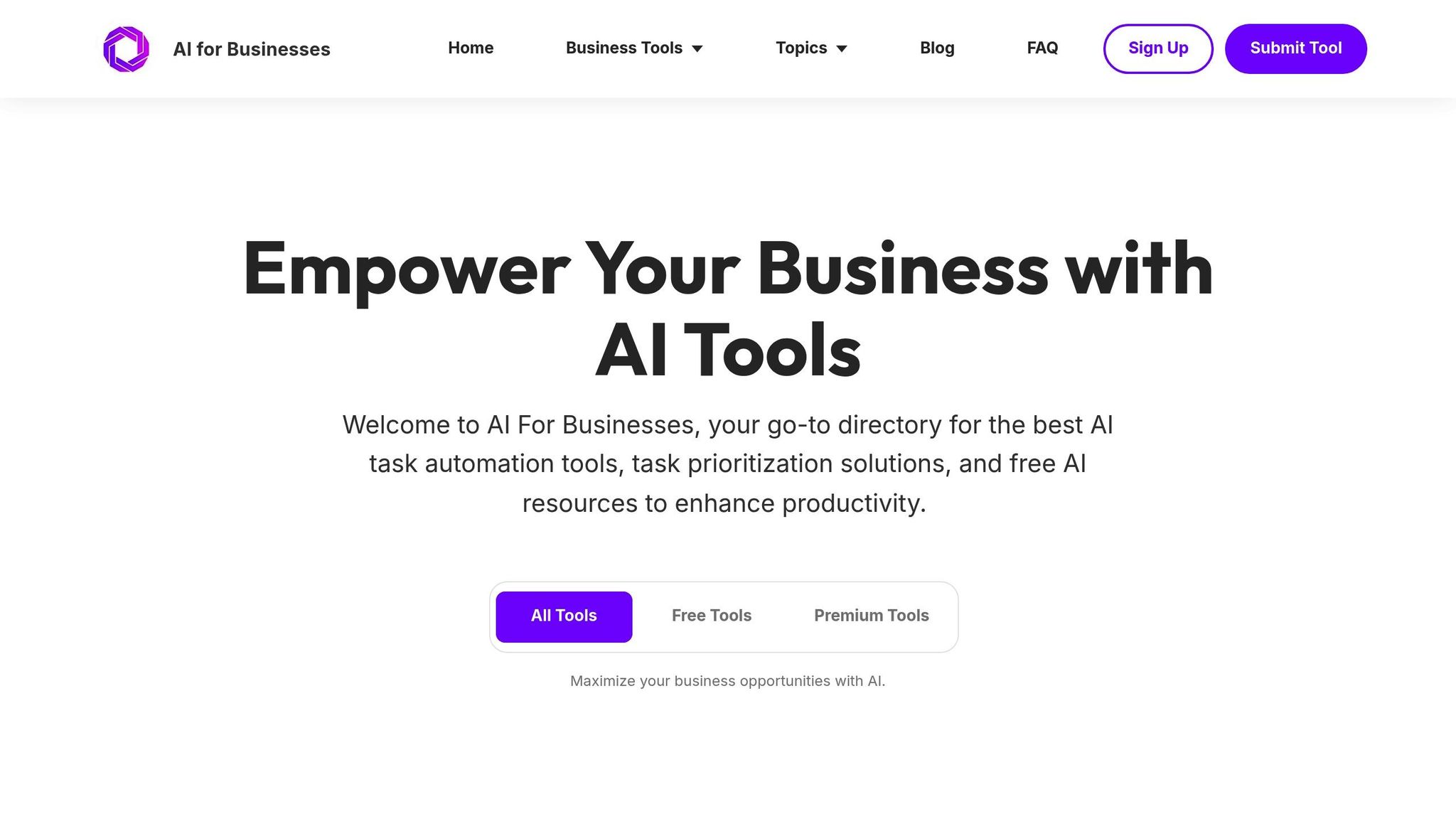
AI for Businesses simplifies the process of finding the right AI tools to meet specific operational challenges. Instead of offering a single solution, it provides a curated directory of AI-powered tools tailored to address various business needs, including regulatory compliance. This approach is particularly beneficial for small and mid-sized enterprises (SMEs) and growing businesses, as it allows them to explore multiple options without being locked into a one-size-fits-all platform.
AI Governance
The platform helps businesses navigate their compliance requirements by offering tools that align with their specific needs. Featured solutions include Looka, Rezi, Stability.ai, and Writesonic, each designed to enhance different aspects of business operations. For more targeted compliance needs, tools like Compliance.ai, IONI, and Theta Lake focus on specific regulatory areas. By presenting a broad selection of tools under one umbrella, AI for Businesses ensures companies can find solutions that address their unique challenges while supporting a wide range of operational goals.
Integration and Pricing
AI for Businesses offers three pricing tiers to accommodate different organizational needs:
- Basic Plan: Free access to a limited selection of tools.
- Pro Plan: Priced at $29/month, this plan includes full access to the platform and priority support.
- Custom Enterprise Solutions: Tailored packages with dedicated support for larger organizations.
This pricing structure makes it easy for businesses to start exploring AI solutions without significant upfront costs. By consolidating a variety of AI tools in one place, the platform simplifies the search for technologies that can enhance efficiency and transform business processes. The flexibility of these plans ensures that organizations of all sizes can find options that align with their goals and budgets, paving the way for further discussion on the platform's strengths and potential areas for improvement.
Advantages and Limitations
Every tool brings its own set of strengths and challenges. The right choice often hinges on factors like the organization's size, industry, and specific regulatory needs.
Compliance.ai is designed specifically for financial services and regulatory change management. Its machine learning models are crafted to automate the tracking and analysis of regulatory updates - an essential feature considering the nearly 200,000 pages of the US Code of Federal Regulations. What sets it apart is its "Expert in the Loop" approach, where human oversight complements automation, ensuring regulatory changes are accurately contextualized. As Kelly Housh, a Consultant at Bremer Bank, puts it:
"Every word makes a difference in regulatory compliance ... so how it applies is very specific to your organization. Having Compliance.ai's software definitely makes my job more efficient."
While Compliance.ai shines in the financial sector, it may not be as effective for industries outside of highly regulated environments. Its specialization delivers powerful tools for banks and financial institutions, but this focus may limit its usefulness elsewhere. This is particularly relevant considering the SEC imposed over $1.3 billion in penalties last year alone.
On the other hand, AI for Businesses offers a broader, more adaptable approach. It provides access to a curated directory of AI tools without locking users into a single vendor. The platform includes a Pro Plan priced at $29/month for full access, while the free Basic Plan allows companies to experiment before committing. However, as a directory rather than a dedicated compliance tool, it lacks a unified system. Organizations must piece together individual tools to create a comprehensive compliance framework.
Addressing the challenges of integration, Richard Dupree, SVP at IHC Group and Operational Risk Manager at Bank of the West, notes:
"Most solutions in the market today are not scalable and still rely on a pull of regulatory content across a multitude of sources, rather than a 'push' of information from a single, reliable source. This is the key value Compliance.ai delivers for banks."
Ultimately, the choice boils down to prioritizing either deep, sector-specific integration or the flexibility to tailor solutions from various tools. Organizations need to assess whether they require an all-in-one platform with specialized capabilities or prefer the freedom to adapt and combine tools as their needs evolve. These decisions directly impact operational efficiency and governance, as highlighted earlier.
| Tool | Key Strengths | Primary Limitations | Best For |
|---|---|---|---|
| Compliance.ai | Real-time monitoring, financial expertise, human oversight | Focused on financial services | Financial institutions and highly regulated sectors |
| AI for Businesses | Wide range of AI tools, flexible pricing, no vendor lock-in | No unified compliance system; requires integration | SMEs and growing businesses exploring compliance options |
Conclusion
Selecting the right AI compliance tool in 2025 hinges on your organization's size, industry, and specific regulatory needs. For financial institutions navigating intricate federal regulations, platforms like Compliance.ai stand out with their real-time monitoring and automation features backed by expert insights. Additionally, consider how often regulations change and the scale of your operations, as these factors can heavily influence your choice.
If your organization requires a more flexible compliance solution, AI for Businesses offers a curated directory approach, making it a strong option for companies that need to respond quickly or work within multiple regulatory environments. This adaptability is particularly useful for businesses operating in diverse or fast-changing industries.
For banking and financial services, timely and accurate regulatory updates are non-negotiable. In such cases, specialized tools with human oversight often outperform general-purpose solutions. On the other hand, businesses in less regulated sectors - or those just beginning to automate compliance - may benefit from cost-effective, flexible tools that are easier to implement and manage.
It's also essential to match your compliance tool to your team's capabilities. For organizations with smaller compliance teams, tools that proactively surface relevant information can save time and reduce manual effort. Companies experiencing growth or evolving needs might prefer modular platforms that allow for scaling without requiring a complete system overhaul.
FAQs
What should I look for in an AI compliance tool for my business in 2025?
When selecting an AI compliance tool for your business in 2025, it's essential to focus on features that meet both current and evolving regulatory demands while addressing your organization's specific needs. Tools with real-time monitoring, automated reporting, and customizable compliance frameworks are particularly valuable, as they can adjust to the unique rules of your industry.
Equally important are features like strong data security, comprehensive audit trails, and the ability to integrate seamlessly with your existing systems. These capabilities not only simplify compliance workflows but also minimize manual tasks and help you stay proactive in navigating regulatory updates.
What is Compliance.ai's 'Expert in the Loop' feature, and how does it improve regulatory compliance?
Compliance.ai's Expert in the Loop feature takes regulatory compliance to the next level by blending cutting-edge AI with the insight of human expertise. This combination ensures that the AI efficiently identifies and analyzes relevant regulations, while human specialists step in to validate and tailor the results to meet a business's unique needs.
With this approach, organizations can minimize errors, stay current with changing regulations, and make smarter decisions. It's especially useful for industries dealing with intricate or rapidly shifting compliance demands, providing both improved efficiency and confidence in navigating regulatory landscapes.
What are the advantages of using a curated directory like AI for Businesses to meet regulatory compliance needs?
Using a directory like AI for Businesses can be a real time-saver. It offers a handpicked selection of AI tools designed to meet specific needs, such as regulatory compliance. Instead of wading through endless options, you’ll find solutions that are already vetted and aligned with your business objectives.
This method helps you discover tools that not only meet compliance requirements but also streamline operations. It’s a practical way to stay prepared for shifting regulations as we move into 2025 and beyond.