Cloud-based ETL (Extract, Transform, Load) simplifies how businesses handle data. It gathers information from different sources, cleans it, and sends it to a central system like a data warehouse. For small and medium-sized businesses (SMEs), this is a game-changer because it reduces costs, speeds up setup, and eliminates the need for large data teams. By 2026, 90% of business analytics will rely on cloud services, making this technology critical for staying competitive.
Key Takeaways:
- Cost Efficiency: Pay-as-you-go pricing avoids expensive upfront costs.
- Ease of Use: Modern tools offer drag-and-drop interfaces, reducing reliance on engineers.
- Scalability: Automatically adjusts to data spikes, perfect for busy seasons like Black Friday.
- Security: Top providers offer strong compliance measures like SOC 2, GDPR, and HIPAA.
- Challenges: Watch out for cost unpredictability, skill gaps, and internet dependency.
Recommended Tools:
Some of the best options for SMEs include:
- Integrate.io: Fixed pricing, great for mid-sized teams ($1,999/month).
- Hevo Data: Real-time syncing, starts at $239/month.
- Fivetran: Automated, usage-based pricing (~$1,000/month).
- Skyvia: Budget-friendly, starts at $79/month.
Pro Tip: Test tools using free trials to match your needs before committing. Focus on features like pre-built connectors, automated schema handling, and real-time monitoring.
Cloud-based ETL is a smart way for SMEs to manage their data without breaking the bank or overloading their teams. Whether you're syncing Shopify sales or analyzing customer behavior, the right tool can make your data work for you.
The Cloud-Based ETL Revolution You Can’t Ignore 🛠️
Benefits and Challenges of Cloud-Based ETL
Following our introduction to cloud ETL basics, let’s dive into its practical benefits and the challenges SMEs might face when adopting this technology.
Main Benefits for SMEs
One of the most attractive features of cloud-based ETL is its cost structure. Instead of sinking money into expensive hardware that may become obsolete, SMEs can benefit from pay-as-you-go pricing. This shift from capital expenditure (CapEx) to operating expense (OpEx) means businesses only pay for what they use. In fact, 76% of SMEs have reported saving money after moving to cloud solutions.
Another standout feature is scalability. Cloud ETL platforms can automatically handle fluctuations in demand. For instance, during high-traffic events like Black Friday or end-of-quarter reporting, your system scales up to meet the demand and then scales back down during quieter periods. This flexibility eliminates the need for idle servers or last-minute capacity upgrades. AWS Glue, for example, offers 99.9% monthly uptime, ensuring your data pipelines remain operational without requiring in-house infrastructure management.
Maintenance is another area where cloud ETL simplifies life for SMEs. Tasks like applying security patches and software updates are handled by the provider. This is a game-changer for smaller teams that lack dedicated data engineering resources. Consider this: maintaining legacy platforms might require 30 to 50 engineers, but cloud ETL allows even small teams to build and manage complex workflows using user-friendly interfaces and pre-built connectors.
Security is often better than what SMEs could achieve on their own. Leading cloud platforms invest heavily in compliance standards like SOC 2, HIPAA, and GDPR. They also offer robust features like encryption (both at rest and in transit), two-factor authentication, and centralized access controls. For many SMEs, replicating this level of security in-house would be both costly and difficult. It’s no surprise that 61% of chief information security officers believe the cloud is as secure - or more secure - than on-premises systems.
Common Challenges for SMEs
While the benefits are compelling, cloud ETL isn’t without its challenges - especially for smaller businesses.
Cost unpredictability can be a stumbling block. Pay-as-you-go pricing sounds great, but unexpected data spikes can lead to surprise bills. For example, a successful marketing campaign that doubles your customer data or a new integration that pulls large amounts of historical data could inflate your costs significantly.
Another hurdle is the skill gap. Many cloud ETL tools require coding knowledge, often in languages like Python or Java. Even low-code platforms come with a learning curve, and without dedicated data engineers, SMEs may need to rely on business analysts or IT staff to manage ETL processes alongside their regular responsibilities. Abe Dearmer from Integrate.io sums it up well:
"Using a tool that requires constant coding and engineering resources can be an expensive, long-term problem".
Integration complexity is another challenge. Data often comes in different formats - JSON from APIs, CSV from spreadsheets, XML from older systems - and when source systems update their structures, pipelines can break. Without tools that automatically adapt to these changes, troubleshooting failed data loads can become a time-consuming task. Additionally, 48% of SMEs cite high initial implementation costs, and 45% view data security risks as a key barrier to adoption.
Lastly, there’s the issue of internet dependency. Unlike on-premises systems, cloud ETL relies entirely on a stable internet connection. If your network goes down, so does your ability to move and process data. To mitigate this, SMEs need redundant connections and contingency plans to maintain continuity during outages.
What to Look for in Cloud-Based ETL Tools
Now that you’re familiar with the perks and challenges of cloud ETL tools, let’s dive into what truly matters when selecting the right one for your business.
Must-Have Features for SMEs
Ease of use should be at the top of your list. If your team lacks dedicated data engineers, go for tools with user-friendly interfaces, like drag-and-drop functionality and visual data mapping. As Charles Wang from Fivetran explains:
"The point of an ETL tool is to avoid coding. The advantages of ELT and cloud computing are significantly diminished if you have to involve skilled DBAs or data engineers every time you replicate new data".
Pre-built connectors are another key feature. Your ETL tool should integrate seamlessly with the tools you already rely on - think CRMs like Salesforce or HubSpot, accounting systems like QuickBooks, or e-commerce platforms like Shopify. For example, Fivetran offers over 700 pre-built connectors, Skyvia supports more than 200, and Portable boasts over 1,000 connectors designed for niche sources. The more connectors available, the quicker you can get started without needing custom integrations.
Automated schema management is crucial to avoid pipeline breakdowns when source data changes. Tools that handle schema drift automatically save you from manually troubleshooting issues. Modern ELT tools excel in this area, showing a 95% reduction in pipeline failures and a 75% cut in query times compared to traditional ETL approaches.
Scalability is non-negotiable. Your ETL tool should automatically adjust to handle data volume spikes without requiring manual tweaks or server upgrades. Iryna Bundzylo from Skyvia puts it well:
"Small business doesn't mean small data anymore... Pick the right ETL tool and you get faster answers, operations that don't fight you, and data clarity that lets you compete with companies ten times your size".
Finally, robust governance and monitoring features are essential to ensure data security, reliability, and cost efficiency.
Governance and Monitoring Features
Beyond the operational must-haves, governance features play a vital role in maintaining data integrity. Automated data quality checks help ensure your information is accurate, complete, and reliable. This includes error correction, duplicate detection, and tracking data lineage to show where your data originated and how it was transformed.
Security and compliance are especially important if you handle sensitive customer data. Look for tools that meet industry standards like SOC 2, GDPR, and HIPAA. Features such as role-based access control (RBAC), field-level encryption (AES-256), and data masking safeguard sensitive information without requiring a specialized security team.
Monitoring dashboards with real-time alerts are a lifesaver for detecting pipeline failures or drops in data quality. Immediate notifications mean you can address issues before they disrupt your operations. This is particularly valuable for SMEs that can’t afford to manually monitor every data flow.
Cost governance is another critical feature. Look for tools with budget alerts, real-time cost tracking, and transparent pricing models. Poor visibility into cloud expenses leads to significant waste - nearly 50% of organizations report that over 25% of their public cloud spend is wasted. Fixed-fee models, like Integrate.io at $1,999/month, provide predictable costs, while usage-based models, such as Stitch starting at $100/month or Fivetran's Monthly Active Rows pricing, scale with your data needs.
sbb-itb-bec6a7e
Best Cloud-Based ETL Tools for SMEs
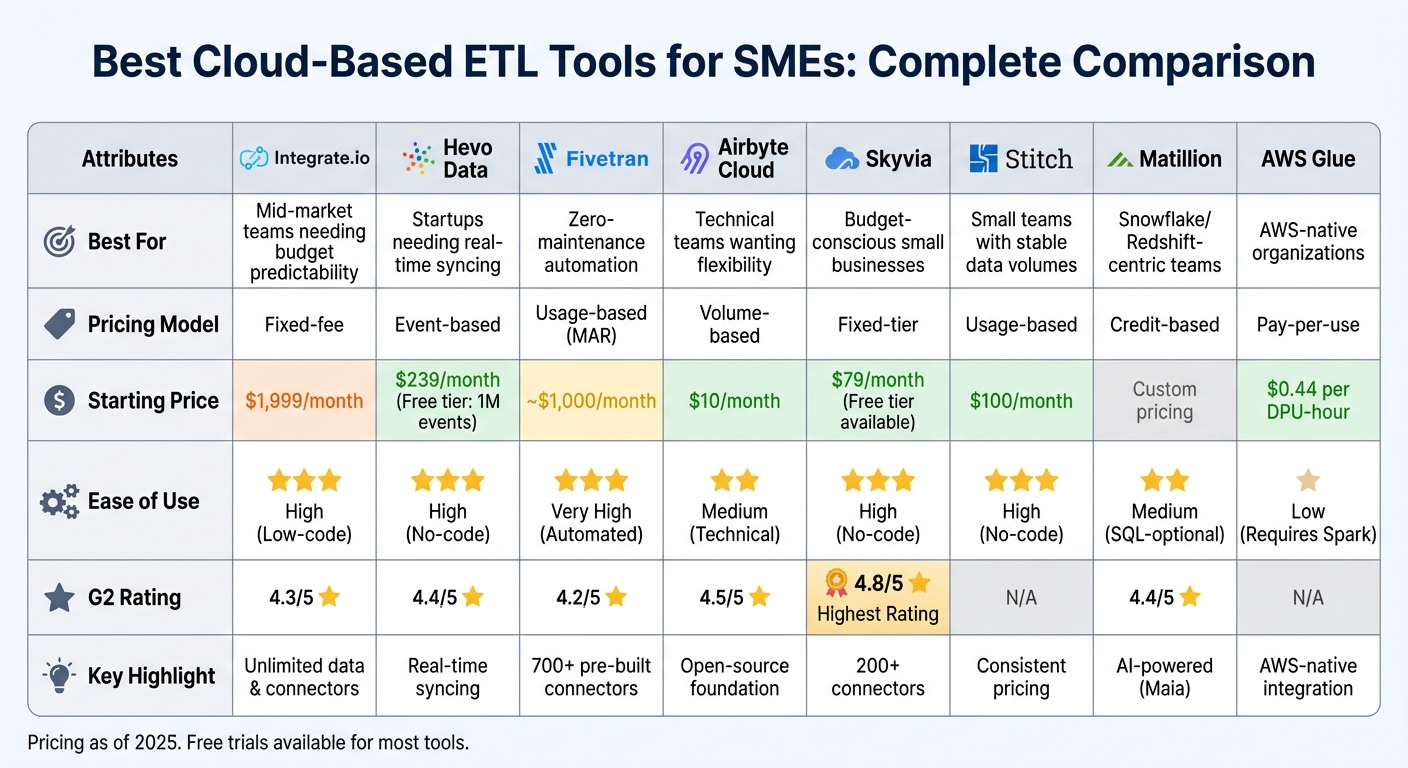
Cloud-Based ETL Tools Comparison for SMEs: Pricing, Features, and Ratings
The ETL market is expected to nearly double by 2030, but small and medium-sized enterprises (SMEs) can still find cost-effective solutions that don’t require massive budgets or large data teams.
Tool Comparison Table
| Tool | Best For | Pricing Model | Starting Price | Ease of Use | G2 Rating |
|---|---|---|---|---|---|
| Integrate.io | Mid-market teams needing budget predictability | Fixed-fee | $1,999/month | High (Low-code) | 4.3/5 |
| Hevo Data | Startups needing real-time syncing | Event-based | $239/month (Free tier: 1M events) | High (No-code) | 4.4/5 |
| Fivetran | Zero-maintenance automation | Usage-based (MAR) | ~$1,000/month | Very High (Automated) | 4.2/5 |
| Airbyte Cloud | Technical teams wanting flexibility | Volume-based | $10/month | Medium (Technical) | 4.5/5 |
| Skyvia | Budget-conscious small businesses | Fixed-tier | $79/month (Free tier available) | High (No-code) | 4.8/5 |
| Stitch | Small teams with stable data volumes | Usage-based | $100/month | High (No-code) | N/A |
| Matillion | Snowflake/Redshift-centric teams | Credit-based | Custom pricing | Medium (SQL-optional) | 4.4/5 |
| AWS Glue | AWS-native organizations | Pay-per-use | $0.44 per DPU-hour | Low (Requires Spark) | N/A |
Detailed Tool Reviews
Integrate.io is a standout choice for mid-market SMEs. Its fixed-fee pricing starts at $1,999/month, offering unlimited data and connectors - ideal for avoiding unexpected costs as data volumes grow. Donal Tobin from Integrate.io highlights its strengths:
"Integrate.io delivers the optimal balance of enterprise-grade capabilities, user accessibility, and cost predictability for mid-market data teams".
It’s particularly effective for e-commerce and SaaS integrations, supporting platforms like Shopify and HubSpot.
Hevo Data caters to startups and small teams that require real-time syncing. It offers a free tier covering up to 1 million events and paid plans starting at $239/month, making it a budget-friendly option. Prudhvi Vasa, Head of Data at a Hevo customer, shares:
"We realized that Hevo provided the best value out of all of them; it had all the features that we wanted at a price that we were comfortable with".
The no-code interface and a high Capterra rating (4.7/5) make it accessible for teams without dedicated data engineers.
Fivetran is often considered the go-to tool for automated ETL. With over 700 pre-built connectors and a set-and-forget approach, it’s designed for ease of use. Pricing starts around $1,000/month, scaling with data usage, and annual commitments often exceed $12,000. This tool is best for SMEs with larger budgets and ambitious growth plans.
Airbyte Cloud appeals to technical teams seeking flexibility without vendor lock-in. Its open-source foundation enables custom connector development, and pricing starts at just $10/month for the Standard plan. For teams managing 30GB of data, costs average $360/month. With a 4.5/5 G2 rating, it strikes a balance between managed services and customization.
Skyvia and Stitch are excellent for small businesses or teams just getting started. Skyvia’s paid plans begin at $79/month, with a free tier available, and it boasts a strong 4.8/5 G2 rating. Stitch, on the other hand, offers a standard plan starting at $100/month, making it a solid choice for teams with consistent data volumes.
For teams invested in specific cloud ecosystems, AWS Glue and Matillion offer warehouse-native ELT solutions. AWS Glue charges $0.44 per DPU-hour but requires Spark or Python expertise. Matillion uses credit-based pricing and is best for organizations that rely on Snowflake, Redshift, or BigQuery. Matillion has even introduced AI tools like Maia to automate repetitive tasks, showcasing how AI is shaping the ETL space.
To make the right choice, consider your technical expertise and budget. Test the tools using free tiers or trial versions to ensure they meet your data integration needs. These steps will help set the stage for a successful ETL implementation, which will be explored further in the next section.
How to Implement Cloud-Based ETL
Implementation Steps
For small and medium-sized enterprises (SMEs), implementing cloud-based ETL can simplify data integration while reducing the need for extensive IT resources. Start by auditing all your data sources - this includes relational databases, APIs, file systems, and streaming platforms. Look for tools that come with a wide range of pre-built connectors to enable quick and seamless integration.
The next step is to define your transformation rules before loading any data. Determine how you'll clean, filter, and standardize the information to ensure it’s consistent and ready for queries in your data warehouse. Many SMEs are now adopting ELT (Extract-Load-Transform) instead of the traditional ETL process. This approach involves loading raw data first and then leveraging the computational power of cloud warehouses for transformations. Charles Wang, Lead Product Evangelist at Fivetran, highlights this shift:
"ETL - extract, transform, load - was once the go-to method for making raw data analytics-ready. Now, data teams are rethinking this legacy process in favor of faster, more flexible ELT pipelines."
Once your transformation rules are set, run thorough tests to ensure everything works as intended. Perform schema tests to confirm structural integrity, data quality tests to catch any anomalies, and reconciliation tests to verify that outputs align with source totals. Use separate environments for development, staging, and production to test changes safely before deploying them live. To safeguard against errors, version and audit your pipeline configurations using Git repositories, enabling quick rollbacks if needed.
Finally, keep a close eye on schema drift - changes in the structure of source systems - and API version updates, as these can silently disrupt your pipelines. Set up automated alerts to notify you of connection failures, schema changes, or expired API tokens. Catching these issues early is crucial, especially when poor data quality costs organizations an average of $12.9 million annually. Once your pipelines are running smoothly, the next challenge is scaling them effectively.
How to Scale ETL Workflows
After establishing a stable ETL process, focus on incremental loading to optimize performance. By using Change Data Capture (CDC), you can sync only new or modified records instead of refreshing the entire dataset. This significantly reduces processing time and cloud expenses. For perspective, while legacy ETL platforms might require 30 to 50 engineers to maintain basic pipelines, modern cloud-native platforms like Airbyte can handle over 2 petabytes of data daily for their customers.
To further enhance efficiency, push data transformations to warehouse destinations like Snowflake or BigQuery. This minimizes the overhead associated with data transit processing. For large datasets, break them into smaller, parallel-processed chunks using time-based or hash partitioning techniques to boost throughput. If you’re using serverless computing, be sure to set concurrency limits to avoid unexpected costs during traffic spikes.
Tracking costs is just as important as scaling performance. Use billing tags to monitor per-pipeline expenses and identify workflows that are driving up costs. This strategy not only helps manage budgets but also ensures that scaling efforts remain cost-effective for SMEs. Centralized orchestration tools, often utilizing Directed Acyclic Graphs (DAGs), can help manage complex task dependencies efficiently. For large-scale data movements, set up recovery checkpoints to ensure that failed loads can resume from the last successful point, saving time and resources. As Jim Kutz puts it:
"Building a scalable ETL pipeline is no longer just a luxury - it's a necessity for any data-driven organization."
Conclusion
Cloud-based ETL has become a cornerstone for small and medium-sized enterprises (SMEs) aiming to harness data for actionable insights. With the market expected to grow from $8.85 billion in 2025 to $18.6 billion by 2030, and 66.8% of ETL deployments already operating in cloud environments, the focus is no longer on if but how to implement cloud ETL effectively.
Start by selecting a platform that aligns with your team's expertise and budget. Low-code tools can reduce development time by 60–70%, offering a cost-effective alternative to hiring a data engineer, whose average salary is $153,000. Be mindful of pricing models: fixed-fee plans, starting at around $1,999 per month, provide predictable costs, while usage-based options can escalate quickly as data volumes increase. Running a 2–3 week proof of concept with your actual data sources is a smart way to evaluate setup time, error handling, and compute costs before making a commitment.
Security should also be a top priority. Look for tools with certifications like SOC 2 Type II, GDPR, HIPAA, and CCPA to simplify vendor risk assessments. Additionally, platforms with pass-through architectures and pre-built connectors tailored to your SaaS ecosystem can streamline integration.
Beyond security, consider shifting from the traditional ETL (Extract-Transform-Load) process to ELT (Extract-Load-Transform). This approach enhances pipeline reliability and leverages your cloud warehouse's native compute power. By loading raw data first and transforming it within the warehouse, you can reduce complexity. Pairing this with Change Data Capture (CDC) enables near-real-time synchronization, delivering the sub-minute data freshness that 60% of companies depend on for operational analytics. Modern implementations of these strategies can yield up to 271% ROI, with payback periods of less than six months - making them a compelling choice even for budget-conscious SMEs.
As your data workflows evolve, focus on governance and monitoring from the start. Since data teams often spend 45% of their time on preparation tasks, automated alerts and validation checks can help catch issues like schema drift, API changes, and connection failures before they disrupt downstream analytics. With the right tools and practices in place, your ETL processes can scale seamlessly alongside your growing business. Following these steps will position your company to maximize the value of its data while keeping operations efficient and reliable.
FAQs
What are the main advantages of using cloud-based ETL for small and medium-sized businesses?
Cloud-based ETL tools bring a host of benefits to small and medium-sized businesses (SMEs), including flexibility, cost savings, and easier data management. These tools are particularly useful for SMEs managing varying data volumes, as they eliminate the need for expensive upfront infrastructure. Instead, businesses can scale their cloud resources as their needs evolve.
On top of that, these solutions prioritize data protection with features like encryption, adherence to industry standards, and strong governance protocols. They also make it easier to pull data from multiple sources, automate complex transformations, and deliver quicker insights. This allows SMEs to make smarter, data-driven choices. With reduced operational expenses and real-time analytics, cloud-based ETL equips SMEs to keep up in today’s fast-moving digital world.
How can small and medium-sized businesses (SMEs) control unpredictable costs in cloud-based ETL?
Keeping cloud-based ETL costs under control starts with optimizing resources and monitoring expenses closely. For small and medium-sized enterprises (SMEs), estimating costs accurately involves looking at factors like data volume, processing complexity, and concurrency levels. Understanding these elements can help pinpoint the main cost drivers and reduce unexpected charges.
To cut costs, you can implement strategies such as:
- Incremental data synchronization: Only process the data that has changed instead of reprocessing everything.
- Removing outdated data: Clear out unnecessary data to save storage and processing resources.
- Using efficient data formats: Choose formats that minimize storage requirements and speed up processing.
You can also take advantage of cloud-native features like auto-scaling, serverless processing, and scheduling tasks during off-peak hours to manage expenses more effectively. Regular audits of your ETL pipelines, combined with automated cost alerts, can help you stay on budget without compromising operational efficiency.
What factors should SMEs consider when selecting a cloud-based ETL tool?
When choosing a cloud-based ETL tool, small and medium-sized enterprises (SMEs) should pay attention to a few key aspects: compatibility, automation, and security. The tool should integrate smoothly with your current setup, whether that's a cloud-native environment, an on-premises system, or a hybrid model.
Automation can be a game-changer. Features like scheduling, schema migration, and monitoring not only save time but also cut down on manual tasks. This means your team can focus on more strategic work instead of repetitive processes.
Don't overlook scalability and data security. Opt for tools that provide robust encryption and comply with regulations to ensure sensitive information stays protected. Tools with pre-built connectors for your specific data sources can also make life easier, as they simplify integration right out of the box. Lastly, responsive vendor support is a must - it can make all the difference when you hit a snag.
By choosing a tool that combines user-friendly design with strong technical features, you'll be better equipped to handle your current workload while preparing for future growth.