Circular supply chains focus on reusing, recycling, and recovering materials to reduce waste and create long-term value. For small and medium-sized enterprises (SMEs), adopting this model can lower costs, meet regulatory requirements, and boost customer trust. However, challenges like managing returns and reverse logistics can make the transition complex.
AI tools simplify this process by predicting demand, optimizing inventory, and automating maintenance and recycling. For example, AI can cut overproduction by up to 20% and reduce return costs by 25%. Compliance with new regulations, like the EU's 2026 Digital Product Passport, is also made easier with AI. SMEs can start small by analyzing existing data and using affordable AI tools tailored for circular supply chains.
Key benefits for SMEs:
- Cost savings: Reduced resource use, better maintenance, and streamlined logistics.
- Regulatory compliance: Automated tracking for laws like Extended Producer Responsibility.
- New revenue streams: Repairs, refurbishments, and leasing through circular models.
- Customer loyalty: Meeting growing demand for sustainable practices.
AI platforms like AI for Businesses provide affordable tools to help SMEs implement circular strategies efficiently. Starting with small-scale AI solutions and scaling up ensures long-term success.
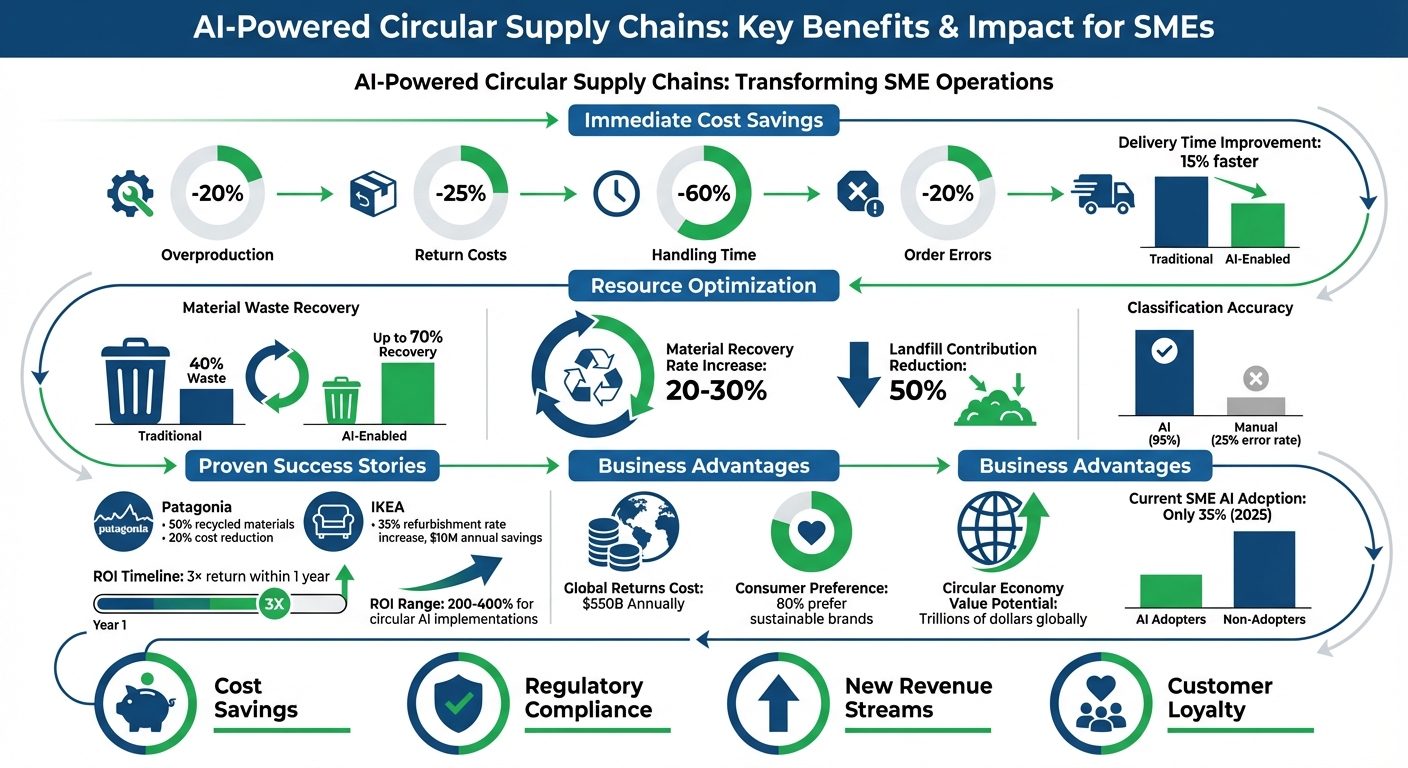
AI-Powered Circular Supply Chain Benefits and Impact Statistics for SMEs
Future of AI In Supply Chain and Circularity with Deborah Dull
sbb-itb-bec6a7e
Why SMEs Should Adopt Circular Supply Chains
Switching to a circular supply chain isn’t just about doing the right thing for the planet - it’s a smart business move with direct financial and competitive benefits. The global transition to a circular economy has the potential to generate trillions of dollars in value. For small and medium-sized enterprises (SMEs), making the shift early can secure a competitive advantage before tightening regulations make it mandatory.
The financial benefits are clear. Circular supply chains not only improve resource efficiency but also help SMEs sidestep rising regulatory costs. For example, the European Union now requires digital circularity data, and Extended Producer Responsibility (EPR) laws are becoming more widespread. Henrik Hvid Jensen, Partner at e.Circular ApS, puts it bluntly:
Soon, supply chains that deplete limited resources, generate excess emissions and discard value after use will no longer be socially or economically acceptable.
Another critical factor is market access. Large corporations are increasingly requiring their suppliers to meet strict ESG (Environmental, Social, and Governance) standards. Without clear circular practices, SMEs risk being excluded from lucrative contracts. Additionally, today’s consumers expect businesses to offer easy returns and sustainable end-of-life solutions, making circularity a baseline expectation for trust and loyalty. Compliance with these standards not only helps avoid penalties but also creates opportunities for cost savings and new markets.
Lower Costs Through Better Resource Use
One of the most immediate benefits of adopting a circular supply chain is cutting operational expenses. By reusing materials instead of constantly buying new ones, SMEs can significantly reduce procurement costs. Closed-loop systems allow businesses to source parts from refurbished or returned stock, slashing spending on raw materials.
Automation powered by AI also plays a big role in reducing waste. For instance, better demand forecasting can prevent overproduction and excess inventory - two common sources of financial loss in traditional supply chains. AI-driven systems can reduce order errors by 20% and speed up delivery times by 15%.
| Cost-Saving Lever | AI Application | Economic Impact |
|---|---|---|
| Resource Use | Smarter material flow analysis | Reduces overproduction and raw material waste |
| Maintenance | Predictive analytics for equipment | Minimizes downtime and avoids costly breakdowns |
| Logistics | Route and trip optimization | Cuts fuel costs and transportation expenses |
| Inventory | Closed-loop sourcing | Saves money by using refurbished components |
| Compliance | Automated regulatory tracking | Prevents fines linked to EPR and waste disposal laws |
For example, AI-powered route optimization can significantly lower fuel consumption and reduce transportation costs. Meanwhile, predictive maintenance extends the life of machinery by identifying issues before they lead to expensive failures.
These cost efficiencies don’t just improve the bottom line - they also boost a company’s reputation and build trust with customers.
Sustainability as a Business Advantage
Cost savings are essential, but circular supply chains also offer significant reputational and revenue benefits. In B2B markets, buyers are increasingly looking for suppliers that demonstrate sustainable practices to align with their own environmental goals.
Circular models can also unlock new revenue streams. Through Product-as-a-Service (PaaS) arrangements, businesses can shift from one-time sales to ongoing income by offering repairs, refurbishments, and leasing options. Retaining ownership of products ensures that materials return to the business, allowing full control over the value cycle. This transition from transactional to relationship-driven models strengthens customer loyalty and creates more predictable revenue.
The World Economic Forum highlights the urgency of this shift:
In 2030, being non-circular won't just be perceived as environmentally irresponsible; it will expose operational weaknesses and erode competitiveness.
Another major advantage is resource decoupling. By keeping materials in use longer and relying less on newly extracted resources, SMEs can protect themselves from volatile commodity prices. When raw material costs spike, circular businesses maintain steadier expenses by relying on recovered materials instead of competing in unpredictable markets.
How AI Supports Circular Supply Chains
AI is revolutionizing circular supply chains by simplifying tough decisions to ensure materials are reused and waste is minimized. By analyzing real-time data, AI optimizes every stage of the process, from predicting returns to scheduling maintenance. For small and medium-sized enterprises (SMEs), this translates into fewer costly errors and more efficient use of resources.
Traditional reverse logistics processes often waste 40% of materials. With AI, it’s possible to recover up to 70% of returns. Here’s how AI is making a difference in circular supply chains.
Forecasting Demand and Managing Inventory
AI helps businesses avoid overproduction by analyzing historical sales data, seasonal trends, and external factors like market changes or weather. This allows companies to predict exactly how much inventory they need, cutting down on excess raw materials and surplus products that might otherwise go to waste.
AI also facilitates closed-loop inventory systems by using returned or refurbished items to meet demand, reducing the need for new materials.
For example, Patagonia used AI-driven lifecycle tracking to cut costs by 20% while achieving 50% recycled material use in its supply chain. IKEA, on the other hand, relied on AI-enhanced reverse logistics to increase refurbishment rates by 35%, saving $10 million annually. Additionally, AI dynamically adjusts safety stock levels and reorder points based on real-time supply and demand, helping businesses avoid both shortages and overstocking. Even SMEs can start small by using existing sales and returns data to train forecasting models like Prophet or XGBoost.
Maintaining Equipment and Extending Asset Life
Traditional maintenance often follows fixed schedules, replacing parts that might still be functional. AI changes this by enabling predictive maintenance. By analyzing sensor data - like vibration, temperature, and pressure - AI can predict when a machine is likely to fail, ensuring parts are used to their full potential before being replaced.
During refurbishment, AI-powered computer vision systems classify returned products for repair, resale, or recycling with 95% accuracy, far outperforming manual inspections, which typically have error rates around 25%. AI can even suggest specific component upgrades to extend a product’s lifespan. For SMEs without advanced IoT setups, adding basic sensors to high-value equipment can provide enough data for AI to detect potential issues.
Managing Returns and Recycling
Globally, returns cost businesses about $550 billion each year and make up 10–15% of e-commerce logistics expenses. AI can significantly reduce these costs by automating reverse logistics processes, from predicting return volumes to directing products to the right destinations. AI-powered systems can cut handling time by 60% and reduce return costs by 25%. By analyzing sales data, product lifecycles, and consumer behavior, AI helps businesses anticipate return spikes and prepare for inspection and refurbishment needs in advance.
When products arrive, AI uses tools like spectral imaging and computer vision to identify materials, ensuring recycling streams achieve 80% purity. AI then determines the best course of action - repair and resell, send to a secondary market, or recycle through specialized facilities.
AI also helps companies comply with stricter regulations. For instance, the EU Digital Product Passport, launching in 2026, will require businesses to report on repairability and recyclability. AI can maintain detailed records of materials throughout their lifecycle, automating compliance and reducing the risk of penalties.
SMEs can start small by using shipment timestamps and warehouse logs to identify bottlenecks in reverse logistics. Integrating AI tools with third-party logistics (3PL) APIs can enhance routing for returned goods. Even simple tools - like using ChatGPT to analyze customer-uploaded photos and pre-classify product conditions - can make a big difference before items even reach the warehouse.
Finding AI Tools Through AI for Businesses
When it comes to making circular supply chains a reality, finding the right AI tools can be a daunting task - especially for small and medium-sized enterprises (SMEs) working with tight budgets. That’s where AI for Businesses steps in, offering a curated directory of AI tools designed to simplify this transition and eliminate the guesswork.
What AI for Businesses Brings to the Table
AI for Businesses focuses on making circularity accessible by providing a carefully selected range of AI tools tailored specifically for SMEs. These tools are chosen for their ability to integrate seamlessly with existing systems, saving businesses from the hassle of piecing together solutions from scratch. Whether it’s inventory management or compliance automation, the platform organizes tools by function, helping SMEs quickly find what they need to implement circular practices without the high costs of custom-built systems.
AI Tools Tailored for Supply Chain Management
The platform highlights several AI tools that address key aspects of circular supply chain management:
- Loopchain: This tool uses AI to match industrial waste streams with reuse opportunities, enabling businesses to reduce waste by an average of 80%.
- Loop ERP: With advanced image recognition, it automatically grades materials at receiving stations, categorizing them as "Like New", "Repairable", or "Scrap" with minimal human input.
- CircKit: Perfect for industries with heavy compliance demands, such as fashion, this tool automates lifecycle assessments and regulatory reporting, cutting reporting times by up to 80%.
- Circular Resale: This tool provides an AI-driven pricing assistant that combines global resale data with store-specific insights, allowing resellers to process inventory up to 15 times faster than manual methods.
While the directory also includes tools like Looka, Rezi, Stability.ai, and Writesonic, these are geared more toward branding and general business functions rather than supply chain-specific needs.
Flexible Pricing for SMEs
Affordability is a key consideration for SMEs, and AI for Businesses offers pricing plans that cater to businesses of varying sizes and stages:
- Basic Plan: Free access to a limited selection of AI tools, ideal for startups exploring circular models.
- Pro Plan: At $29/month, this plan provides full access to all tools and priority support - perfect for SMEs looking to scale their operations.
- Enterprise Plan: Custom pricing tailored for larger organizations with complex needs, including dedicated support and bespoke tool integration.
Individual tools also feature tiered pricing options. For example, Circular Resale offers a free tier for businesses earning under $1,000 monthly from resales. Meanwhile, CircKit boasts a ≈99% cost reduction compared to hiring consultants for manual lifecycle assessments. This combination of platform-level and tool-specific pricing ensures SMEs can start small and expand their capabilities as their circular supply chains evolve. It’s a practical way to support businesses in making the shift to circular operations without breaking the bank.
Steps to Implement AI in Your Circular Supply Chain
Review Your Current Supply Chain
Before diving into new technologies, take a close look at the data you already have. Many small and medium-sized enterprises (SMEs) are sitting on a goldmine of information - like Excel logs, shipment timestamps, customer complaints, and warehouse records - that can help pinpoint inefficiencies and areas of waste. You don’t need expensive IoT sensors to get started. For example, analyzing this data might reveal underutilized truck capacity or other bottlenecks.
Start by focusing on reverse logistics. Look at return volumes and conditions across products and regions to uncover inefficiencies. AI can help here by analyzing customer-submitted photos and descriptions of returns to decide if items can be resold, repaired, or recycled. As of late 2025, only 35% of SMEs are using AI, which means there's a big opportunity to get ahead by starting now. Mapping out your material flows - tracking what raw materials you’re ordering and identifying overproduction - can also reveal quick ways to cut waste and save money. These steps lay the foundation for selecting AI tools tailored to your specific needs.
Choose and Install AI Tools
Use the insights from your supply chain review to address specific problem areas. For example, if forecasting returns is a challenge, you could train a model using tools like XGBoost or Prophet with your historical sales data. If manual sorting is a bottleneck, AI solutions with OCR (optical character recognition) and visual recognition capabilities can classify product conditions automatically. The goal is to start with tools that are easy to integrate into your existing systems, such as your Warehouse Management System or your third-party logistics (3PL) provider's API.
Successful AI implementation isn’t just about the technology - it’s about getting your team on board. Strategic Adoption and Stakeholder Engagement (SASE) plays a critical role, with a 100% normalized importance in predicting success. This means clear communication and gradual implementation are key. Start small, perhaps by testing AI tools on a single product category, and then expand as you see results. Once the tools are in place, continuous tracking and refinement will help ensure long-term success.
Track Results and Adjust
Set up real-time dashboards to monitor critical metrics. For example, track how much of your demand is being met with refurbished stock instead of new materials - this can help measure the effectiveness of your circular supply chain model. Other important metrics include material recovery rates, refurbishment success rates, and Scope 3 emissions, all of which can highlight areas for improvement.
Plan to allocate roughly 10% of your initial supply chain budget for ongoing monitoring and adjustments. AI thrives on fresh data and continuous refinement. If you notice issues like low triage accuracy in the first few months or a plateau in refurbishment rates after five months, dig deeper. You might need to tweak sorting methods or explore new recovery partners. Companies that see ROI increases of 200–400% from circular AI are those that treat implementation as an evolving process, not a one-and-done effort.
Conclusion
Circular supply chains offer a smart way for SMEs to cut costs, increase profits, and stand out in the market. By using AI to automate returns triage and sorting, businesses can reduce handling times by up to 60% and lower per-item return costs by 25%. On top of that, AI-powered condition assessments can help recover value from as much as 70% of returns, turning what used to be a cost center into a source of profit.
The benefits don’t stop there. Companies leveraging AI in circular supply chains are seeing material recovery rates climb by 20–30% and landfill contributions drop by as much as 50%. For example, Patagonia has achieved 50% usage of recycled materials and reduced overall costs by 20%, thanks to AI-driven lifecycle tracking.
"AI agents revolutionize circular supply chain management by automating returns, refurbishment, recycling, and disposal, fostering sustainable product lifecycles and economic gains."
This guide has shown how sustainability doesn’t just satisfy consumer demand - 80% of consumers prefer sustainable brands - but also generates a 3× ROI within a year. Compliance with regulations like the Digital Product Passport and the ability to build customer trust through sustainable practices make AI-enhanced circular supply chains a strategic necessity for today’s SMEs.
FAQs
What’s the easiest AI project to start with for a circular supply chain?
Using AI to improve reverse logistics - like handling returns, repairs, or recycling - is a smart way to get started. This process tackles an important part of circular supply chains with straightforward, actionable tasks. By optimizing the flow of products back through the supply chain, businesses can cut down on waste and use resources more efficiently. For SMEs looking to integrate AI into circular supply chains, this is a practical and approachable first step.
What data do I need to use AI for returns, repairs, and recycling?
To effectively harness AI in managing returns, repairs, and recycling, you’ll need access to data on product condition, market demand, and processing costs. AI tools take this information and determine the best course of action for each item - whether it should be refurbished, resold, recycled, or donated.
Beyond decision-making, AI helps streamline operations. It optimizes material flows, forecasts raw material requirements, and simplifies reverse logistics. This automation ensures smoother product lifecycle management while aiming for greater efficiency across the board.
How can AI help my business meet the 2026 EU Digital Product Passport rules?
AI can assist your business in meeting the 2026 EU Digital Product Passport (DPP) requirements by streamlining tasks like data collection, verification, and sharing throughout a product's lifecycle. This helps ensure traceability while aligning with rules on sustainability, durability, and repairability. On top of that, AI-powered tools can refine supply chain operations, including reverse logistics and recycling efforts, aiding compliance with EU standards and supporting circular economy goals.