AI-driven journey personalization is transforming how businesses engage with customers by using data to create tailored experiences. Companies like Coca-Cola, Starbucks, Netflix, and Amazon have seen major results by leveraging machine learning to predict customer needs and deliver personalized interactions. Here’s a quick summary of the key outcomes:
- Coca-Cola: Shifted to real-time, personalized cart reminders, boosting conversion rates to 89% and revenue by 36%.
- Starbucks: AI-powered app features increased digital engagement by 23%, average check sizes by 14%, and loyalty members by 3.3 million.
- Netflix: Personalized recommendations drive 80% of content views, improve user engagement by 40%, and save $1 billion annually in retention.
- Amazon: AI-driven recommendations contribute to 35% of total revenue, with dynamic pricing and tailored promotions enhancing customer experiences.
AI tools like predictive analytics, real-time data processing, and machine learning models enable businesses to deliver the right message at the right time. Whether it’s personalized emails, product recommendations, or dynamic pricing, these strategies drive higher conversions, customer loyalty, and revenue growth. Small businesses can also benefit by starting with high-impact automations like abandoned cart emails and leveraging accessible AI platforms like Blueshift or Nosto.
How to Create Personalized Customer Journeys with AI (Loop Marketing Tailor Stage)
sbb-itb-bec6a7e
Case Study: Starbucks Mobile App Personalization
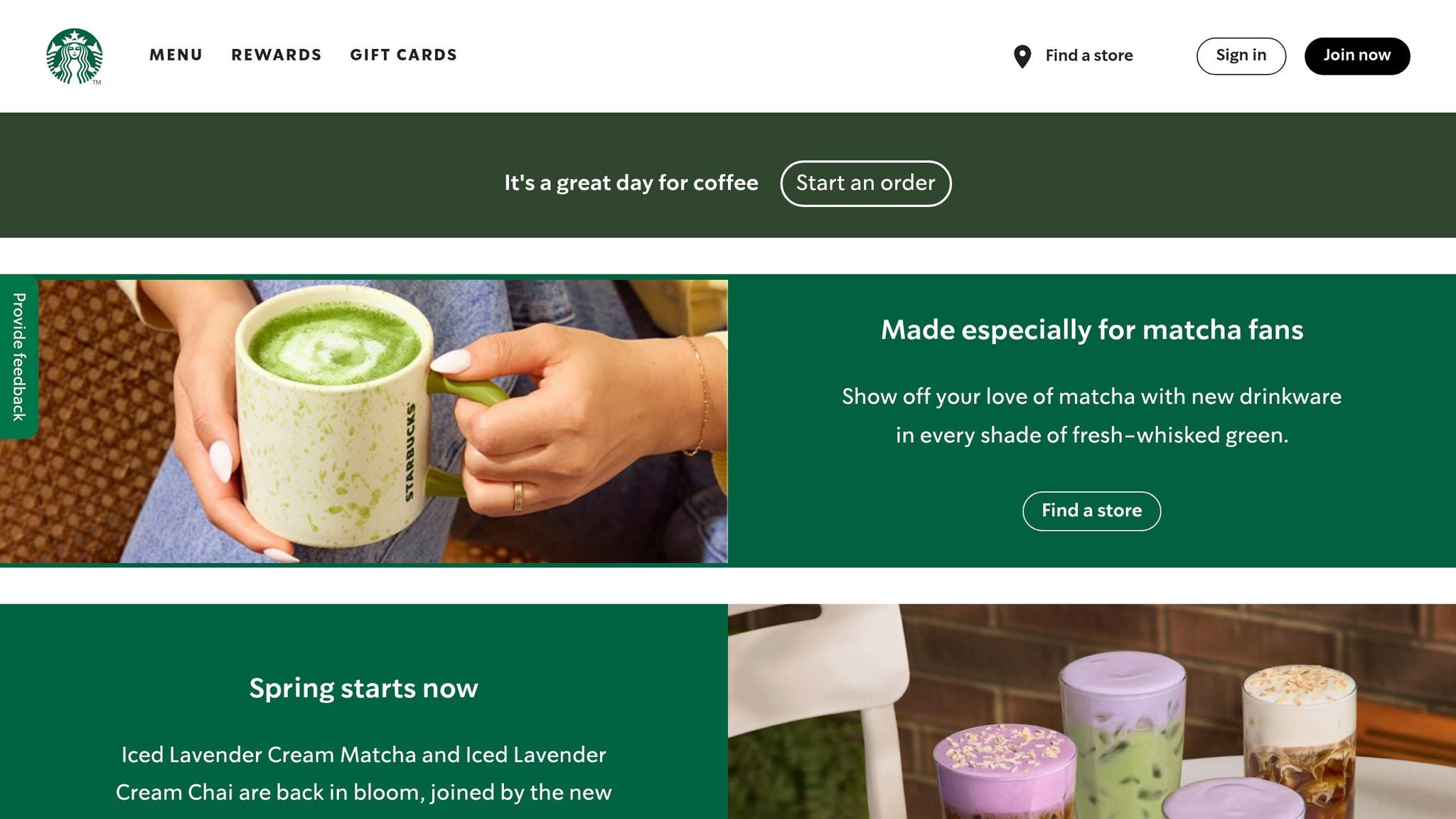
Starbucks has revolutionized its mobile app experience with Deep Brew, an AI engine that processes billions of data points daily. By analyzing factors like purchase history, loyalty behaviors, and real-time conditions - such as weather, location, and time of day - the app powers a "Just For You" carousel. This feature suggests drinks tailored to the moment, like a warm vanilla latte on a rainy morning or an iced matcha during a hot afternoon. It's a prime example of how contextual data can create personalized, meaningful interactions from raw customer information, showing businesses how to implement AI effectively.
AI Recommendations in the Starbucks App
The app goes beyond simple suggestions by predicting customer needs even before they start browsing. For instance, it can forecast routine orders and offer one-tap reordering at the usual times. This predictive functionality works seamlessly with the Smart Queue system, which optimizes mobile pickup times to enhance convenience.
Deep Brew also supports operational tools like Green Dot Assist, a generative AI feature introduced in early 2025. This tool provides baristas with real-time recipes and allergen details, helping reduce drive-thru wait times by 18 seconds per window - a 14% improvement. This efficiency allows staff to focus more on customer interactions, while the AI streamlines the ordering process and boosts overall performance.
Results: Loyalty and Revenue Growth
The results of these AI-driven features have been striking. Between late 2025 and early 2026, Starbucks saw a 14% increase in average check sizes, gained 3.3 million new loyalty members, and improved digital engagement by 23%. Personalized recommendations had a 20–30% higher conversion rate, contributing approximately $410 million in additional revenue. Food attachment rates rose by 7%, while the return on investment for AI initiatives improved by 30%.
By February 2026, digital transactions accounted for 56% of Starbucks' total sales, with mobile orders making up over 30% in the U.S.. The app now delivers more than 2.3 billion personalized experiences annually, driving a consistent 4% growth in global same-store sales.
"Imagine a customer simply stating, 'Hey, I need my Starbucks order. I'll be there in 10 minutes,' and finding their custom drink ready for pickup." – Brian Niccol, CEO, Starbucks
Case Study: Netflix Content Personalization
Netflix has developed a highly advanced AI recommendation system that keeps over 200 million subscribers engaged. This system uses a hybrid approach, blending collaborative filtering - which identifies patterns from users with similar tastes - and content-based filtering, which matches viewers with specific genres, cast members, or themes. Together, these methods allow Netflix to predict what viewers might enjoy next with an impressive 95% accuracy.
How Netflix Predicts Viewing Preferences
Netflix categorizes its audience into more than 2,000 "taste communities" by analyzing subtle user behaviors. The platform's AI examines factors like viewing history, how often users pause or rewind, the time of day they watch, the devices they use, and even "hover time" - the amount of time spent considering a title before moving on. To refine these predictions, Netflix employs deep learning models such as Personalized Video Ranking (PVR), Top-N Ranker, and Continue Watching Ranker.
Another standout feature is dynamic visual personalization, where Netflix tailors thumbnails for the same show based on individual preferences. For instance, a user interested in female-led stories might see Pulp Fiction with a thumbnail of Uma Thurman, while someone drawn to action might see John Travolta instead. This tactic has boosted click-through rates by as much as 30%, especially within the crucial first 60 to 90 seconds when users are most likely to lose interest.
This level of personalization has proven to enhance both user engagement and loyalty.
Results: Watch Time and Retention Improvements
Netflix's AI recommendations play a massive role in shaping user habits. A striking 80% of the content viewed on Netflix is discovered through these AI-driven suggestions. Over two years, the system has reduced the effort users spend searching by 43% and improved the relevance of recommendations by 42%. Netflix also boasts an industry-leading churn rate of just 2.3%–2.4%.
"Netflix estimates that their recommendation system saves them $1 billion per year in customer retention." – Data Driven Daily
Beyond retention, the recommendation engine has increased user engagement by 40% and cut churn rates by 25% through automation. With $1 billion in annual savings tied directly to its personalization strategy, Netflix’s approach is a standout example of how AI can drive measurable business success.
Case Study: Amazon Shopping Experience Personalization
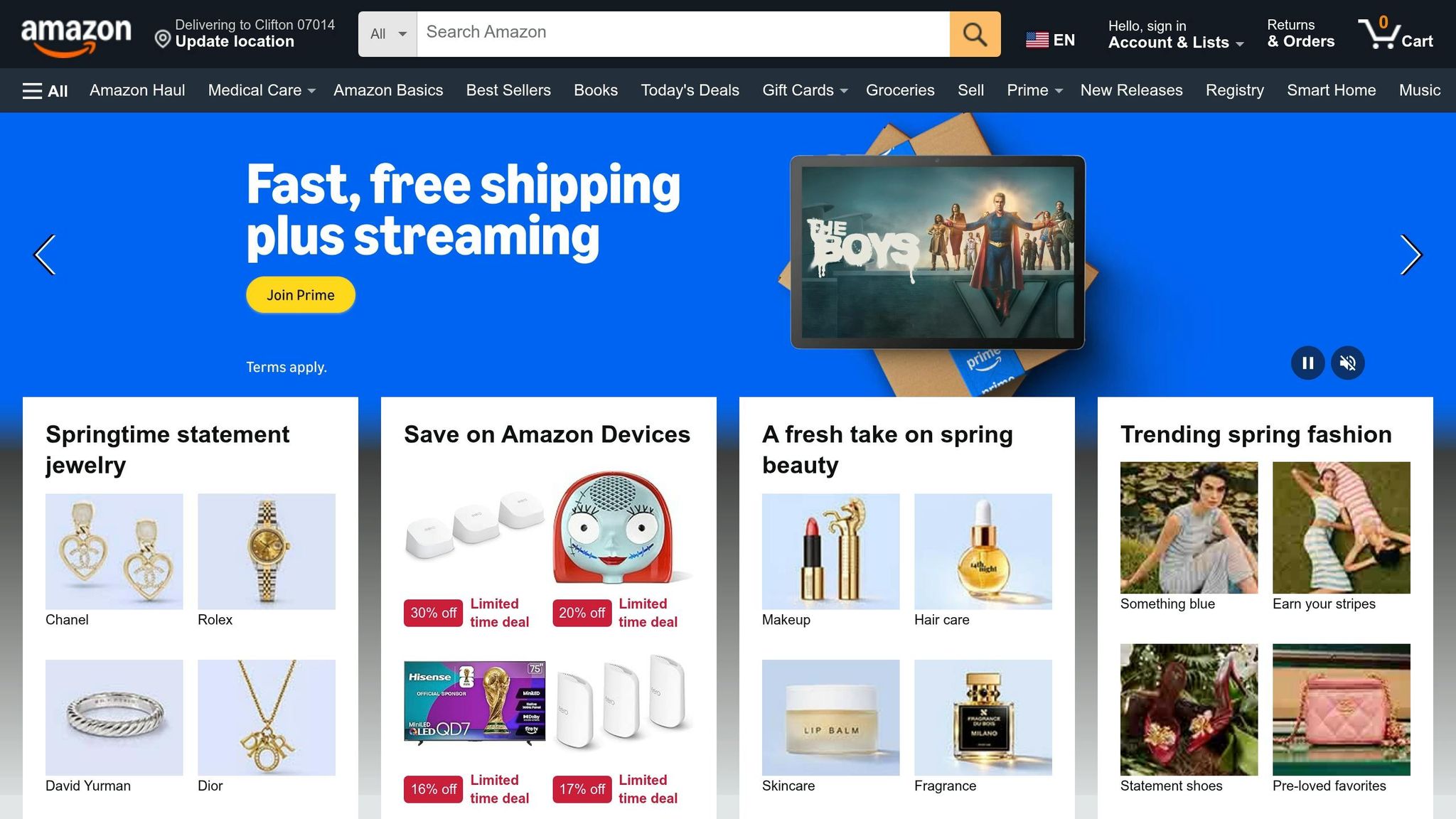
Amazon has developed an advanced AI-powered personalization engine, processing over 150 billion data points daily to create tailored shopping experiences for its more than 300 million active customers. This system combines collaborative filtering, content-based filtering, and deep learning to identify and respond to complex behavioral patterns in real time. The result? Personalization efforts contribute to an impressive 35% of Amazon's total revenue, showcasing how essential this approach is to the company's success. This foundation supports deeper customer engagement across all shopping interactions.
Personalized Product Recommendations
Amazon’s recommendation engine uses real-time data to refine product suggestions as customers browse. By analyzing everything from browsing history and purchase trends to immediate actions like clicks, hovers, and time spent on pages, the system updates recommendations in as little as 100 milliseconds. For example, during the 2023 holiday season, real-time session modeling adjusted suggestions mid-browse. A search for "noise-canceling headphones" might instantly surface related items like travel cases or audio cables, leading to a 12% increase in cross-category conversions.
In September 2024, Amazon introduced a generative AI feature powered by Large Language Models (LLMs) to rewrite product titles and descriptions dynamically. This personalization ensures that search results prioritize attributes important to individual shoppers - like highlighting "gluten-free" options for health-conscious customers. Additionally, Amazon launched Rufus, a conversational AI shopping assistant that offers tailored recommendations and product comparisons. By November 2025, Rufus had been used by more than 250 million customers, with monthly usage growing 140% year-over-year. Customers engaging with Rufus are 60% more likely to make a purchase.
"If the primary LLM generates a product description that is too generic or fails to highlight key features unique to a specific customer, the evaluator LLM will flag the issue." – Mihir Bhanot, Director of Personalization, Amazon
Dynamic Pricing and Targeted Promotions
Amazon doesn’t stop at product suggestions - it also uses AI to fine-tune pricing and promotions. The company adjusts product prices up to 2.5 million times daily through dynamic pricing algorithms. These algorithms consider factors like customer segments, demand trends, competitor pricing, and purchasing power. Deep reinforcement learning helps balance short-term clicks with long-term customer loyalty.
Tools like Amazon Personalize enable targeted marketing campaigns by leveraging pre-configured algorithms, or "recipes", for user segmentation. Meanwhile, Amazon Bedrock and LLMs generate personalized marketing content, such as custom subject lines for emails or unique taglines for promotions.
Amazon’s real-time systems process interactions in just 100 milliseconds, allowing prices and promotions to adapt instantly based on user behavior, like clickstreams or exit intent. Predictive analytics also play a role, forecasting customer needs up to 2–4 weeks in advance. This enables proactive promotions and "predictive refill" suggestions, which account for 23% of repeat purchases in certain categories. Hyper-personalized recommendations have been shown to drive 2.3x higher conversion rates compared to generic suggestions, while AI-driven personalization increases average order value by 10–30%. These dynamic strategies not only boost sales but also reinforce Amazon’s dedication to creating a highly personalized shopping experience.
Results Summary and Implementation Guide
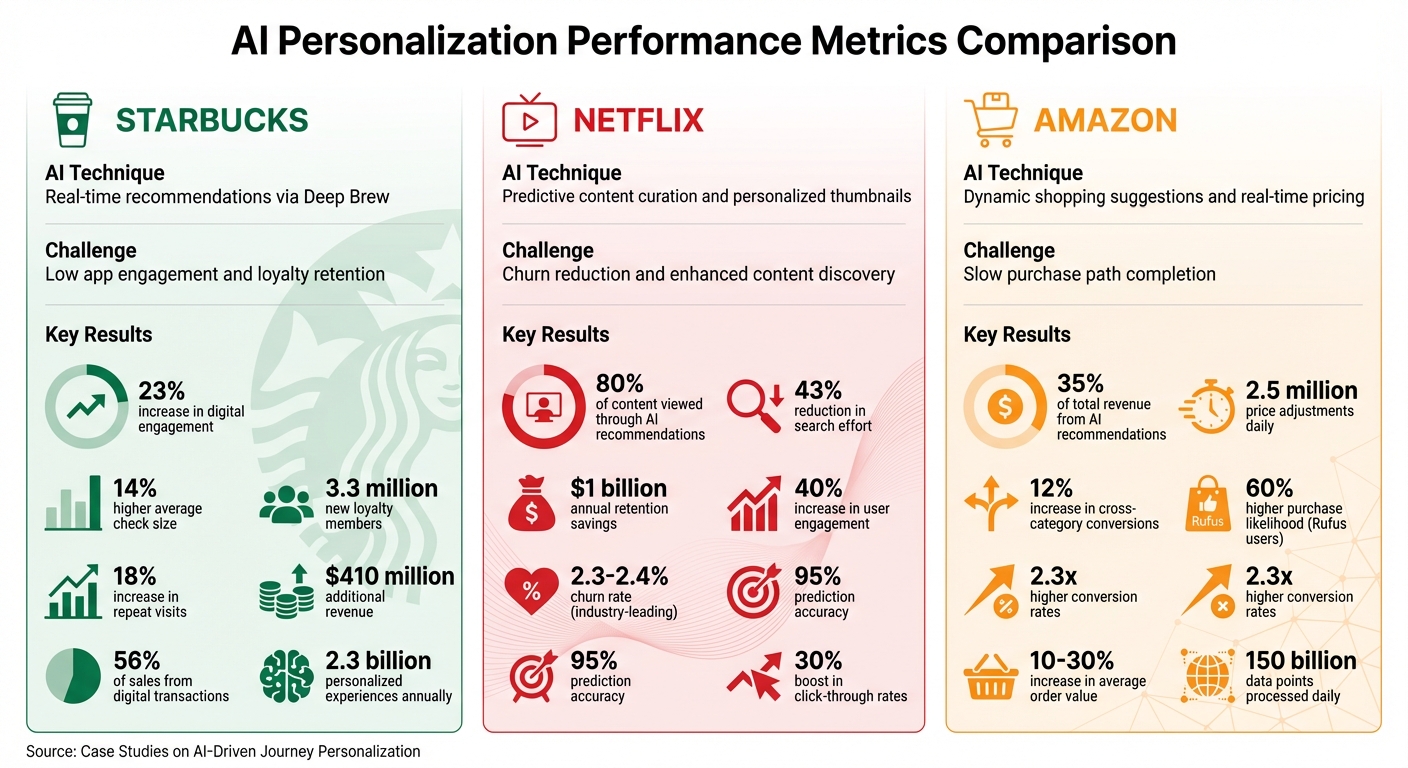
AI Personalization Results: Starbucks, Netflix, and Amazon Performance Metrics
Performance Metrics Comparison
The three case studies highlight how businesses across various industries have achieved measurable outcomes through AI-driven personalization. Each company tackled distinct challenges and saw impressive results by strategically using AI.
| Company | AI Technique | Challenge Addressed | Results Achieved |
|---|---|---|---|
| Starbucks | Real-time recommendations via Deep Brew | Low app engagement and loyalty retention | 23% increase in digital engagement, 14% higher average check size, 3.3 million new loyalty members |
| Netflix | Predictive content curation and personalized thumbnails | Churn reduction and enhanced content discovery | 80% of content viewed through AI recommendations, 43% reduction in search effort, $1 billion annual retention savings |
| Amazon | Dynamic shopping suggestions and real-time pricing | Slow purchase path completion | 35% of total revenue from AI recommendations |
In addition to these standout metrics, Starbucks experienced an 18% increase in repeat visits thanks to AI-powered challenges and gamification. Personalized promotions also added $5.5 million in weekly revenue. These successes underline actionable strategies that businesses can adopt.
Implementation Steps for Small Businesses
The results show that businesses of any size can harness AI personalization effectively, even without large budgets. A great example is Five Below, which used Blueshift with just a two-person digital marketing team to drive a 22% increase in digital sales and achieve a 41% open rate on abandoned cart emails. As Carrie Bova, Senior Digital Marketing Manager at Five Below, explained:
"I've been able to do so much with Blueshift just as a two-person team, without depending on larger tech teams or extended timelines".
To get started, small businesses should focus on these steps:
- Centralize customer data: Use a Customer Data Platform (CDP) to ensure data accuracy and consistency.
- Prioritize high-impact automations: Start with workflows like abandoned cart emails, browse abandonment notifications, and welcome series. These tend to generate the most engagement.
- Run pilot programs: Test AI personalization on specific customer segments or channels before scaling. For instance, Sweetwater integrated AI-powered content recommendations into its CRM, boosting click-through rates for educational content by 22%.
Mike Clem, Chief Growth Officer at Sweetwater, emphasized the importance of having the right tools:
"If you don't have a customer engagement platform, get one. If you have one that's not Blueshift, throw it out and get with these guys".
On average, companies using AI personalization see a 15–25% lift in conversion rates. Fast-growing businesses, in particular, generate 40% more revenue from hyper-personalization compared to slower-growing competitors.
Finding AI Tools with AI for Businesses
For small and medium-sized enterprises (SMEs) eager to explore AI personalization, AI for Businesses (https://aiforbusinesses.com) provides a curated directory of tools. This platform connects businesses with user-friendly AI solutions that improve customer experiences without requiring enterprise-scale investments.
Instead of building custom AI systems, SMEs can take advantage of existing APIs and platforms. Tools like Blueshift enable multi-channel personalization with minimal engineering resources, while Nosto automates product recommendations to ease merchandising efforts. For example, a fashion brand based in Los Angeles achieved a 60x ROI and grew email revenue from 11% to 14.5% of total sales by using AI-driven evergreen campaigns with Polar Analytics and Bespoke AI.
The key takeaway? Start with targeted, high-value use cases and expand as results are measured. This approach allows businesses to achieve meaningful outcomes while keeping resources in check.
FAQs
What customer data do I need to start AI personalization?
To kick off AI-driven personalization, begin by gathering first-party data - this includes information like purchase history, engagement trends, and loyalty program activity. Add behavioral data to the mix, such as browsing patterns, email interactions, and device preferences. For a more detailed understanding of your audience, tap into CRM systems to track customer preferences and objectives. By blending these data sources, AI can craft tailored messages, recommendations, and experiences that boost both engagement and conversion rates.
How can a small business launch personalization without a big team?
Small businesses can tap into AI tools to personalize customer experiences quickly, without needing extensive setup or technical know-how. Take, for example, a flavor syrup brand that boosted its revenue in just a month thanks to AI-driven solutions. Similarly, a bakery managed to reclaim 10 hours every week by automating routine tasks. By using AI for automated marketing, tailored recommendations, or enhanced customer engagement, businesses can fuel growth without adding extra staff or dealing with complicated integrations.
How do I measure ROI from AI journey personalization?
To gauge the return on investment (ROI) from AI-powered journey personalization, focus on tracking key performance indicators (KPIs) like revenue growth, conversion rates, and user engagement. For instance, many businesses have seen noticeable improvements in metrics such as gross merchandise volume, click-through rates, and transaction rates after adopting AI-driven personalization strategies. These numbers, along with increases in sales, higher email open rates, and stronger customer engagement, offer a clear picture of how these efforts contribute to overall business growth.