Email marketing delivers an impressive $36 return for every $1 spent, but nearly 47% of marketers struggle to measure success. For SMEs, this can mean wasted resources and missed revenue. Benchmarking solves this by offering context: Is your 22% open rate good or bad? Without comparison, you’re guessing. Top email marketers achieve results 2–4x better than others by tracking key metrics like open rates, CTR, and bounce rates against industry standards.
Key takeaways:
- Open rates vary by sector (e.g., nonprofits average 46.49%, retail 38.58%).
- Click-through rates (CTR) average 2.3%, but nonprofits often exceed this at 2.66%.
- Bounce rates above 5% harm sender reputation - keep them below 2%.
With proper benchmarking, SMEs can identify weak spots, focus on high-performing campaigns, and make smarter decisions. AI tools like Klaviyo and HubSpot simplify this process, offering real-time insights and tailored benchmarks. Start by comparing your performance to industry averages, track progress, and refine your strategy to stay competitive.
B2B Email Marketing Benchmarks and How to Use Them–Chad S. White
The Problem: SMEs Lack Clear Email Performance Standards
Measuring email performance is one of the biggest hurdles email marketers face. For small and medium-sized enterprises (SMEs), this issue becomes even more pressing. Without clear benchmarks, decisions are often based on gut instincts rather than reliable data.
This lack of clarity has serious consequences. When you don’t have a clear picture of what "good" performance looks like, you might settle for an open rate that's far below what top performers achieve - sometimes two to four times lower. This uncertainty can erode confidence, with only 27% of small businesses feeling "very confident" in their marketing strategies.
Why Average Email Metrics Can Be Misleading
Many SMEs fall into the trap of aiming for "average" metrics, like a 20% open rate, even though top performers in the same industries achieve significantly higher results.
Consider this example: A nonprofit initially felt disappointed with its 20% open rate. However, after benchmarking, they discovered that industry averages ranged from 15% to 25%. By segmenting their audience and making data-driven adjustments, they boosted engagement by 50% in just six months.
Adding to the challenge, SMEs often deal with poor-quality data. Issues like duplicate records, outdated information, and scattered data across tools like CRMs, email platforms, and social media make accurate measurement even harder. If your bounce rate exceeds 5%, it’s more than just a misleading metric - it actively harms your sender reputation. These data problems amplify uncertainty, leading to flawed strategies and missed opportunities.
How Guesswork Limits SME Growth
Without benchmarks, SMEs often waste resources and miss out on growth. For instance, while only 2% to 5% of website visitors make an immediate purchase, the majority need nurturing through email campaigns. But if you don’t know whether your click-through rate is strong or weak, refining your approach becomes a guessing game.
"Without data, you're just another person with an opinion."
– W. Edwards Deming, Data Scientist
Limited resources make this even tougher. Many SMEs operate with tight budgets and devote less than an hour a day to marketing, forcing them to rely on basic tactics. This often results in tracking too many metrics without understanding which ones actually matter. The result? Metric fatigue, which can lead to analysis paralysis.
The stakes are high. With 81% of small businesses worried about how economic uncertainty might impact their marketing efforts, wasting money on underperforming campaigns isn’t just inefficient - it can be disastrous. Without solid data to guide decisions, it’s impossible to know whether to increase email marketing budgets, focus on specific campaigns, or address weak spots where competitors are excelling. These challenges highlight the importance of having precise metrics to drive smarter, more effective email strategies.
Key Email Metrics SMEs Should Track
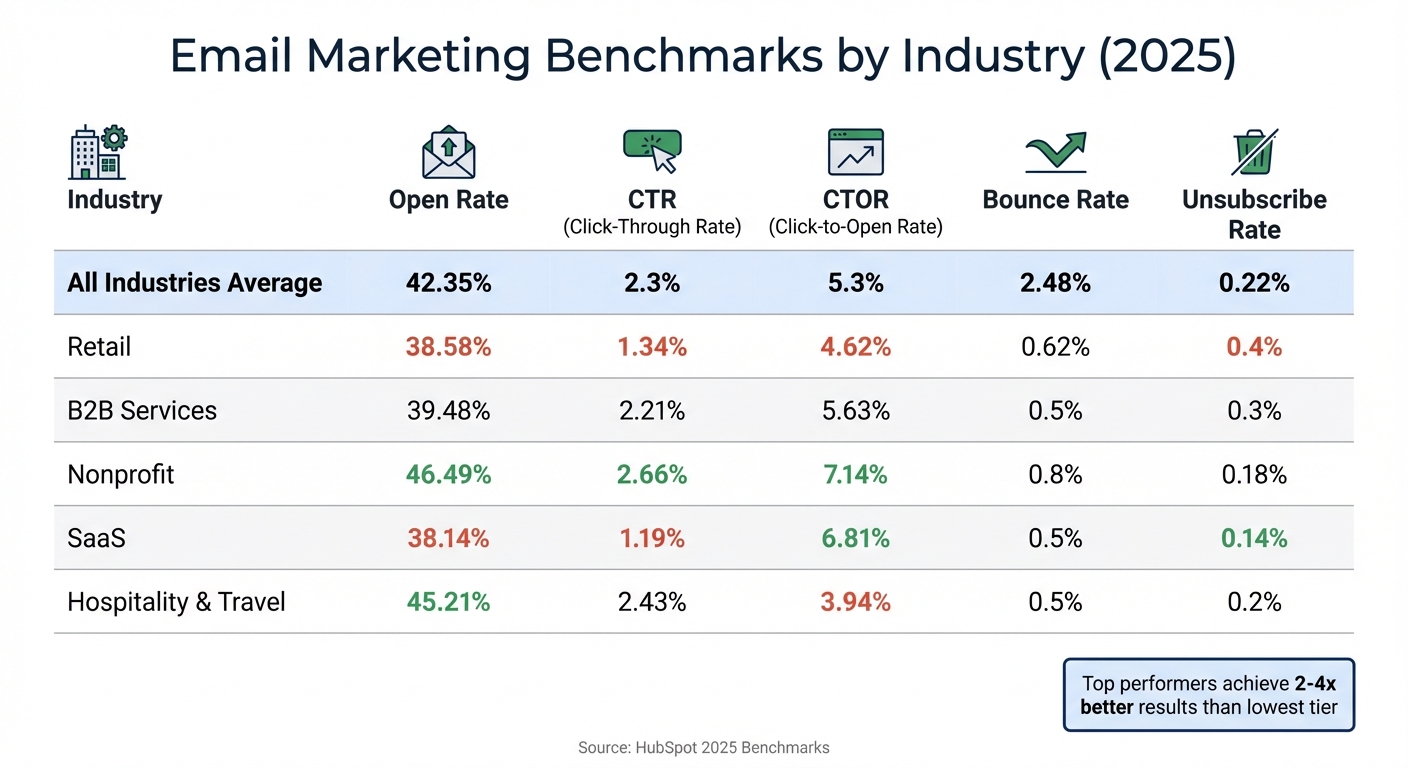
Email Marketing Benchmarks by Industry: Open Rates, CTR, and Bounce Rates Comparison
For small and medium-sized enterprises (SMEs), tracking the right email metrics is crucial for building effective campaigns. These metrics not only reveal how well your emails perform but also give insight into the health of your subscriber list. With so many data points available, the focus should be on those that align with your business goals and help maintain a strong audience base.
Core Email Performance Metrics
Open Rate indicates the percentage of recipients who open your email. The average across industries is 42.35% (HubSpot 2025 Benchmarks), though this varies by sector. Nonprofits tend to achieve higher rates at 46.49%, while retail averages around 38.58%. Be mindful, however, of factors like Apple’s Mail Privacy Protection, which can artificially inflate open rates by up to 18 percentage points. A rate above 45–50% usually reflects compelling subject lines and a trusted sender reputation.
Click-Through Rate (CTR) measures the percentage of delivered emails that result in clicks. The average CTR is about 2.3% across industries, with nonprofits often exceeding this at 2.66%, while retail lags behind at 1.34%. This metric sheds light on how well your content and calls-to-action resonate with your audience.
Click-to-Open Rate (CTOR) focuses on engagement quality by considering only those who opened the email. The industry average is 5.3%, but achieving a CTOR above 20% is a strong indicator of effective content. In a competitive landscape, brands that excel don’t just capture attention - they leave a lasting impression.
Conversion Rate tracks the percentage of recipients who take a desired action, like making a purchase or signing up for an event. The average conversion rate is around 8.17%, linking your email efforts directly to revenue. If your CTR is solid but conversions are low, the issue might lie with your landing page or offer rather than the email itself.
Bounce Rate measures how many emails fail to reach recipients. A healthy bounce rate is below 2%, while the average is about 2.48%. If your rate exceeds 5%, it’s a red flag for list quality issues that can harm your sender reputation. Remember to differentiate between hard bounces (permanent issues like invalid addresses) and soft bounces (temporary problems like full inboxes).
Unsubscribe Rate and Spam Complaint Rate are critical for gauging content relevance. The average unsubscribe rate is 0.22%, with anything below 0.5% considered healthy. Spam complaint rates should stay under 0.1% to maintain deliverability.
| Industry | Open Rate | CTR | CTOR | Bounce Rate | Unsubscribe Rate |
|---|---|---|---|---|---|
| All Industries Avg. | 42.35% | 2.3% | 5.3% | 2.48% | 0.22% |
| Retail | 38.58% | 1.34% | 4.62% | 0.62% | 0.4% |
| B2B Services | 39.48% | 2.21% | 5.63% | 0.5% | 0.3% |
| Nonprofit | 46.49% | 2.66% | 7.14% | 0.8% | 0.18% |
| SaaS | 38.14% | 1.19% | 6.81% | 0.5% | 0.14% |
| Hospitality & Travel | 45.21% | 2.43% | 3.94% | 0.5% | 0.2% |
(Source: HubSpot 2025 Benchmarks)
While these metrics highlight performance, keeping your subscriber list healthy is just as important.
Additional Metrics for List Health
Deliverability Rate is vital because even the most engaging email won’t matter if it doesn’t reach the inbox. This metric, combined with bounce rates, helps protect your sender reputation.
Pay attention to your Email List Growth Rate and inactive subscribers - those who haven’t engaged in 90–180 days. An average list growth rate of about 2.5% can counteract natural list decay. Identifying inactive subscribers can signal when to clean your list or launch re-engagement campaigns.
"In only 7 months, we added more than 95,654 names to our email list using OptinMonster's Exit Intent™ technology"
– Michael Stelzner, Social Media Examiner
For SMEs focused on revenue, Return on Investment (ROI) and Revenue Per Email (RPE) are essential. Email marketing typically delivers an impressive $36 return for every $1 spent.
Using Industry and Internal Benchmarks
After establishing core metrics and ensuring your list is in good shape, comparing performance against both industry standards and your own historical data provides actionable insights. While industry averages offer a baseline, your unique audience, product, and email frequency mean internal benchmarks are just as valuable. For instance, if your B2B service emails achieve a 35% open rate - below the industry average of 39.48% - but this marks an improvement from 28% six months ago, you’re on the right path. Conversely, a drop in CTOR from 12% to 6% may signal the need for a content refresh.
Setting SMART goals (Specific, Measurable, Achievable, Relevant, Time-bound) turns benchmarks into actionable plans. For example, instead of vaguely aiming to "improve engagement", you might target increasing CTOR from 5% to 8% within three months by testing single-CTA emails and optimizing send times.
Some experts suggest the "20-2-10" golden ratio: a 20% open rate, 2% CTR, and 10% CTOR as a baseline for email health. However, these should be adjusted based on your industry and past performance. Testing optimal send times, like Thursday mornings between 8–9 AM, can also drive better results.
How SMEs Can Benchmark Against Similar Businesses
Benchmarking isn't just about measuring performance - it's about setting clear standards and using data to refine email strategies that drive SME growth. To benchmark effectively, you need to dig deep, starting with your industry, then narrowing down by region, audience type, and campaign size.
Choosing the Right Comparison Groups
The first step is selecting the right filters. Industry sector is an obvious starting point, but it’s only part of the picture. For instance, a retail business in the U.S. will experience different email performance metrics than one in Japan - average open rates are 24.39% in the U.S. compared to 35.59% in Japan. Audience type is another key factor: B2B companies often deal with longer decision-making cycles, while B2C campaigns are geared toward quicker, impulse-driven actions. Even campaign size plays a role - smaller retail campaigns (5,000–10,000 emails) in Western Europe see a 4.3% click-through rate (CTR), outperforming the 3.7% global average.
The source of your benchmark data is equally important. To get the most relevant insights, focus on reports from Email Service Providers (ESPs) like Constant Contact or Mailchimp, which cater to small businesses. Data from agencies that primarily serve enterprise brands might skew higher and fail to reflect the realities of SMEs.
| Industry | Avg. Open Rate | Avg. CTR | Avg. Bounce Rate |
|---|---|---|---|
| Manufacturing | 41.1% | 9.6% | 0.60% |
| Real Estate | 41.6% | 8.7% | 0.31% |
| Retail | 40.6% | 7.7% | 0.24% |
| Education | 35.4% | 8.3% | 0.49% |
| Marketing & Advertising | 38.3% | 7.5% | 0.29% |
| Software & Web Apps | 39.8% | 2.9% | 0.57% |
Once you've identified the right comparison groups, it's time to move beyond averages and uncover areas where you can improve.
Why Averages Don't Tell the Whole Story
Relying on average benchmarks can be misleading. Industry averages often include poorly-performing "batch and blast" campaigns that drag down the numbers. Top performers (quintile 1) achieve results two to four times higher than those in the lowest tier. Without context, metrics like a 3% click rate might seem great in manufacturing but fall short in education. Smaller email lists also tend to show higher engagement, so comparing a 2,000-subscriber list to a competitor's 200,000-subscriber campaign won't give you meaningful insights.
A Step-by-Step Benchmarking Guide for SMEs
With your comparison groups defined and the limitations of averages in mind, follow a structured process to benchmark effectively. The Benchmark Distillery Process offers a clear roadmap:
- Review multiple reports: Gather data from credible sources to get a well-rounded view.
- Focus on relevance: Narrow down the data to match your specific niche, considering factors like industry, region, and audience type.
- Set SMART goals: Use these benchmarks to establish realistic, measurable targets.
- Update benchmarks annually: Aim to refresh your benchmarks in February, when most industry reports are released.
Before comparing externally, group your campaigns by type - newsletters, promotions, or triggered emails. Then, establish an internal baseline by analyzing your performance over the past one to four quarters. This historical data provides a clearer picture of your unique audience and business dynamics.
Finally, identify gaps between your performance and the benchmarks, and ask yourself, "So What? Now What?" This approach helps turn insights into actionable steps. For example, if your click-to-open rate is below the industry standard, experiment with new content formats, stronger calls-to-action, or better segmentation strategies to close the gap.
sbb-itb-bec6a7e
Turning Benchmark Data Into Better Email Campaigns
Identifying and Prioritizing Areas for Improvement
Align your email metrics with your business goals. For example, focus on click-through rate (CTR) if driving traffic is your goal, or emphasize conversion rate to boost sales. Aim for benchmarks like a 20% open rate, 2% CTR, and 10% click-to-open rate (CTOR) to keep your campaigns engaging.
Pinpoint where your current performance falls short compared to industry standards. With Apple's Mail Privacy Protection making open rates less reliable, shift your attention to CTOR - it’s a more meaningful indicator of how well your content connects with readers who actually open your emails. Focus on areas with the most potential for improvement. For instance, if your CTR is sitting at 1% while the industry average is 2.44%, you have a clear opportunity to double your performance.
These insights provide the foundation for refining your email content and design, which we’ll explore next.
Improving Key Email Metrics
Want to boost open rates? Test personalized subject lines and schedule your emails for Tuesday or Thursday mornings between 8:00 AM and 9:00 AM. Personalized subject lines alone can increase open rates by 50%.
To improve CTR, focus on optimized call-to-action (CTA) buttons and ensure your emails are mobile-friendly. Segmentation is another game-changer: it can increase revenue by up to 760%. Use RFM analysis (Recency, Frequency, Monetary value) to create highly targeted groups. For example, send exclusive deals to recent, high-value customers, while using re-engagement campaigns for those who’ve been inactive for a while.
To keep subscribers from opting out entirely, offer a preference center where they can adjust how often they hear from you and choose the types of content they want to receive. And remember, balance matters: keep your content 80% informational and only 20% promotional.
Once you’ve made these adjustments, keep testing and monitoring to maintain momentum.
Continuous Improvement Through Testing and Monitoring
A/B testing is your best friend for fine-tuning subject lines, CTA designs, and send times. Different audience segments may respond differently, so test within specific groups based on factors like location or past behavior.
Maintain deliverability by regularly removing hard bounces. Keep your spam complaint rate at or below 0.1%. Use benchmark data to guide ongoing tests and refine your approach. Instead of reacting to individual campaign results, track trends over time with line graphs to get a clearer picture of long-term performance.
Schedule monthly audits to compare your progress against past results, and refresh your industry benchmarks annually. February is an ideal time for this, as many new reports are released then.
"Email marketing is a highly sensitive medium where small changes and smart strategies can cause big variances in results." - Geoff Linton, President, Tekside.io
Using AI Tools to Scale Email Benchmarking
How AI Improves Email Benchmarking
Bringing AI into your benchmarking process can transform how you analyze data and refine email campaigns. For many small and medium-sized enterprises (SMEs), manual benchmarking is a time sink they can’t afford. Traditional methods often rely on spreadsheets and manual data collection, which can be tedious and error-prone. AI changes the game by automating these tasks with real-time dashboards that track key metrics like open rates, click-through rates, and conversions - completely removing the need for manual data entry. This can save SMEs an impressive 5–10 hours each week.
But AI doesn’t stop at tracking past performance. It also uses predictive benchmarking to evaluate subscriber engagement with scores ranging from 0 to 100. These scores help identify which subscribers are most likely to interact with future campaigns and which ones might be damaging your sender reputation. Here’s a striking stat: high-scoring subscribers (80–100) often generate up to 78% of email revenue, even though they only make up 20% of your list. AI also flags unusual patterns - like sudden dips in deliverability or spikes in unsubscribes - before they escalate into major issues.
Unlike relying on broad industry averages, some AI tools (like Klaviyo) take a more tailored approach. They create peer groups of 100 companies similar in size, industry, and market position to deliver benchmarks that are far more relevant to your business.
"We only realized [our unsubscribe rate] was an issue because of the benchmarks Klaviyo gives us, which we can use to create a roadmap for improvements." – Ivan Monells, Co-founder, Brava Fabrics
These AI-driven insights and tools are reshaping how businesses approach email marketing, making it more efficient and effective.
AI Tools for Email Optimization
AI-powered platforms make it easier for SMEs to improve email performance without needing to hire dedicated analytics teams. For instance, HubSpot Marketing Hub uses "Breeze Intelligence" to track revenue attribution and predict engagement by categorizing leads as Hot, Warm, or Cold.
Klaviyo takes it a step further by updating its peer benchmark data every month. For content creation, tools like Writesonic generate email copy and subject lines based on proven engagement trends, while Mailchimp's Creative Assistant suggests subject lines and compares your metrics to similar businesses. ActiveCampaign offers predictive sending features and AI Brand Kits to maintain design consistency while pinpointing the best time to send emails to individual contacts.
The results speak for themselves. The YMCA of Alexandria used ActiveCampaign’s AI tools to achieve a 12.8% click-through rate and grow their contact list by 27%, saving 10 hours of manual work per campaign. Similarly, 24S, a retailer under LVMH, saw a 7% uptick in add-to-cart rates and a 35% increase in purchase conversions after implementing AI-driven recommendations. These tools are helping SMEs achieve measurable improvements in their email strategies, building on the data-driven techniques discussed earlier.
Finding AI Tools Through AI for Businesses
With so many AI tools available, finding the right fit for your SME can feel overwhelming. That’s where AI for Businesses comes in. This curated directory simplifies the search by showcasing AI tools designed specifically for small and medium-sized businesses. Whether you’re looking for content creation software like Writesonic or design tools like Looka, this platform helps you zero in on solutions tailored to your needs.
Instead of wasting time testing multiple platforms, AI for Businesses lets you compare tools based on your specific requirements - whether that’s email analytics, design, or content creation. The directory is designed to help SMEs find options that align with their budgets and technical capabilities, without the complexity of enterprise-level systems. It’s a straightforward way to discover tools that can streamline and enhance your email campaigns.
Conclusion: Using Email Benchmarking to Grow Your SME
Email benchmarking goes beyond just tracking metrics - it's about making smarter decisions that directly impact your business's success. By measuring your performance against both your past results and industry standards, you can map out a clear path to improvement. On average, email marketing delivers $36 for every $1 spent, with retail businesses seeing returns as high as $45 per dollar. Achieving these results, however, requires more than guesswork - it demands a strategy rooted in data.
To get started, establish your own performance baselines and compare them to industry benchmarks. For instance, if your open rate is 15% when the standard is 20–25%, or if your click-through rate is lagging, this comparison highlights where you need to focus. As Geoff Linton, President of Tekside.io, explains:
"Benchmarking is an important discipline for marketers to assess their current performance and identify priority areas for improvement".
The good news? AI tools have made this process much easier for SMEs. Instead of manually gathering and analyzing data, automated platforms now handle tasks like real-time tracking, predictive scoring, and spotting anomalies. These tools not only provide insights into past performance but also forecast trends and suggest actionable optimizations. With automation, you can consistently refine your approach.
To maximize results, set SMART goals, segment your audience based on behavior, test variations of subject lines and calls-to-action (CTAs), and keep your email list clean by removing inactive subscribers. Combining these best practices with AI-powered insights ensures you're not just staying competitive - you’re setting your SME up for long-term success. For a curated list of AI tools tailored to small businesses, check out AI for Businesses.
Start small, track your progress consistently, and let data steer your efforts. Benchmarking transforms uncertainty into opportunity, turning your email campaigns into a powerful engine for growth.
FAQs
How can SMEs evaluate if their email metrics are performing well?
To gauge whether their email metrics are on par with the competition, small and medium-sized enterprises (SMEs) should measure their performance - open rates, click-through rates, bounce rates, and conversions - against industry averages. These benchmarks are often published in reports or accessible through tools that outline typical metrics for different sectors.
AI-driven benchmarking tools, such as those highlighted on AI for Businesses, make this process easier. These tools provide tailored insights, helping SMEs pinpoint areas that need attention and make smarter, data-backed decisions to fine-tune their email campaigns.
Which email metrics should SMEs focus on to improve performance?
SMEs aiming to improve their email marketing efforts should keep a close eye on key metrics that reveal how well their campaigns are performing. Here are the ones that matter most:
- Open rate: This shows how many recipients opened your email. It's a great way to assess whether your subject lines are grabbing attention.
- Click-through rate (CTR): This measures the percentage of recipients who clicked on links within your email, offering insight into how engaging your content is.
- Bounce rate: This tracks emails that didn’t make it to recipients' inboxes, highlighting potential issues with your email list.
- Unsubscribe rate: A rising number here could signal dissatisfaction or that your emails aren’t hitting the mark with your audience.
- Conversion rate: This measures how many recipients took the desired action, such as making a purchase or signing up for a service.
- Email list growth rate: This tracks how quickly your subscriber list is expanding, giving you a sense of your reach over time.
Regularly analyzing these metrics helps SMEs fine-tune their email strategies, improve engagement, and make the most of their marketing budget.
How can AI tools help SMEs benchmark email performance more effectively?
AI tools make email benchmarking a breeze for small and medium-sized businesses by taking care of data collection and analysis automatically. With the power of machine learning, these tools deliver real-time benchmarks tailored to specific industries, allowing SMEs to measure metrics like open rates, click-through rates, and conversions against similar businesses. They even factor in seasonal trends and new patterns, eliminating the need for manual adjustments.
But AI doesn’t stop at benchmarking. It can forecast subscriber behavior, pinpoint the best times to send emails, and even suggest tweaks to subject lines to increase engagement. By automating these tasks, AI gives marketers more time to focus on strategy, enabling quicker, data-backed decisions that boost campaign ROI. For businesses looking for practical solutions, AI for Businesses provides a handpicked selection of tools that seamlessly fit into existing workflows, helping elevate email marketing results.