AI-driven personalization is transforming how businesses interact with customers. By analyzing user behavior in real time, AI creates tailored experiences that boost engagement, sales, and customer satisfaction. Here's what you need to know:
- 71% of consumers expect personalized interactions, and 76% feel frustrated without them.
- AI personalization can increase revenue by 5%–15% and cut customer acquisition costs by up to 50%.
- Tools like machine learning analyze data like clicks, scroll depth, and purchase history to predict user preferences.
- Real-time responses - like personalized discounts or product suggestions - can improve conversion rates and retention.
From tracking subtle user actions to delivering instant, tailored recommendations, AI personalization is helping businesses stay ahead by making every interaction more relevant and effective.
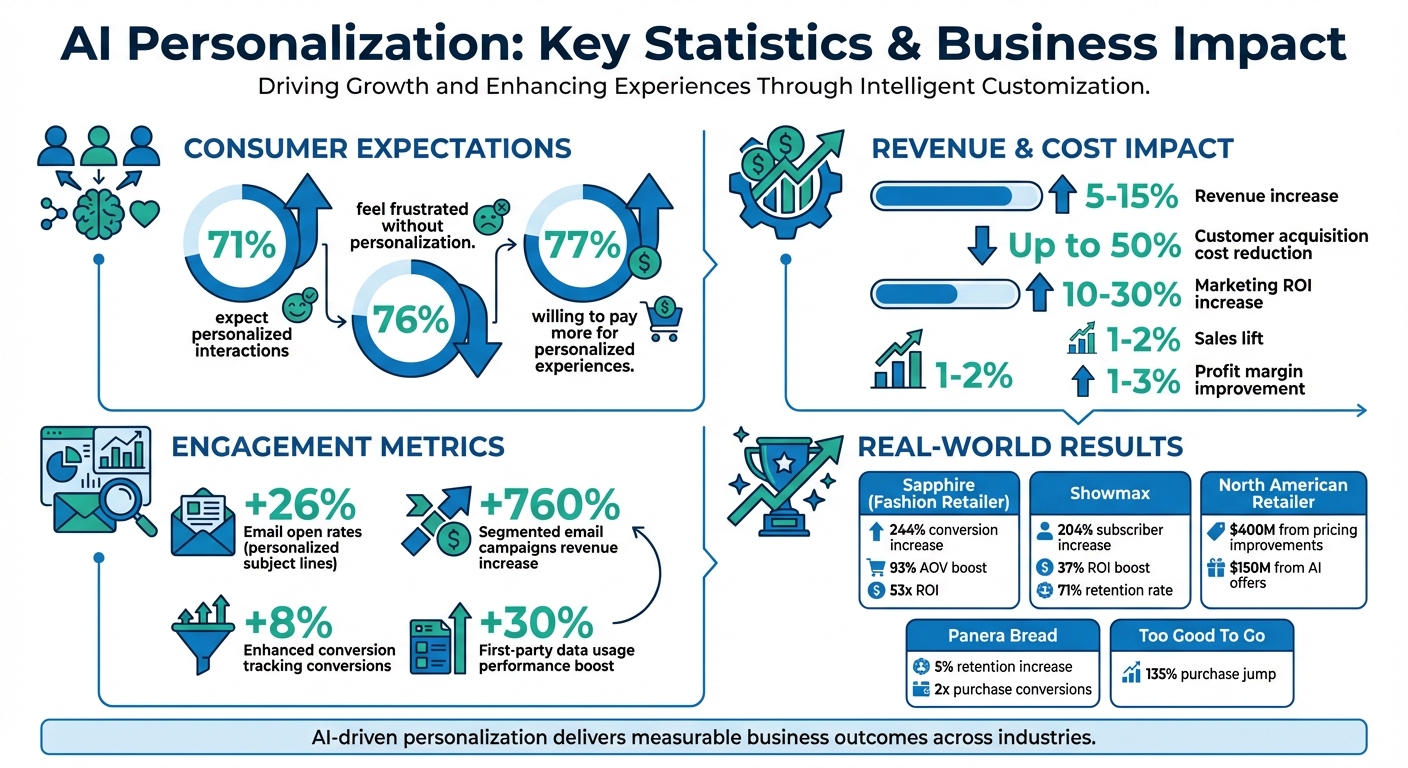
AI Personalization Impact: Key Statistics and ROI Metrics
How to use AI tool to predict user behavior?
How AI Collects User Behavior Data
AI-driven personalization starts with gathering three main types of data: behavioral, demographic/contextual, and transactional. These data sources help uncover customer interactions and preferences.
What sets AI apart from traditional analytics is its ability to capture subtle details like scroll depth, dwell time, and even moments of hesitation. These micro-signals provide insights into user intent before any action is taken, enabling real-time responses while the user is still engaged on the platform.
Behavioral Data
Behavioral data tracks every move a user makes on a website or app. This includes clicks, browsing history, search terms, time spent on specific pages, and the sequence of their interactions. For example, if someone repeatedly visits a product page but doesn’t add the item to their cart, the AI might interpret this as hesitation and respond by offering a discount or highlighting customer reviews. Even tracking scroll depth can reveal which sections of a page are engaging and which ones are being skipped.
In November 2025, Loftie, a wellness brand, introduced the Loftie Rest app. This app uses AI to analyze screen time, Apple Health data, and alarm-setting habits. Combining these insights with self-reported sleep quality, the app creates personalized bedtime stories and sleep coaching for its 15,000 subscribers.
"We use AI to pull in screentime data and Apple Health data, and layer that into data we have about your alarm-setting habits and your self-reported sleep quality and feedback." – Matthew Hassett, Founder and CEO of Loftie.
While behavioral data is critical, demographic and contextual details take personalization to the next level.
Demographic and Contextual Data
Demographic data - like age, location, and gender - lays the groundwork for a user profile. Adding real-time contextual details, such as the device being used, time of day, local weather, and IP address location, creates a more dynamic understanding. This approach ensures recommendations feel relevant to both the user’s identity and their immediate circumstances. For instance, a clothing retailer might suggest warm jackets to someone browsing from Alaska, while steering a Florida-based shopper toward lighter clothing. Similarly, a coffee shop app could promote hot beverages on rainy mornings by factoring in local weather data.
In 2025, Ikea introduced an AI assistant on the GPT store platform. This assistant offers furniture suggestions tailored to a user’s home size, style preferences, and budget. Within the first few months, 20% of interactions with the assistant led to visits to Ikea stores.
Transactional Data
Transactional data focuses on purchase history, cart activity, payment methods (like digital wallets), and price sensitivity. This data helps pinpoint what motivates a customer to buy and predicts when they’re likely to make a purchase. For example, if someone consistently buys organic coffee every three weeks, the AI could send a reorder reminder just before they run out. Additionally, tracking abandoned carts allows the system to adjust offers - like free shipping or discounts - based on what resonates most with the customer.
In December 2020, Grubhub launched its "Taste of 2020" campaign using the Braze API. By analyzing 32 custom attributes for each user - such as order frequency, favorite cuisines, and tipping habits - the campaign delivered personalized year-in-review emails. This effort led to a 100% increase in social media mentions and an 18% boost in word-of-mouth referrals.
Using Machine Learning to Analyze Behavior Patterns
Machine learning (ML) takes raw data and transforms it into actionable insights by continuously learning from every interaction. It doesn't just group users into categories - it evolves with each interaction, refining its predictions over time.
One key advantage of ML is its ability to consolidate fragmented user actions across devices - like a phone, laptop, or app - into a unified profile. Through identity resolution, ML identifies essential data points, such as time of day or scroll depth, to better predict future behavior. This leads to micro-segmentation, which goes beyond basic demographics to uncover more nuanced user groups.
Pattern Recognition and Segmentation
ML excels at grouping users based on shared behaviors and preferences using two core techniques: clustering and classification.
- Clustering: This unsupervised method identifies patterns among users who exhibit similar behaviors, such as browsing habits, campaign engagement, or product usage.
- Classification: This technique answers specific yes-or-no questions, like whether a user is at "high risk of churn" or "likely to convert".
Additionally, ML leverages collaborative and content-based filtering to predict user preferences. For example, Spotify analyzes user engagement data while tagging its library by genre, tempo, and mood. Over the decade leading to 2024, this approach helped Spotify grow its user base to over 600 million and boost annual revenue to $14 billion - a staggering 1,000% increase in both metrics. This success highlights how pattern recognition can fuel customer engagement.
Similarly, in December 2025, Showmax introduced a segmentation system using over 600 metadata tags to organize content by genre and user behavior. By delivering personalized, cross-channel messages through Braze, they achieved remarkable results: a 204% increase in subscribers, a 37% ROI boost, and a 71% retention rate. These numbers underscore how segmentation drives personalization and measurable business outcomes.
Predictive Analytics for Personalization
Predictive analytics takes segmentation a step further by estimating the likelihood of specific user actions, such as conversions, churn, or responses to discounts. ML models analyze both historical and real-time data to calculate propensity scores, which predict the probability of certain outcomes. This helps businesses tailor incentives - whether it’s a discount, early access, or a loyalty reward - based on a user's engagement history.
Between 2024 and 2025, a major North American retailer upgraded its marketing strategy by integrating legacy point-of-sale data with its marketing stack. This enabled the retailer to prioritize retention for frequent shoppers. By shifting from generic discounts to targeted, data-driven offers, the company generated $400 million in value from pricing improvements and another $150 million from AI-driven personalized offers - all within a single year.
"The shift isn't just from manual to automated. It's from fixed rules to living systems that adjust to every click, swipe, and purchase." – AI Digital
This dynamic learning process enables businesses to deliver real-time, personalized experiences that resonate deeply with their users.
Delivering Real-Time Personalization
AI takes the lead in transforming user experiences by interpreting behavior patterns and adjusting interactions almost instantly - often within 200 milliseconds. This lightning-fast responsiveness translates into tangible business benefits, such as a 1%–2% boost in sales and 1%–3% improvement in profit margins, thanks to precisely targeted promotions. Companies that excel in advanced personalization consistently outperform those relying on slower, manual methods. This rapid adaptability lays the groundwork for delivering dynamically tailored content and timely responses.
Dynamic Content Creation
Using predictive insights, AI customizes content in real time. Key website elements - like hero banners, testimonials, pricing details, and product recommendations - are adjusted based on a user’s intent and where they are in their journey. For example, instead of showing every visitor the same homepage, the system analyzes subtle cues, such as repeated visits to a pricing page or extended interaction with a product configurator, to determine whether the user is ready to make a purchase or still gathering information.
AI also incorporates external, real-time data to refine the experience further. Factors like location, weather, and device type come into play. If a user’s city is experiencing rain, an outdoor retailer might highlight rain gear instead of sunglasses.
"VWO's personalization features, combined with the Copilot insights and reporting, make it easy to identify opportunities and take action fast, helping us deliver tailored experiences that convert." – George Salib, Senior Manager of Digital Marketing at Orascom Hotels Management
Retail and eCommerce brands that introduce a second messaging channel for personalization often see 4.5X increases in purchases per user. Centralizing data is key to achieving this consistency. By merging website interactions, email communications, and mobile app behavior into a unified, real-time view through a Customer Data Platform (CDP), brands can create seamless experiences. For instance, if a user abandons a cart on mobile, they might receive a relevant email prompt within minutes, keeping the engagement alive.
Behavior-Triggered Responses
AI doesn’t just react - it acts. Specific user behaviors, like abandoning a cart or engaging with high-margin products, trigger immediate, targeted responses.
Take Panera Bread as an example. In April 2024, the company used an AI-driven decision engine integrated with Braze to manage a significant menu overhaul. They delivered 4,000 personalized offer combinations based on live session data, which resulted in a 5% increase in retention among at-risk customers and doubled purchase conversions. Similarly, Too Good To Go, a food-waste reduction app, utilized proximity-based notifications to inform users about nearby "Surprise Bags." This strategy led to a 135% jump in purchases and doubled the conversion rate for these messages.
AI continually refines its predictions to ensure the next-best action is always relevant. Marketers leveraging generative AI for personalized messaging report creating custom content - complete with tailored tone and imagery - up to 50 times faster than traditional methods.
sbb-itb-bec6a7e
AI Tools for Tracking and Personalization
For small and medium-sized enterprises (SMEs) aiming to adopt AI-driven personalization, there’s a range of specialized tools available. These tools help with data collection and delivering content in real time. The key is selecting the right platform - whether it’s a recommendation engine, a unified customer data solution, or a tool for managing cross-channel engagement. Each serves a specific purpose, so understanding their differences can save businesses from spending on redundant solutions. When properly integrated, these AI tools can simplify operations by consolidating data and automating personalized customer interactions.
Integrating AI Tools into Business Operations
To integrate AI tools into your existing systems, you’ll need to connect them through SDKs and APIs. Twilio Segment is an excellent starting point. It gathers and unifies real-time customer data from sources like websites, mobile apps, and email into a single, comprehensive profile. This eliminates fragmented data and ensures AI models work with accurate, reliable information. Once this centralized data is in place, businesses can activate it using advanced tools.
For instance, Amazon Personalize builds machine learning models with your imported data and delivers real-time recommendations through private APIs. It supports features like product suggestions, user segmentation, and personalized search results, all within your app. Meanwhile, Adobe Target focuses on session-specific personalization. Its "Next-hit personalization" feature uses real-time customer data to adjust on-site elements - like hero images, testimonials, or pricing - based on a user’s behavior during their visit.
For businesses managing multi-channel communication, Braze offers tools to create personalized customer journeys across email, push notifications, and SMS. Features like "Intelligent Timing" automatically identify the best moments to engage users, while "Predictive Events" detect when a customer is likely to make a purchase or leave, prompting immediate action.
"To thrive in this hyper-competitive market, businesses must harness the power of AI-driven personalization, leveraging real-time customer data to fuel growth." – Twilio Segment
If you’re looking for curated AI tools tailored to SMEs, AI for Businesses (https://aiforbusinesses.com) is a helpful resource. It provides a directory of AI-powered solutions to enhance operational efficiency and customer engagement.
Comparison of AI Tools
| Tool | Primary Function | Real-Time Capabilities | Data Processing Speed |
|---|---|---|---|
| Twilio Segment | Customer Data Platform (CDP) | Real-time data streaming and activation | High-speed ingestion and unification |
| Amazon Personalize | Recommendation Engine | Real-time recommendation API and batch workflows | High-speed model training and inference |
| Adobe Target | Experience Optimization | "Next-hit" personalization during active sessions | Real-time evaluation of visitor criteria |
| Braze | Cross-Channel Engagement | Real-time orchestration and behavioral triggers | Instant profile updates via streaming data |
The evolution from rules-based personalization to predictive AI marks a major shift in how businesses approach customer engagement. Traditional systems depend on static "if this, then that" logic, requiring constant manual updates to adapt to changing customer behaviors. In contrast, modern AI tools employ adaptive learning models. These models automatically differentiate between casual browsers and loyal customers, fine-tuning content delivery in the background without the need for constant human input.
Measuring the ROI of AI-Powered Personalization
To understand the financial impact of AI-driven personalization, it’s crucial to track specific performance indicators before and after implementation. Start by gathering 3–6 months of baseline data to account for seasonal variations and establish a solid benchmark. This historical data serves as the foundation for evaluating whether AI tools are delivering tangible business results.
The simplest way to calculate ROI is through this formula: (Revenue lift + Cost savings) / Total investment. Revenue lift typically comes from higher conversion rates, increased average order value (AOV), and improved customer lifetime value (CLV). On the cost side, AI personalization often reduces customer acquisition costs (CAC) - sometimes by as much as 50% - while increasing marketing ROI by 10% to 30%.
"Measurement without action is just data hoarding. Personalization winners... are the ones who can prove their efforts are moving the needle on metrics that matter." – Anubhav Verma, Associate Content Marketing Manager, Optimizely
When testing personalization, always use control groups. Divide your audience so one group experiences personalized content while another receives the standard version. This approach isolates the true impact of AI from external factors like holidays or market trends. For instance, in January 2026, Pakistani fashion retailer Sapphire ran a controlled test with AI-powered homepage banners and smart recommendations. The results? A 244% increase in conversions, a 93% boost in average order value, and a total ROI of 53x.
Key Metrics to Monitor
Focus on metrics that directly tie to revenue and customer behavior. Here are the key areas to watch:
- Engagement metrics: These include time on site, bounce rate, and pages per session, which help determine whether personalized content resonates with visitors. However, engagement alone isn’t enough - make sure it correlates with conversions.
- Conversion metrics: These measure immediate business outcomes like click-through rates, lead form completions, and purchase rates. For instance, emails with personalized subject lines are 26% more likely to be opened, and segmented email campaigns can drive a 760% revenue increase. In retail, AI-powered promotions often deliver a 1% to 2% lift in total sales and a 1% to 3% improvement in profit margins.
- Customer value metrics: Long-term indicators like customer lifetime value (CLV), retention rates, and churn rates reveal whether personalization fosters lasting relationships or just one-off transactions.
- Financial efficiency metrics: Metrics like customer acquisition cost (CAC) and marketing ROI help determine whether the investment in AI tools is paying off.
Marketers who use first-party data to fuel AI personalization report a 30% performance boost compared to those who don’t. Additionally, enhanced conversion tracking delivers 8% more conversions than standard methods. These improvements matter because 71% of consumers now expect personalized interactions, and 76% feel frustrated when companies fail to deliver.
Comparing Results Before and After AI Implementation
Side-by-side comparisons are essential for assessing the success of AI personalization. Use dashboards to display metrics by audience segment and personalization strategy. This lets you pinpoint which tactics yield the highest returns.
For example, in January 2026, Adidas implemented AI-powered personalization during a traffic surge, focusing on targeted coupons and category optimization. The result? A 259% increase in average order value from new users and a 35.5% boost in conversion rates from returning users within a month.
| Business Performance Metric | Before AI Personalization | After AI Implementation |
|---|---|---|
| Customer Acquisition Cost (CAC) | Baseline | Up to 50% reduction |
| Marketing ROI | Standard | 10–30% increase |
| Email Open Rates | Generic subject lines | 26% increase |
| Sales Margins | Mass discounts | 1–3% improvement |
| Conversion Accuracy | Standard tracking | 8% increase in conversions |
Samsung showcased the power of omnichannel personalization in January 2026 when launching the Galaxy Note. By targeting users interested in competitor devices with web push notifications and personalized messaging, Samsung achieved a 24% increase in conversion rates and a 275% contribution to overall conversion performance. Similarly, a European telecom company tested 2,000 personalized text messages, finding that customers receiving AI-enhanced messages engaged 10% more often than those who didn’t.
When calculating your total investment, don’t forget to include technology, personnel, and operational costs. Companies that use Marketing Mix Modeling (MMM) are over twice as likely to exceed revenue goals by 10% or more. Moreover, businesses leading in AI marketing see 60% faster revenue growth than their peers and adapt to consumer trends twice as quickly.
Conclusion
Personalization powered by AI has become a game-changer, especially as 71% of consumers expect tailored experiences, while 76% feel frustrated by generic interactions. For small and medium-sized enterprises (SMEs), AI tools offer the opportunity to move beyond static customer segments to real-time, behavior-driven profiles. This shift can result in impressive outcomes - like increasing revenues by 5–15%, reducing customer acquisition costs by up to 50%, and improving marketing ROI by 10–30%.
To put these insights into action, start with a targeted, data-driven strategy. Focus on gathering high-quality first-party data and ensuring your tools work seamlessly together. Over time, this approach will help refine your AI models and enhance personalization efforts. With 77% of consumers willing to pay more for brands that deliver personalized experiences, the business case for AI-driven personalization is undeniable.
Looking to take your customer interactions to the next level? AI for Businesses offers a carefully selected directory of AI tools designed to help SMEs and scale-ups optimize their operations. Explore how these tools can elevate your customer experience today with AI for Businesses.
FAQs
How does AI use data to create personalized user experiences?
AI crafts personalized experiences by examining behavioral data like browsing habits, purchase history, and interactions with digital platforms. Through machine learning, it detects patterns and predicts user preferences, allowing platforms to deliver customized recommendations, content, and messages in real time.
Take streaming services, for instance - they create playlists based on your listening history. Similarly, e-commerce platforms suggest products that align with what you've previously purchased. Even subtle behaviors, like how long you linger on a page or items left in your cart, are analyzed. This allows AI to adjust experiences on the fly, making interactions feel more relevant and engaging. The result? Users feel understood, which can lead to stronger satisfaction, loyalty, and connection with the platform.
What are the advantages of using AI for real-time personalization in businesses?
AI-powered real-time personalization allows businesses to craft experiences that feel tailor-made for each customer. By swiftly analyzing user actions - like clicks, purchases, or browsing habits - companies can respond in the moment, delivering interactions that feel relevant and timely. This level of personalization not only meets customer expectations but also increases engagement and satisfaction.
Beyond just engagement, this approach can improve conversion rates and foster loyalty. By dynamically adjusting content, offers, and messaging to align with individual preferences, businesses can create smoother and more meaningful customer journeys. The result? Stronger relationships and smarter decision-making.
On a broader scale, AI-driven personalization helps companies refine their marketing strategies, make better use of resources, and ultimately fuel growth. It’s a game-changer for businesses looking to stay ahead in a competitive landscape.
How can small businesses use AI tools to create personalized customer experiences?
Small businesses can tap into the power of AI tools to analyze customer data and deliver experiences that feel personal and engaging. By examining inputs like browsing history, purchase patterns, social media activity, and customer feedback, AI can craft tailored recommendations, targeted marketing messages, and customized service interactions.
To get started, it's essential to prioritize tools that are ethical, transparent, and compliant with privacy standards. AI can predict customer preferences, suggest products, or even handle routine inquiries through automation. This not only saves time but also helps nurture stronger customer relationships. Setting clear goals and working with accurate, high-quality data makes the integration process smoother, enabling businesses to gradually scale their personalization efforts and build long-term customer loyalty.