AI-powered compliance dashboards are transforming how businesses manage regulatory requirements. These tools use artificial intelligence, machine learning, and natural language processing (NLP) to streamline compliance monitoring, identify risks, and ensure organizations meet regulatory standards. Here's what you need to know:
- Purpose: Centralize compliance data, automate monitoring, and provide real-time alerts for potential issues.
- Key Benefits: Reduce manual work by up to 85%, cut error rates from 12% to 0.2%, and save businesses thousands annually.
- SME Advantage: Affordable solutions ($50–$500/user/month) offer enterprise-level compliance capabilities, helping small teams integrate AI to meet standards without large compliance staff.
- Technology: Predictive analytics, anomaly detection, and NLP simplify regulatory updates, flag risks early, and create audit-ready records.
- Impact: Companies using these tools report a 66% boost in compliance productivity and a significant drop in regulatory fines.
AI dashboards are reshaping compliance by shifting from reactive problem-solving to proactive risk management, saving time, money, and resources.
Azure AI Foundry demo | AI compliance made simple with AI control mapping
sbb-itb-bec6a7e
How AI-Powered Compliance Dashboards Work
AI-powered compliance dashboards take raw data and turn it into actionable insights by leveraging advanced AI technologies. The process begins with data ingestion, where the dashboard continuously pulls information from various systems like ERPs, CRMs, HR platforms, audit logs (e.g., Azure, Salesforce), and incident management tools (e.g., Jira, ServiceNow) through APIs. This real-time data processing creates a continuous stream of information, providing an up-to-date view of compliance and supporting informed decision-making.
After data is collected, specialized AI engines get to work. Natural Language Processing (NLP) scans and interprets complex regulatory documents to identify obligations, restrictions, and deadlines, mapping them to your internal policies to expose any gaps. Meanwhile, machine learning models analyze patterns in transactional and behavioral data, detecting anomalies such as potential money laundering activities or unauthorized access that might escape human attention. Predictive analytics adds another layer by using historical and current data to forecast risks, shifting the focus from reactive problem-solving to proactive risk management.
AI Technologies Used in Compliance Dashboards
The architecture of these dashboards depends on a variety of AI tools working together. For instance, Retrieval-Augmented Generation (RAG) ensures that AI insights are tailored to your organization’s specific policies, reducing the risk of inaccuracies often associated with generalized data. Tools like SHAP or LIME, known as explainability wrappers, provide user-friendly explanations for AI decisions - such as why a loan application was flagged as high-risk - offering transparency that regulators demand. Some systems even incorporate agentic AI, capable of autonomously handling complex, multi-step tasks like conducting ESG and sanctions screenings for vendors.
"The real opportunity lies in building proactive, resilient systems from the ground up... shifting the paradigm from reactive remediation to strategic prevention."
– Compliance & Risks
This shift toward prevention is supported by a robust technical foundation. Key features include immutable audit trails, often built with append-only logs or blockchain technology. These ensure that compliance records remain unaltered, a crucial requirement for regulations like the EU AI Act. Additionally, many dashboards can be deployed in Virtual Private Clouds (VPC) or on-premise environments, keeping sensitive legal data within the organization’s boundaries. These technologies enable real-time monitoring and rapid responses to compliance issues.
Real-Time Monitoring and Alerts
The system’s real-time monitoring capabilities take compliance management to the next level. Dashboards translate regulations into machine-enforceable policy code, which continuously checks live data against compliance rules, such as ensuring "All S3 buckets must enforce encryption". If violations occur or thresholds are breached, the system generates instant alerts via email, SMS, or in-dashboard notifications, prioritizing them based on their severity and potential business impact.
Some systems also include circuit-breakers that automatically halt operations when activities deviate from established safety parameters, preventing risks from escalating. Companies using these real-time tools report a 75% improvement in decision-making speed and a 60% reduction in compliance-related incidents, such as fines or breaches. Notably, over 50% of compliance officers now actively use or test AI-driven compliance solutions, a significant increase from 30% in 2023.
Benefits of AI-Powered Compliance Dashboards
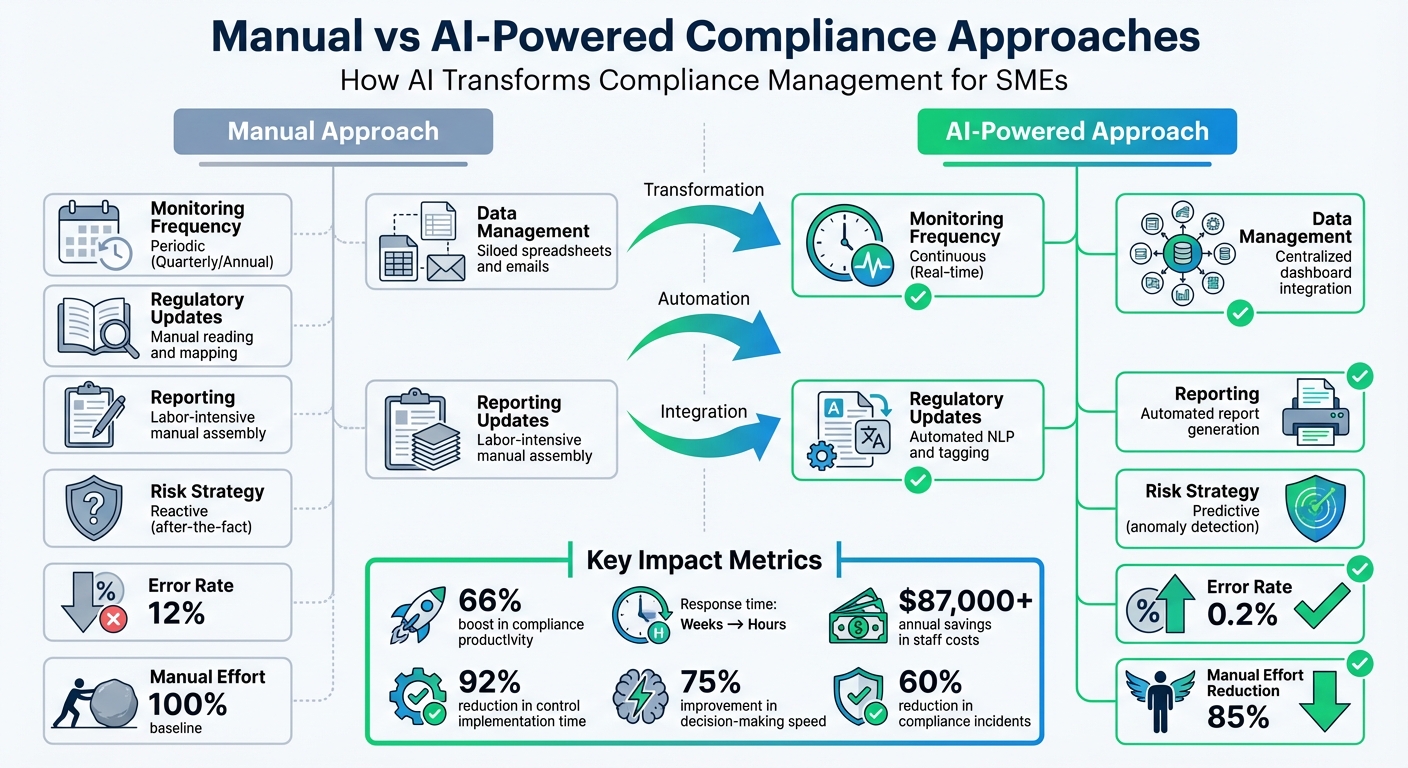
Manual vs AI-Powered Compliance: Efficiency and Impact Comparison
For small and medium-sized enterprises (SMEs), moving from manual compliance processes to AI-powered dashboards brings noticeable improvements in efficiency and cost control. Traditional approaches - like periodic audits, scattered spreadsheets, and manual checks - often leave businesses exposed to regulatory gaps and costly violations. With regulatory demands increasing, the need for automated solutions that centralize data and enable real-time risk detection has become more pressing. Automating compliance tasks addresses these challenges by offering continuous monitoring and instant response capabilities.
Efficiency Improvements Over Manual Methods
AI dashboards eliminate the delays associated with quarterly or annual audits by continuously monitoring compliance and flagging issues in real time. Using Natural Language Processing (NLP), these systems can automatically scan, tag, and map regulations, reducing response times from weeks to just hours.
For example, mid-sized companies have reported saving over $87,000 annually in staff costs by cutting manual reporting tasks from hours to mere minutes. Error rates also drop significantly - from about 12% to just 0.2% - eliminating the need for costly resubmissions and additional quality checks. AI tools can reduce manual effort in document review and regulatory mapping by 85% and cut the time needed to draft control implementations by 92%. Overall, these tools increase compliance productivity by an average of 66%.
| Feature | Manual Approach | AI-Powered Approach | Impact on Compliance |
|---|---|---|---|
| Monitoring Frequency | Periodic (Quarterly/Annual) | Continuous (Real-time) | Immediate detection of violations |
| Data Management | Siloed spreadsheets and emails | Centralized dashboard integration | Single source of truth; fewer errors |
| Regulatory Updates | Manual reading and mapping | Automated NLP scanning and tagging | Response time reduced from weeks to hours |
| Reporting | Labor-intensive manual assembly | Automated report generation | Always audit-ready |
| Risk Strategy | Reactive (after-the-fact) | Predictive (anomaly detection) | Prevents costly violations |
These efficiency improvements not only simplify operations but also pave the way for cost savings and reduced risk exposure.
Cost Savings and Risk Reduction
Beyond improving efficiency, AI dashboards significantly cut costs by preventing compliance violations before they happen. For instance, GDPR fines reached approximately $1.3 billion in 2024, highlighting the financial risks of non-compliance. Predictive analytics can identify patterns and anomalies that might otherwise go unnoticed, allowing businesses to address potential issues proactively instead of reactively. This shift from reacting to foresight helps reduce penalties, legal expenses, and potential damage to reputation.
AI systems also lower operational costs by minimizing the need for large compliance teams. With these tools, organizations can monitor thousands of events simultaneously without requiring a proportional increase in staff. While enterprise-level implementations may demand six-figure investments for custom integrations, these costs are typically recouped within 12–18 months through reduced manual labor and avoided fines. For SMEs with tighter budgets, cloud-based platforms offer affordable options, with pricing ranging from $50 to $500 per user per month. This makes AI-powered compliance solutions accessible and practical for smaller businesses.
Key Features of AI-Powered Compliance Dashboards
When assessing AI-powered compliance dashboards, businesses should prioritize features that simplify compliance management and deliver actionable insights. These tools are designed to centralize data and keep organizations aligned with evolving regulations.
Real-Time Data Integration and Custom Visualizations
AI-powered compliance dashboards excel at integrating data from systems like ERP, CRM, HR, LMS, and SIEM through APIs. This eliminates manual data entry and consolidates scattered information into a unified view, creating a reliable source for compliance tracking.
Interactive visualizations, such as KPI cards, heatmaps, and drill-down-enabled donut charts, make it easier to pinpoint compliance gaps. For instance, a compliance officer might notice a red zone on a heatmap, click it, and instantly access details about missed training deadlines or flagged transactions.
Customization is another standout feature. Role-based views ensure that executives see high-level trends, while managers receive detailed, team-specific insights. Some dashboards even allow users to refine visualizations using natural language prompts like, "Show me audit findings by priority", removing the need for complex formulas.
Beyond visualization, these dashboards actively support compliance through advanced regulatory monitoring and anomaly detection.
Regulatory Scanning and Anomaly Detection
AI-powered dashboards continuously scan regulatory feeds, agency websites, and news sources to identify new rules as they appear. Using Natural Language Processing (NLP) and Large Language Models (LLMs), they break down complex regulations into actionable obligations, deadlines, and restrictions. These are then mapped to internal policies, highlighting gaps automatically - a process that has cut manual regulatory reviews by 85%.
Anomaly detection runs in the background, analyzing transactions, communications, and operations to spot irregular patterns that could signal compliance breaches. Machine learning identifies unusual activities, such as suspicious transactions or communications, and flags them early. The system also maintains tamper-proof logs of every event, creating an audit trail that regulators can trust.
To ensure transparency, leading dashboards include tools like SHAP or LIME to explain why certain activities are flagged as high-risk. They also feature "circuit-breakers" or "stop buttons", enabling compliance officers to pause or override AI-driven decisions when necessary. This human-in-the-loop approach ensures AI remains a supportive and transparent tool for compliance management.
Common Challenges and Solutions
Rolling out AI-powered compliance dashboards isn’t without its hurdles. Businesses often face obstacles during deployment, but understanding these challenges - and how to address them - can make the process smoother and more effective. Below, we’ll explore some common issues and practical ways to overcome them.
Managing Data Privacy Concerns
One major worry for businesses is the potential for data leakage. Sensitive information could be misused, either by being exposed outside the organization or by inadvertently training public AI models. This concern becomes even more critical under regulations like GDPR, which imposed hefty fines in 2024.
To address this, it’s essential to choose AI tools that ensure your data stays private. Look for platforms that guarantee no third-party model training and keep all data within a secure environment. Encryption and Privacy Impact Assessments (PIAs) can further safeguard sensitive information throughout the AI’s lifecycle. This ties into earlier discussions about real-time monitoring safeguards, which reinforce data integrity.
Another key step is ensuring that AI dashboards respect existing user permissions. By integrating with identity systems like Microsoft Entra or SharePoint, these tools can automatically enforce user-level access controls. This reduces the risk of sensitive data being exposed to unauthorized users. It’s also worth noting that non-compliance with regulations like the EU AI Act can result in penalties as high as 7% of global annual turnover.
Making AI Decisions Understandable
Transparency is just as critical as privacy. When AI decisions are unclear, compliance officers are left frustrated, unable to understand why a specific transaction or policy violation was flagged. Regulators are increasingly demanding clarity, with GDPR Article 22 granting individuals the right to understand automated decisions that impact them.
"The algorithm decided is not an acceptable explanation." - Julie Banfield, Product Manager, IBM
Explainable AI (XAI) tools offer a solution by making AI outcomes easier to interpret. For instance, tools like SHAP and LIME provide human-readable explanations for AI decisions. Retrieval-Augmented Generation (RAG) can further enhance transparency by anchoring AI claims to verifiable internal policies or regulatory texts, showing exactly which clause triggered a flag. Decision trees and flow diagrams also help visualize the AI’s reasoning process.
To maintain control, human-in-the-loop systems allow compliance officers to review and, if necessary, override AI-driven decisions before they’re finalized. Circuit-breakers can also be implemented to halt AI processes if they deviate from predefined safety parameters. This structured approach to explainability can significantly reduce the workload for manual audits - by as much as 70% to 80%.
Table: Challenges and Solutions
| Challenge | AI Solution | Example Benefit |
|---|---|---|
| Data Privacy/Leakage | Encryption and private environment hosting | Keeps sensitive data within the organization and prevents public model training |
| Opaque Decisions | Explainable AI (XAI) wrappers and RAG | Shows compliance officers the exact policy or clause behind a flagged risk |
| Regulatory Change | NLP-driven regulatory scanning and mapping | Cuts down the time to analyze new regulations from weeks to hours |
| Human Oversight | Intervention dashboards and human-in-the-loop | Allows experts to correct or override AI decisions, avoiding goal drift |
| Audit Readiness | Immutable logging of AI interactions | Provides a secure, tamper-proof record for regulatory audits |
Conclusion
AI-powered compliance dashboards are transforming how SMEs handle regulatory management. Instead of relying on manual processes, businesses now benefit from real-time monitoring that identifies risks before they escalate into costly penalties. This shift from periodic audits to proactive oversight enables companies to detect negative trends early and act immediately.
The numbers back this up. Companies using AI-driven compliance tools report an average 66% increase in productivity. With regulatory violations costing businesses an average of $15 million annually and compliance requirements growing by over 200% in the last decade, automation offers a clear path forward. Many businesses see a return on investment within 12 to 18 months, thanks to reduced labor costs and avoided fines.
"89% of risk, fraud & compliance professionals rated AI a 'force for good' in a 2024 Thomson Reuters survey." - RegScale
To get started, focus on automating high-volume, repetitive tasks like monitoring regulatory changes or drafting compliance documents. While AI handles data-heavy tasks and pattern recognition, human oversight remains essential for ethical decisions and strategic planning. Ensure your data is clean and standardized before integrating it with AI systems to minimize errors.
If you're considering AI compliance tools, AI for Businesses provides a curated selection tailored for SMEs and scale-ups. Their platform offers cost-effective solutions that make enterprise-level compliance accessible to smaller organizations.
Key Takeaways
AI-powered compliance dashboards bring clear advantages to businesses. They consolidate all compliance metrics into a single interface, eliminating the hassle of navigating fragmented systems. Real-time alerts and predictive analytics help you address potential violations before they lead to penalties or harm your reputation.
Automated tools reduce the time needed to interpret new compliance requirements from weeks to hours, while user-friendly natural language interfaces allow anyone on your team to generate reports without specialized expertise. Features like immutable audit trails and explainable AI ensure you're always prepared for audits, with tamper-proof records that clearly show how decisions were made.
These tools also grow with your business. As regulations become more complex, AI systems adapt without requiring significant increases in staffing. With over 50% of compliance officers now using or testing AI (up from 30% in 2023), the real question is not if you should adopt these tools, but how quickly you can implement them to remain competitive. By embracing AI now, you can achieve proactive, cost-efficient compliance that scales with your needs.
FAQs
What data sources can an AI compliance dashboard connect to?
An AI compliance dashboard integrates with various data sources such as accounting systems, regulatory updates, public datasets, internal policies, and compliance-related documents. By linking these sources, it simplifies monitoring processes and helps businesses maintain alignment with compliance requirements efficiently.
How do these dashboards explain why something was flagged?
AI-powered compliance dashboards leverage explainable AI (XAI) to make it clear why specific issues or risks are flagged. These systems dig into data, pinpoint potential problems, and offer clear explanations for each alert. Often, they tie these alerts to specific data points or rule violations, making it easier to trace the root cause.
What sets these dashboards apart is their use of visual explanations and traceable reasoning. This helps compliance teams not only understand why something was flagged but also evaluate its validity and decide on the next steps. The result? Greater transparency, better regulatory alignment, and improved readiness for audits.
How do you keep sensitive compliance data private with AI?
Sensitive compliance data can remain private when leveraging AI by employing methods like federated learning. This approach ensures that data stays on local devices, sharing only encrypted updates rather than raw information.
To further safeguard this data, consider implementing measures such as:
- Role-based access controls: Restrict access to sensitive information based on user roles.
- Data redaction: Mask or remove sensitive details from datasets.
- Retention policies: Define clear rules for how long data is stored and when it should be deleted.
- Vendor due diligence: Thoroughly vet third-party providers to ensure they meet security and compliance standards.
These steps help create a secure environment for managing compliance data while maintaining privacy.