AI-powered adaptive UIs are transforming digital experiences by tailoring them to individual user needs in real time. This article explores how companies like Duolingo, Sephora, Grammarly, and Bank of America use AI to create dynamic, user-focused interfaces that boost engagement, retention, and efficiency.
Key insights include:
- Duolingo: Uses machine learning to personalize language lessons, improving retention by 12%.
- Sephora: Employs AR and AI for virtual makeup trials, tripling purchase likelihood and reducing returns by 30%.
- Grammarly: Combines NLP and user feedback to enhance writing quality, saving users time and improving productivity by 40%.
- Bank of America: Leverages NLP and predictive analytics with its Erica assistant, achieving a 98% query resolution rate and enhancing customer satisfaction.
These case studies demonstrate how businesses, regardless of size, can leverage AI to deliver tailored user experiences that drive measurable results.
AI Interfaces Of The Future | Design Review
Case Study 1: Duolingo – Adaptive Learning Paths
Duolingo has turned language learning into a fun, game-like experience. At the core of this system is BirdBrain, a machine learning engine that predicts how likely a learner is to answer a question correctly. It does this by analyzing factors like how many times a word has been seen, the accuracy of past answers, the practice modes used, and the time since the learner's last session.
How Duolingo Uses AI
BirdBrain relies on massive data processing to strike the right balance between challenging and accessible content. Built using PyTorch on AWS, it trains on data from 500 million lessons and makes 300 million predictions every day to identify exercises that might challenge users .
In tandem with Duolingo's Session Generator, BirdBrain skips over topics learners already know and focuses on material they find harder. Klinton Bicknell, Ph.D., Head of AI at Duolingo, highlights this approach:
"A great teacher also knows what you know, so that they can teach you exactly what you need to know next".
Boosting Engagement and Retention
This smart personalization has had a noticeable impact on user engagement. After Duolingo introduced BirdBrain in March 2020, its adaptive learning paths quickly began to show results. By October 2020, over 20% of all lessons on the platform were personalized by BirdBrain. A/B testing conducted by Duolingo's AI team showed that learners engaged with BirdBrain-personalized lessons completed more exercises in one session and returned to the app more consistently.
The use of deep learning for these tailored lessons led to a 12% improvement in second-day retention. Klinton Bicknell further explains:
"Learners who had lessons constructed using Birdbrain are more likely to continue learning by doing more lessons and are also more likely to return again day after day".
This personalized approach has been key to retaining millions of users, proving that customization isn’t just a perk - it’s essential for keeping learners engaged.
Case Study 2: Sephora – Virtual Artist for Personalized Beauty
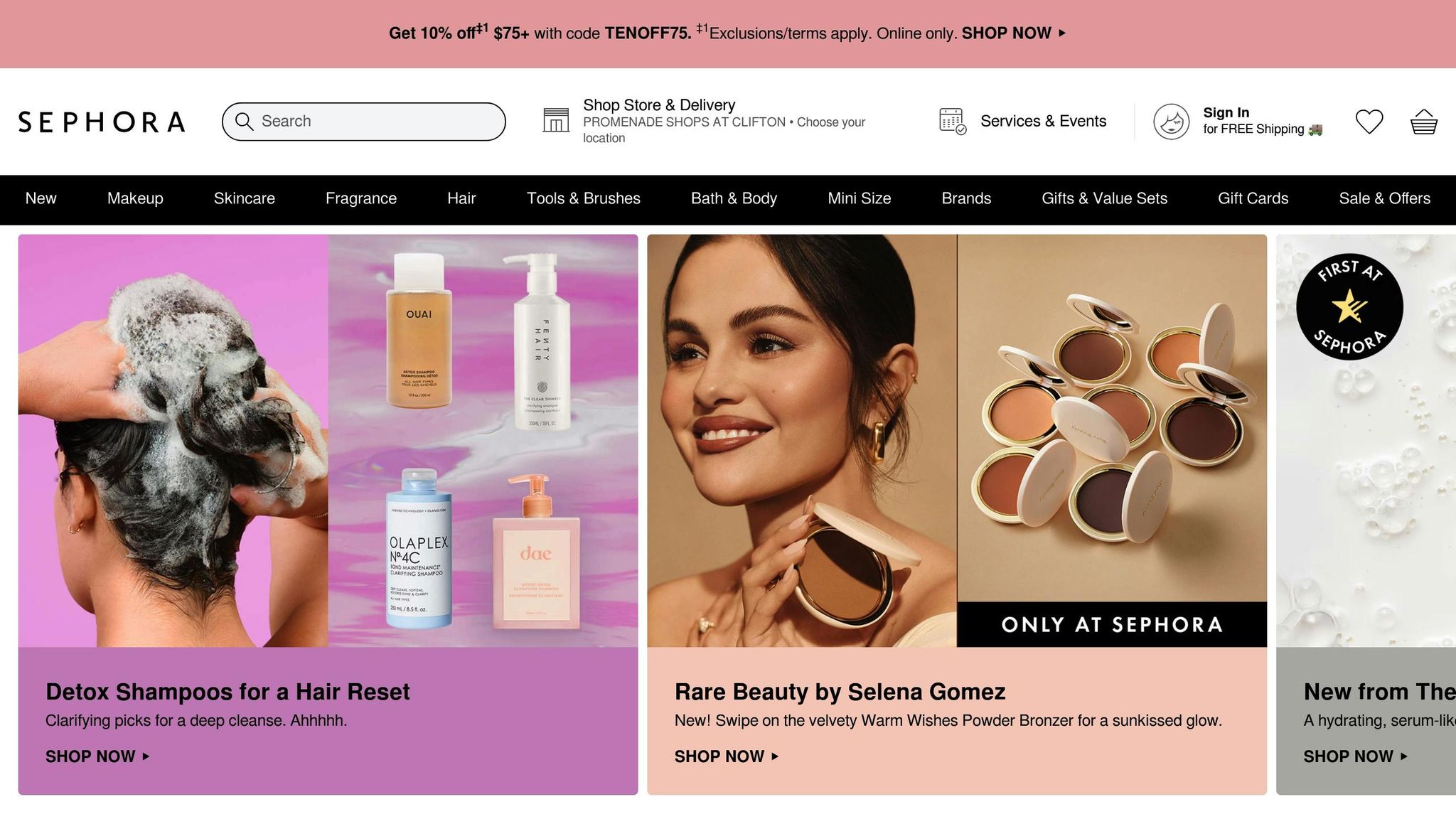
Sephora's Virtual Artist is a standout example of how tailored experiences can transform user engagement. Back in 2016, Sephora teamed up with ModiFace to launch this tool, which uses augmented reality and facial recognition to map facial features in real-time. The result? Users can virtually try on products before committing to a purchase - a game-changer for beauty enthusiasts.
This technology isn’t confined to just one platform. It’s available on Sephora’s mobile app, website, Facebook Messenger, and even in-store Beauty Hub kiosks with interactive mirrors. One standout feature, Color Match, analyzes photos or live video feeds to recommend foundation and concealer shades. This directly addresses a major pain point for 70% of women: mismatched foundation. It’s a practical and innovative way to take virtual trials to the next level.
AI-Powered Virtual Makeup Trials
At the heart of Virtual Artist is computer vision technology, which tracks facial features with pinpoint accuracy. Mary Beth Laughton, EVP of Omni Retail, sums up Sephora’s approach perfectly:
"Digital and innovation have always been part of our DNA at Sephora... we've got to be where our clients are, and give her tools and experiences that meet her needs."
By 2018, the impact of this tool was clear: over 200 million virtual shade try-ons and 8.5 million visits. But it doesn’t stop there. Virtual Artist uses purchase history and user preferences to refine its recommendations, ensuring a personalized shopping experience every time.
Business Outcomes
The numbers speak volumes. Virtual Artist users are three times more likely to make a purchase, and makeup returns have dropped by 30%. Session times have quadrupled, jumping from 3 minutes to 12, and order values have increased by 25%. Even more impressive, repeat customer rates have risen by 17%. Between 2016 and 2022, Sephora’s e-commerce net sales skyrocketed from $580 million to over $3 billion, with digital tools like Virtual Artist playing a key role.
The success isn’t limited to online platforms. The Color Match tool on Facebook Messenger boosted in-store booking rates by 11% within just two years. Parham Aarabi, CEO of ModiFace, highlighted Sephora’s forward-thinking mentality:
"Sephora has gotten it from day one, wanting and incorporating new ideas. It's great to have a partner that believes in technology."
Case Study 3: Grammarly – Real-Time Writing Suggestions
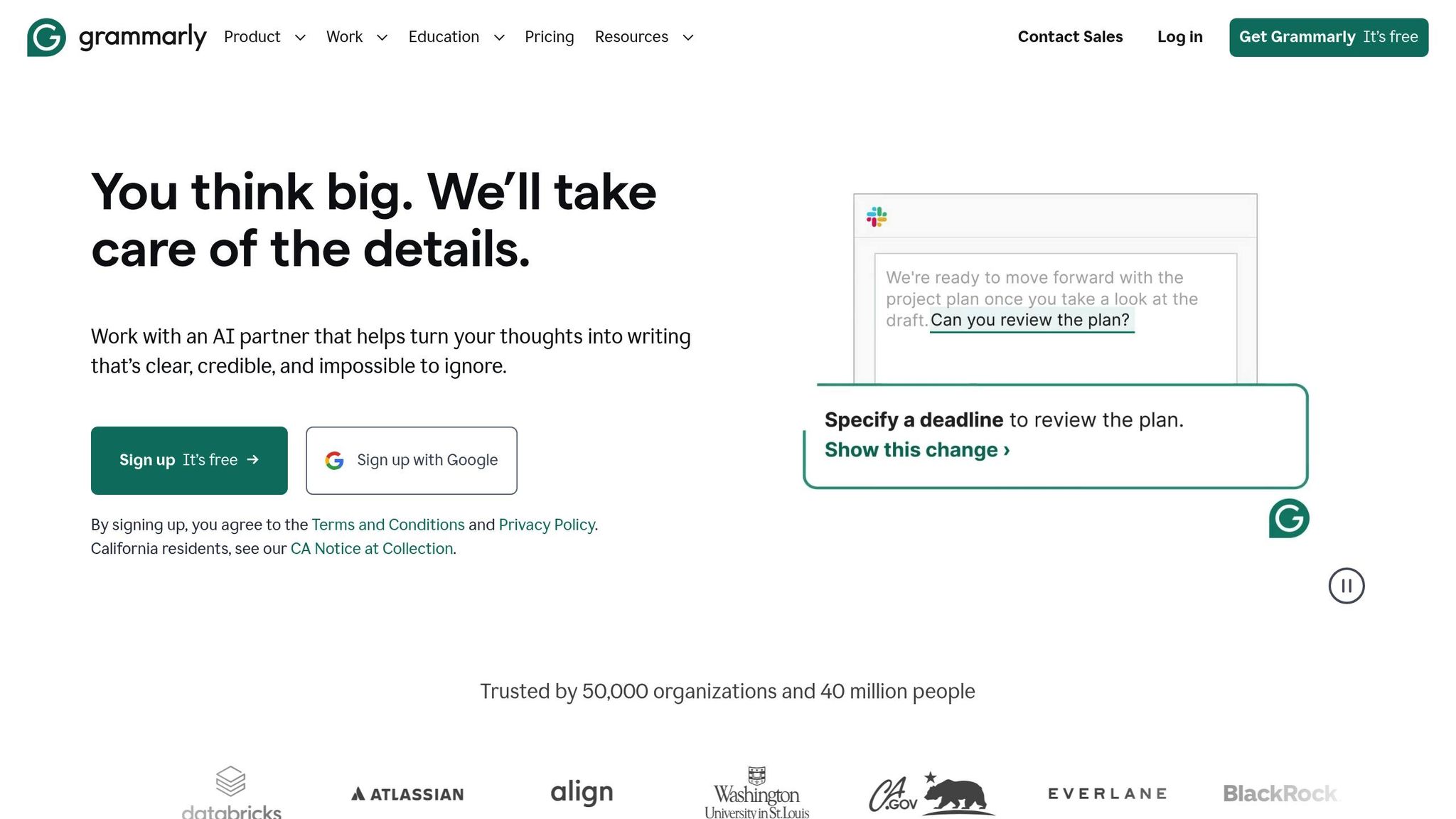
Grammarly takes writing assistance to a new level by using AI to adapt and enhance user experiences dynamically. The platform approaches writing as a type of translation - turning flawed English into polished, accurate text. By combining deep learning, rule-based systems, and expert linguistic insights, Grammarly provides real-time feedback across over 1 million websites and apps. What makes it stand out is its ability to learn from user behavior, becoming more effective with every accepted or dismissed suggestion.
Grammarly’s interface is designed for clarity and ease of use. It highlights issues with colored underlines, categorizing them into areas like correctness, clarity, or engagement, and uses a floating widget to suggest improvements. Users can tailor their experience by selecting specific writing styles, dialects, or goals, such as "professional" or "convincing". This adaptability not only personalizes the writing process but also ensures the tool evolves and improves based on user interaction.
Personalized Writing Assistance
Grammarly doesn’t just fix mistakes - it boosts productivity. Professionals using the platform reported a 20% reduction in errors, cutting out 30–70 mistakes daily. Teams that integrated Grammarly into their workflows saw a 40% increase in output, measured by words-per-minute. Additionally, users spent 71% less time idling while drafting emails, as Grammarly kept them focused and streamlined their writing process.
The results speak for themselves. Zoom, for instance, reclaimed over 7,000 hours of productivity within nine months by leveraging Grammarly’s real-time style guidance. Databricks saved $1.4 million annually by using tone and clarity suggestions to elevate everyday writing into a strategic tool. Similarly, Frost & Sullivan managed to cut report editing time by 66% while doubling their project output.
Improvements in User Experience
These features directly enhance both user satisfaction and operational efficiency.
Grammarly boasts a 4.9/5 customer satisfaction rating and serves 50,000 organizations alongside 40 million daily users. In one internal study, when the Customer Care team temporarily lost access to Grammarly, their Customer Satisfaction (CSAT) scores dropped by 20%.
"Our employees are massive fans - Grammarly is in that class of technologies in which the individual benefit means something to them".
On top of that, teams using Grammarly reported a 283% ROI and saved 1,600 hours annually thanks to real-time style guidance. Organizations also reported saving an average of $5,000 per employee per year, proving that adaptive interfaces like Grammarly’s can deliver tangible benefits by understanding and addressing user needs effectively.
sbb-itb-bec6a7e
Case Study 4: Bank of America – Erica Virtual Assistant

Bank of America introduced its virtual assistant, Erica, in 2018 with the goal of anticipating and addressing customer needs. By August 2025, Erica had supported nearly 50 million users through an impressive 3 billion interactions, averaging 58 million per month. With over 75,000 updates enhancing its functionality, Erica now operates with a library of more than 700 predefined responses.
Powered by Natural Language Processing (NLP) and Machine Learning (ML), Erica deciphers user input to understand intent and provide tailored financial guidance. It offers proactive notifications based on user behavior, such as spending patterns, balance forecasts, and scheduled payments. For instance, Erica can predict a customer’s balance trends over the next week or suggest personalized cash-back opportunities.
AI-Driven Adaptations for Financial Services
Erica’s intelligence evolves to meet a broad spectrum of banking needs. It handles everyday tasks like locking debit or credit cards and searching for transactions while seamlessly transferring more complex inquiries to human financial specialists when necessary. This approach has proven highly effective, achieving a 98% containment rate, meaning the vast majority of users get the answers they need without requiring human assistance.
Erica’s capabilities extend beyond retail banking into specialized services. In wealth management, tools like askMERRILL and askPRIVATE BANK - built on Erica’s AI foundation - recorded 23 million interactions in 2024. These tools help advisors gather insights and engage clients with timely investment opportunities. For corporate clients, the CashPro Chat tool now manages over 40% of client interactions, assisting businesses with treasury management and transaction tracking. Nikki Katz, Bank of America’s Head of Digital, highlighted Erica’s role:
"Erica is the bedrock upon which we've built an unmatched high-tech, high touch client experience".
Efficiency and Customer Satisfaction
Erica’s features deliver clear benefits to customers, enhancing satisfaction and efficiency. Customers have spent 18.7 million hours engaging with Erica, receiving over 1.7 billion personalized insights. This success has earned Erica recognition, including being named the "Best Chatbot/Virtual Assistant in the U.S. and North America" by Global Finance magazine. Additionally, J.D. Power ranked Bank of America highest in customer satisfaction for its retail banking advice and mobile app experience. Like Duolingo and Sephora, Erica’s ability to personalize interactions has been a key factor in its success.
Internally, Erica has transformed operations as well. The Erica for Employees tool has achieved over 90% adoption among the bank’s 213,000 staff, cutting IT service desk calls in half and improving developer efficiency by more than 20%. Aditya Bhasin, the bank’s Chief Technology and Information Officer, reflected on the broader impact:
"AI is having a transformative effect on employee efficiency and operational excellence".
Key Takeaways from Case Studies
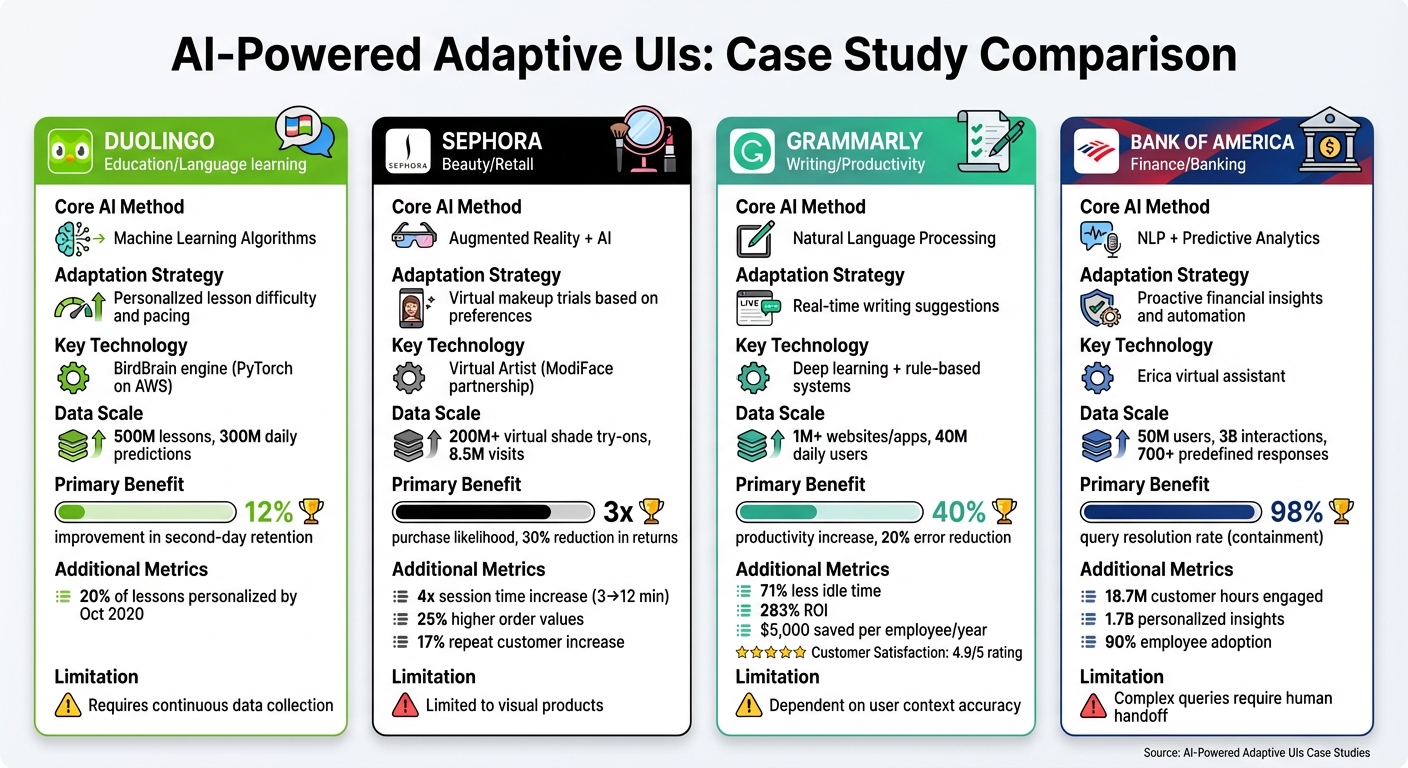
AI-Powered Adaptive UI Case Studies: Comparative Analysis of Duolingo, Sephora, Grammarly, and Bank of America
Key Adaptive UI Patterns
In all four case studies - Duolingo, Sephora, Grammarly, and Bank of America - companies transitioned from static interfaces to dynamic, personalized systems. These organizations rely heavily on user insights to drive personalization, ensuring their designs address real user needs while avoiding unnecessary complexity. Instead of relying on rigid demographic categories, they focus on adapting to users' immediate intent.
One emerging approach is non-deterministic design, where interfaces adjust dynamically based on context. Yannis Paniaras, Principal Designer at Microsoft Digital Studio, highlights this shift:
"Designers are shifting their focus from standard UI towards the vocabulary of prompts, dynamically designed adaptive cards, and finding consistency within the UX context".
A unified data foundation plays a crucial role in these adaptive UIs. For example, Bank of America's Erica uses centralized data to deliver accurate insights, while Duolingo refines its learning algorithms based on user activity. High-quality data is essential for these systems to provide relevant and accurate responses.
The table below summarizes the strategies and outcomes from these case studies.
Comparative Analysis Table
Here’s a side-by-side comparison of the approaches and results seen across these companies:
| Company | Core AI Method | Adaptation Strategy | Benefit | Limitation |
|---|---|---|---|---|
| Duolingo | Machine learning algorithms | Personalized lesson difficulty and pacing | Higher engagement and retention | Requires continuous data collection |
| Sephora | Augmented reality + AI | Virtual makeup trials based on preferences | Increased product discovery and sales | Limited to visual products |
| Grammarly | Natural language processing | Real-time writing suggestions | Improved writing quality and satisfaction | Dependent on user context accuracy |
| Bank of America | NLP + predictive analytics | Proactive financial insights and automation | Enhanced query handling and support | Complex queries require human handoff |
Recommendations for SMEs
For small and medium-sized enterprises (SMEs), these case studies offer valuable lessons for implementing adaptive UIs effectively.
Personalized interfaces can significantly boost engagement and efficiency. Start small - like Saks Fifth Avenue, which tested intent-based personalization on just 5% of its traffic before scaling up. This gradual approach allows you to gather insights, demonstrate value, and refine your system before committing to larger investments.
Prioritize data quality over sheer volume. Chris Yu, Senior Vice President at U.S. Bank, underscores the importance of actionable data:
"The only way to present relevant information the customer is looking for, in the moment they're looking for it, is to have a platform that provides predictive insights".
To achieve this, consolidate data from all touchpoints - whether it’s your website, mobile app, or physical store - to create a unified customer view.
Finally, consider using pre-built AI tools rather than developing custom solutions from scratch. Platforms like AI for Businesses offer ready-made AI capabilities tailored to SMEs. These tools can simplify the implementation of adaptive UIs while keeping costs manageable and reducing the need for extensive technical expertise.
AI for Businesses: A Resource for SMEs
Small and medium-sized enterprises (SMEs) often face a tough challenge when it comes to choosing AI tools, especially for adaptive user interfaces. With an 80% failure rate for AI projects, it’s no wonder many businesses feel overwhelmed. That’s where AI for Businesses steps in. This platform offers a carefully curated directory of AI tools, specifically tailored for SMEs and scale-ups, to simplify the decision-making process.
The directory highlights proven tools like Writesonic for creating adaptive content, Drift and Intercom for customer interaction chatbots, and Rezi for automating HR tasks. These solutions are ready to deploy and designed to address common business needs. With AI adoption rates jumping from 48% to 72% in just one year, having a reliable resource to navigate the crowded AI landscape is more important than ever. This platform streamlines the search for effective and trustworthy AI tools, saving businesses time and effort.
AI researcher Vicki Larson emphasizes the importance of agility in AI adoption:
"The companies winning with AI aren't necessarily the ones with the biggest budgets or the fanciest technology. They're the ones who experiment fast, learn from failures, and scale what works".
The platform offers flexible pricing to accommodate different business needs: a free Basic plan, a $29/month Pro plan, and custom Enterprise options.
For businesses looking to integrate AI, the key is to start small. Identify a specific operational bottleneck - like slow customer support response times or ineffective product recommendations - and test a solution from the directory. Research shows that companies focusing on value creation and scalability are 2.5x more likely to achieve meaningful returns on their AI investments. Using a targeted approach with tools from a trusted directory can be far more effective than attempting to build custom solutions from scratch. This resource empowers SMEs to replicate the successes seen in case studies and make AI work for their unique needs.
FAQs
How do AI-powered adaptive user interfaces enhance engagement and retention?
AI-powered user interfaces are transforming how people interact with digital platforms. By customizing the experience based on each user's preferences, behavior, and context, these interfaces adjust elements like layout, content, and functionality in real time. The result? A smoother, more intuitive experience that feels tailor-made.
Take businesses as an example - those leveraging AI-driven personalization tools often see noticeable boosts in user satisfaction, engagement, and even conversion rates. Why? Because these interfaces serve up relevant content and recommendations on the spot, cutting down on frustration and making tasks easier to complete. This approach not only reduces mental effort but also builds trust, encouraging users to stick around and return. It’s all about creating a responsive experience that feels effortless and keeps people coming back for more.
Why is data quality important for AI-powered adaptive user interfaces?
The success of AI-driven adaptive user interfaces hinges on the quality of the data they rely on. High-quality data enables AI models to make precise predictions, create personalized user experiences, and adjust seamlessly to changing user behaviors. On the flip side, poor-quality data - whether incomplete, biased, or inconsistent - can lead to inaccurate outputs, frustrating interactions, and diminished user trust.
To keep adaptive UIs functioning effectively, businesses must prioritize clean, unbiased, and consistent data. Regular monitoring and thorough quality checks are essential to catch errors early and maintain accurate, user-focused interactions. As adaptive interfaces become more prevalent, putting data quality at the forefront is critical for delivering smooth, reliable, and trustworthy user experiences.
How can small businesses start using AI-powered adaptive user interfaces?
Small businesses can tap into AI-powered adaptive user interfaces (UIs) by focusing on solving specific problems, like enhancing customer service or simplifying internal operations. The key is to start with small, focused projects that use AI to handle repetitive tasks or tailor experiences to user preferences. Each initiative should have a clear, measurable goal.
To begin, ensure your data is organized and choose tools that are easy to implement and scale. Ready-made AI solutions are a budget-friendly option, especially for businesses without deep technical expertise. Once you’re comfortable, you can tweak these tools to better suit your needs and track their performance to ensure they’re hitting the mark. The best approach? Start small, learn as you go, and build from there.