AI is transforming how small and medium-sized businesses (SMEs) handle performance management. Traditional methods are often inefficient, biased, and lack proper data, leaving managers overwhelmed and employees dissatisfied. AI solves these issues by automating tasks, providing objective insights, and predicting trends like burnout or turnover. Here's what AI can do for SMEs:
- Save Time: Automates data collection and report generation, reducing review preparation time by up to 87%.
- Improve Accuracy: Uses metrics like project completion rates to eliminate bias and ensure fair evaluations.
- Boost Retention: Predicts employee risks like burnout, helping businesses act early and retain talent.
- Cut Costs: Offers affordable solutions starting at $8 per employee per month, far cheaper than traditional HR methods.
AI makes performance management faster, fairer, and more efficient, helping SMEs focus on growth without the usual HR headaches.
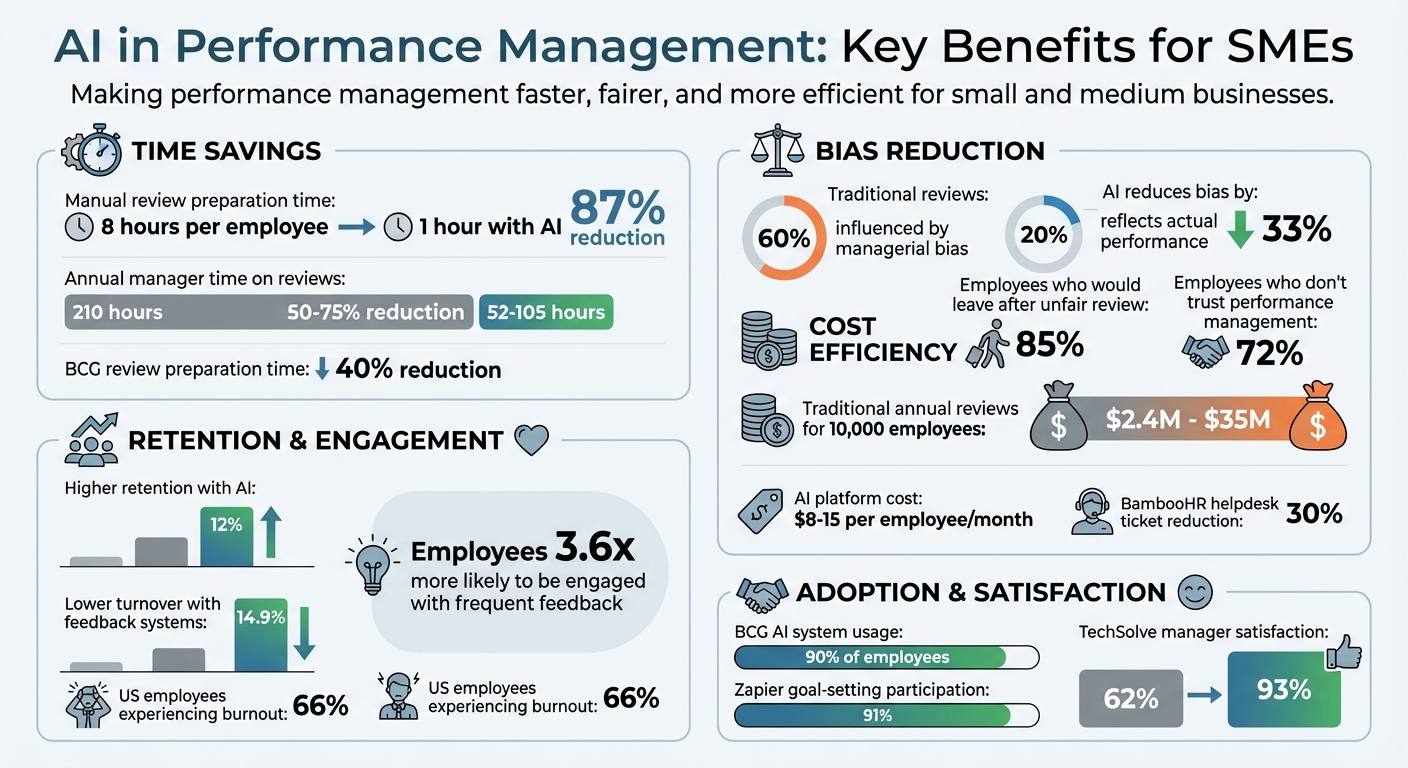
AI Performance Management Benefits for SMEs: Key Statistics and Time Savings
AI for SMEs: From Corporate Trend to Real Business Advantage
sbb-itb-bec6a7e
Performance Management Challenges SMEs Face
Small and medium-sized enterprises (SMEs) often handle HR tasks with limited resources. Unlike larger companies with dedicated HR teams, SMEs typically rely on a single business owner or a small team juggling multiple roles. These limitations make performance management particularly challenging.
Manual Processes That Waste Time
Traditional performance management methods can be a huge time drain. For example, drafting a single performance review manually can take up to 8 hours per employee. On top of that, managers may spend over 210 hours each year handling tasks like review drafting, scheduling, gathering feedback, and generating reports. For SMEs already stretched thin, this administrative workload pulls attention away from activities that directly contribute to revenue.
"For small businesses, the human resources (HR) function is often a juggling act. With limited staff and resources, managing everything from recruitment to performance reviews can be overwhelming." - Evalflow
Biased and Subjective Reviews
When performance reviews rely solely on a manager’s memory, bias becomes a major issue. Studies reveal that 60% of performance ratings are influenced by managerial bias, while only 20% reflect actual performance. Common biases include recency bias (focusing too much on recent events), the halo effect, and affinity bias.
The effects are far-reaching. Nearly one-third of employees receive inaccurate evaluations due to biased reviews, leading to unfair decisions about promotions, demotions, or even terminations. This lack of fairness has consequences: 60% of employees say they’d leave a company if reviews felt unfair, and 72% of workers don’t trust their organization’s performance management process. For SMEs, this erosion of trust can hurt employee retention and overall engagement.
Insufficient Data for Decisions
More than 70% of small businesses admit they lack a formal performance management system. Instead, many rely on informal conversations and gut instincts - what experts call "black box" decision-making. Performance data often ends up scattered across spreadsheets, emails, and notes, making it nearly impossible to identify trends like burnout risks or readiness for promotion.
Without a centralized system, managers struggle to make informed decisions. They end up relying on subjective impressions rather than concrete metrics. This approach increases the likelihood of mismatched roles, unaddressed skill gaps, and unexpected employee turnover - problems that could be avoided with better access to performance data.
How AI Solves These Performance Management Problems
By tackling inefficiencies like manual data entry and subjective feedback, AI transforms performance management. It streamlines processes, making reviews more accurate and forecasting more proactive. For small and medium-sized enterprises (SMEs), this means replacing guesswork and scattered spreadsheets with sharper analytics.
Automated Data Collection and Analysis
AI tools can automatically gather data from platforms your team already uses - think Slack, Jira, or Confluence. This allows managers to track deadlines, collaboration trends, and task completion without the hassle of manual check-ins or tedious data entry. Natural Language Processing (NLP) even turns raw notes into polished performance reports in minutes, slashing the time needed to prepare reviews.
Take Boston Consulting Group (BCG) as an example. In January 2026, they integrated AI into their evaluation process using an AI integration checklist, with nearly 90% of employees using the system. Their AI tools cut review preparation time by 40%, all while improving the quality of feedback.
AI also simplifies goal setting by suggesting KPIs tailored to specific roles and monitoring progress toward SMART goals in real time. Zapier, for instance, implemented an AI-powered goal-setting system in January 2026. It achieved a 91% participation rate, leading to clearer and more measurable objectives across the company. These automated processes ensure evaluations are grounded in objective, actionable data.
Data-Driven, Objective Reviews
AI eliminates much of the subjectivity that can cloud performance reviews. Instead of relying on impressions, evaluations are based on hard metrics like project completion rates, goal attainment, and the skills applied. It even analyzes rating patterns across teams to flag inconsistencies, helping align "tough" or "easy" graders with company standards. NLP takes this a step further by identifying biased language in feedback and suggesting neutral, evidence-based alternatives.
"AI grounds feedback in objective data like project completion rates, goal achievement, and skills used rather than subjective perceptions, significantly reducing the impact of individual biases."
- Maria Valero, Editorial Strategist, HR, Workday
AI’s ability to integrate data from multiple sources provides a continuous, well-rounded view of employee performance. This reduces the risk of managers relying on selective memory or recent events when making assessments. And this matters - a staggering 85% of employees would consider leaving their job after receiving an unfair review. For example, TechSolve Co., a small business with just 25 employees, adopted Evalflow's AI features in June 2025. As a result, manager satisfaction scores jumped from 62% to 93%, thanks to fairer, data-backed reviews.
But AI doesn’t stop at improving current reviews - it also helps managers anticipate future challenges.
Forecasting Performance Trends
AI is not just about analyzing the past; it’s about predicting the future. Machine learning models can identify patterns in engagement, work rhythm, and activity to flag employees who might leave before they even resign. At TechSolve Co., Evalflow’s AI flagged potential turnover three months earlier than their previous manual methods, giving the company time to act. These predictive insights have a direct impact on retention.
AI can also detect burnout risks by analyzing workload, "deep work" patterns, and survey responses. This is especially important given that 66% of US employees report experiencing burnout. Beyond mitigating risks, AI identifies high-potential employees by recognizing consistent performance trends that managers might overlook. It even uses historical data to help SMEs plan staffing needs based on upcoming project demands.
"The question isn't whether performance management should be human or automated. Instead, it's whether the systems we use reflect how work happens now."
- Sean Pallera, Hubstaff
Benefits of AI Performance Management for SMEs
AI is proving to be a game-changer for small and medium-sized enterprises (SMEs), addressing performance management challenges with measurable results.
Reduced Time Spent on Administrative Tasks
One of AI's standout advantages is the time it saves on administrative tasks. Managers no longer have to spend hours piecing together data from spreadsheets, emails, and project boards. Instead, AI organizes activity logs into structured review narratives. What used to take eight hours can now be done in just one hour.
The time savings are substantial. Companies using AI-driven performance tools report cutting 50% to 75% of the time spent on reviews. For example, BambooHR, which supports over 34,000 SMEs, integrated Moveworks' AI to handle routine HR queries. The result? A 30% drop in helpdesk tickets, allowing staff to focus on more strategic tasks. As one CFO at Rho put it:
"The performance reviews used to be this thing I dreaded... and you gave me that weekend back. The ROI on this tool is very, very high - both from a personal how-you-feel-about-your-work standpoint and dollars and cents".
Unbiased Performance Reviews
Human bias is an unavoidable factor in traditional performance reviews, often influencing up to 60% of ratings. Shockingly, only 20% of these ratings accurately reflect actual performance. AI steps in to counter this issue by relying on objective metrics such as project completion rates, goal achievements, and measurable outcomes, rather than subjective impressions.
The impact is clear. AI reduces bias in assessments by 33%. It flags inconsistencies, detects biased language, and ensures reviews are based on year-round data. This is crucial since 85% of employees say they’d consider leaving after receiving an unfair review. For instance, when TechSolve Co. adopted Evalflow's AI features in mid-2025, manager satisfaction scores soared from 62% to 93%, thanks to more consistent and evidence-based reviews.
With fairer evaluations, employees feel more valued, leading to higher engagement.
Better Employee Satisfaction and Retention
Fair and consistent feedback directly boosts employee engagement. Companies with robust feedback systems experience 14.9% lower turnover compared to those without. AI makes this possible by enabling regular check-ins instead of limiting feedback to annual reviews. Employees who receive frequent feedback are 3.6 times more likely to be engaged.
Organizations leveraging AI for performance insights also report 12% higher retention rates. Given that 66% of U.S. employees reported burnout in 2025, AI's ability to detect disengagement early through sentiment analysis offers a critical advantage. It acts as an early warning system, something manual processes struggle to achieve.
As engagement and retention improve, businesses can scale operations without the usual growing pains.
Growth Without Proportional Cost Increases
Scaling performance management traditionally comes with hefty costs. Annual reviews for 10,000 employees can range from $2.4 million to $35 million, factoring in manager time and lost productivity. AI disrupts this trend by automating tasks that would otherwise require additional HR staff.
The cost-effectiveness is undeniable. Most AI performance platforms charge between $8 and $15 per employee per month, a fraction of the cost of hiring new HR personnel. For example, when BambooHR expanded in 2025, their AI system absorbed the additional HR workload without needing extra staff. This reduced their administrative burden by 30%, all while supporting their growth.
AI allows SMEs to grow efficiently, keeping costs in check while maintaining high performance standards.
Finding the Right AI Tools for Your SME
Using AI for Businesses to Find Tools
AI has proven its value in performance management, but finding the right tool for your business can feel overwhelming. That’s where AI for Businesses comes in. This platform offers a curated directory of AI tools tailored for SMEs and scale-ups, saving you hours of research by bringing vetted solutions together in one place.
The directory includes tools like Looka, Writesonic, and Stability.ai, which address a variety of business needs beyond performance management. Whether you’re a small startup with 15 employees looking for basic goal alignment or a mid-sized company with 100 employees needing advanced analytics and bias detection, this centralized resource simplifies the process and ensures compatibility.
When choosing tools, consider your company’s size and specific needs:
- For 10–20 employees, prioritize tools focused on OKR (Objectives and Key Results) alignment.
- For 20–50 employees, look for platforms that support structured performance reviews.
- For 50–150 employees, opt for solutions with advanced analytics and bias detection features.
It’s also crucial to ensure the tools integrate seamlessly with your existing tech stack. Look for compatibility with platforms like Slack or Teams for feedback prompts, HRIS systems such as BambooHR or Rippling for data syncing, and calendar tools to schedule one-on-one meetings.
When evaluating tools, use demos to assess usability. For example, ask how long it takes to document a 30-minute one-on-one meeting. If it takes more than 10 minutes, it could discourage managers from adopting the tool. Ideally, documentation should take less than 5 minutes. Additionally, most AI performance platforms (85.7%) offer free trials, giving you a chance to test them before making a commitment.
By understanding your current needs, you can confidently pick the right solution for your business.
AI for Businesses Plan Comparison
AI for Businesses offers three pricing options, catering to different SME requirements:
| Plan | Price | Best For | Key Features |
|---|---|---|---|
| Basic | Free | Startups exploring AI options | Limited tool access, basic directory browsing |
| Pro | $29/month | Growing SMEs ready to scale | Full access to all AI tools, priority support |
| Enterprise | Custom | Established businesses with specific needs | Custom tool integration, dedicated support |
Here’s a tip: focus on the present. If you have 30 employees, avoid selecting tools designed for 100-employee companies with features like complex succession planning. Instead, choose a solution that aligns with your current size, leaving room for about 50% growth. This approach ensures you’re not overpaying for unnecessary features while still preparing for future expansion.
How to Implement AI Performance Management
Begin with a Small-Scale Test
Start small to minimize risk. Select a pilot group - around 10–20% of tech-savvy employees - and run a test for two to three months. This allows you to identify system bugs, gather feedback, and build trust before rolling the system out to the entire company. A phased approach like this also helps tackle common challenges such as manual processes, bias, and insufficient data in a controlled environment.
Take Salesforce as an example: in 2025, they used this strategy and saw a 25% boost in employee engagement.
Before launching the pilot, address concerns head-on. Host a team meeting to clarify that AI is there to handle repetitive tasks, not to replace jobs. Transparency is critical, especially since about 60% of employees express concerns about AI in performance management. Reassure your team that while AI can streamline processes, managers will still make the final decisions.
After the pilot, focus on training and refining workflows based on the insights gathered.
Train Your Team and Adjust Workflows
Training isn't just about learning which buttons to click. Managers need to understand how to interpret AI-generated insights and combine them with their judgment during one-on-one meetings. For instance, if AI identifies a trend in employee sentiment, use it as a starting point for discussion - not as a definitive conclusion.
Training should focus on real-world scenarios. Show managers how AI summaries can simplify reviews and encourage continuous feedback rather than relying on a single, high-pressure annual evaluation. This approach aligns with the "performance flywheel" concept, where feedback becomes an ongoing conversation. Modern AI tools can integrate with platforms like Slack, Teams, and HR systems to capture real-time achievements and feedback seamlessly. Given that 94% of HR leaders emphasize the importance of proper AI training, dedicating time to this step is essential.
Once training is complete and workflows are updated, it's time to measure the impact and fine-tune the process.
Track Results and Make Adjustments
To improve, you need to measure. Before implementing your AI solution, document baseline metrics such as the time managers spend on reviews, employee turnover rates, and engagement scores. These benchmarks will help you compare results after the rollout. Regularly tracking these metrics - ideally on a monthly basis - allows you to identify trends early and confirm whether you're meeting your goals.
Keep an eye out for model drift, which happens when AI accuracy declines as data patterns evolve. Additionally, audit AI outputs regularly to check for biased language or discrepancies across different demographics. By monitoring performance and making timely adjustments, you can optimize your AI-powered performance management system for long-term success.
Conclusion
AI-powered performance management tackles the time and resource challenges that small and medium-sized businesses (SMEs) often face. By automating data collection, using objective metrics to reduce bias, and predicting turnover risks early, these tools save time on performance reviews and help improve employee retention rates.
Beyond just saving time, AI shifts performance management from a once-a-year obligation to an ongoing process. Continuous feedback allows managers to address issues as they happen, rather than waiting months for formal evaluations. With AI taking care of tasks like compiling data, generating reports, and scheduling, managers can focus on what matters most: coaching their teams and having meaningful, strategic conversations. Many organizations have already seen faster processes and better-quality feedback as a result of this shift.
AI also enhances performance management by predicting burnout, tracking real-time progress, and aligning team goals. These features not only improve efficiency but also boost employee satisfaction. And adopting AI doesn’t require a massive IT team or endless research. Platforms like AI for Businesses provide tailored tools for SMEs, offering affordable plans starting as low as $29/month. These solutions are designed to integrate seamlessly into your existing workflows without breaking the bank.
The best approach? Start small, measure your outcomes, and refine your strategy over time. The evidence is clear: AI doesn’t replace managers - it enhances their ability to lead by automating repetitive tasks and surfacing valuable insights. Whether you oversee a team of 10 or 100, the right AI tools can turn performance management into a continuous driver of success.
FAQs
What data does AI use to evaluate performance?
AI uses data like project results, communication patterns, feedback trends, goal progress, and employee performance metrics to assess effectiveness. By analyzing this information, it highlights strengths and pinpoints areas needing improvement, streamlining performance management with a more data-focused approach.
How do we keep AI reviews fair and privacy-safe?
To promote transparency and protect privacy in AI-based reviews, organizations need to establish well-defined governance processes, maintain documented policies, and implement strong accountability systems. Prioritizing transparency and conducting thorough privacy impact assessments are essential steps. It's also crucial to ensure compliance with relevant data protection laws.
Sensitive information must be safeguarded using strong cybersecurity practices and by fostering collaboration across different teams. Regular testing of AI systems, combined with staying updated on changing regulations, can help prevent misuse, protect privacy, and reduce the risk of bias in AI-driven performance evaluations.
What’s the quickest way to pilot AI performance tools?
The quickest way to test AI performance tools is by starting with small-scale trials - think one team or department to keep things manageable. Look for tools that offer quick onboarding, easy integration, and features like automated feedback or predictive insights. These make it easier for small and medium-sized businesses (SMEs) to gauge how effective the tool is and whether it delivers a good return on investment (ROI) before committing further. Opt for tools that provide flexible trial options to keep the risks and upfront commitments low.