AI is transforming customer support by solving key challenges like disjointed data, slow response times, and rising costs. It enables businesses to deliver faster, personalized, and consistent support across channels like email, social media, and live chat. Here’s how:
- Unified Customer Data: AI connects tools like CRMs and social platforms, creating a single customer profile to avoid repetitive interactions.
- Faster Responses: AI chatbots handle routine queries instantly, while smart triage ensures complex issues reach the right agents.
- Cost Savings: Automating up to 85% of queries reduces expenses by 30%-50%.
- Proactive Solutions: Predictive analytics identify and address issues before customers even report them.
For example, Klarna’s AI assistant replaced 700 agents' workload, cutting resolution times to under 2 minutes and adding $40M in profits in 2024.
AI isn’t just a tool - it’s a way to improve customer satisfaction, reduce churn, and save money. With affordable solutions starting at $29/month, now is the time for small and medium businesses to integrate AI into their support strategies.
Generative AI Omnichannel Customer Service
Common Problems in Omnichannel Customer Support
While omnichannel support offers clear advantages, many small and medium-sized enterprises (SMEs) struggle with challenges that hinder the customer experience. These difficulties often arise from outdated systems and reactive strategies that fail to meet modern customer expectations. Let’s break down these issues.
Disconnected Customer Data Across Channels
One of the biggest hurdles is fragmented customer data. Teams in marketing, sales, and customer service often operate in silos, using separate tools that don’t integrate well. This lack of communication means that when a customer reaches out, support agents often have no insight into previous interactions - whether it’s a chat with a marketing bot, an email from sales, or a previous phone call.
The impact is significant: 33% of customers say repeating their information is their top frustration, and 70% will walk away after just one bad experience. On the flip side, 80% of customers are more likely to buy from brands that personalize their interactions, like having an agent who already knows about their earlier support ticket. This problem becomes even more pronounced when slow response times enter the mix.
Slow Response Times and Overworked Support Staff
Traditional customer support models often rely on human agents juggling multiple channels without a unified view of customer data. This leads to inefficiencies that frustrate both customers and staff. For instance, 33% of customers cite "waiting on hold" as their biggest annoyance, and 75% say dealing with customer service can feel exhausting.
The strain is evident on the support teams as well - 64% of contact center agents report that their digital tools don’t provide adequate support. These inefficiencies not only hurt customer satisfaction but also drive up operational costs, which brings us to the next challenge.
High Operating Costs and Reactive Service Approaches
Disconnected systems aren’t just inconvenient - they’re expensive. SMEs often spend heavily on managing fragmented tools across departments, while manual workflows, like switching between screens or chasing down information, waste valuable time. A reactive approach to customer service, where action is only taken after complaints arise, adds to these costs.
"Advanced AI can transform customer service operations from a reactive cost center to a proactive value creator" – BCG
The stakes are high: over 30% of customers will abandon a brand after a single poor experience, while companies with strong omnichannel strategies see 89% customer retention. For example, Booksy, a scheduling platform, saves $600,000 annually by automating 70% of customer service tickets with AI. Similarly, a global payments processor reduced churn by up to 20% per year by using machine learning to predict merchant attrition within seven days. These examples highlight how AI is poised to tackle these challenges and revolutionize omnichannel support.
How AI Solves Omnichannel Support Problems
Now that we’ve discussed the challenges, let’s dive into how AI offers practical solutions that small and medium-sized enterprises (SMEs) can start using today.
Combining Data for Complete Customer Profiles
AI brings all customer touchpoints together into a single, real-time profile. By leveraging APIs and middleware, it connects tools like email systems, CRMs, and social media platforms to create a central database. This means that whenever a customer contacts your business, your team can immediately access their entire history - everything from website activity and past purchases to previous support tickets.
The magic of this technology lies in its ability to update data across all channels in real time. With natural language processing (NLP), conversations can flow seamlessly between platforms, so customers don’t have to repeat themselves. This is crucial because 71% of shoppers expect consistency across channels, but only 29% feel those expectations are being met.
The benefits for businesses are hard to ignore. Companies that embrace these omnichannel integrations report 5% to 15% revenue growth and cut their service costs by over 20%. For SMEs, tools like DocsBot or Notion AI can tap into existing knowledge bases, delivering consistent support across web and social platforms without requiring heavy infrastructure investments.
By unifying data, AI doesn’t just streamline support - it also speeds up customer interactions with intelligent automation.
AI Chatbots and Virtual Assistants
AI chatbots offer instant, 24/7 support across time zones, eliminating the need for multi-shift staffing. Unlike older rule-based bots, modern AI assistants use machine learning and large language models to understand context, intent, slang, and even typos.
These tools resolve routine questions in seconds, far faster than human agents. For more complex issues, AI acts as a smart triage system, prioritizing inquiries and routing them to the right human expert with all the necessary context. This ensures smooth transitions between automated and human support, enhancing the overall customer experience.
Take Klarna as an example: in February 2024, they launched an OpenAI-powered assistant that handled the workload of 700 full-time agents in just its first month. It reduced repeat inquiries by 25%, cut the average resolution time from 11 minutes to under 2 minutes, and is projected to add $40 million in profits for the year. Similarly, Camping World introduced a virtual assistant, “Arvee,” which boosted customer engagement by 40% and reduced average wait times to just 33 seconds.
AI doesn’t just replace tasks - it supports your team too. It acts as a co-pilot, offering real-time suggestions, summarizing lengthy conversations, and pulling up relevant knowledge base articles. Studies show that customer support professionals using AI tools saw a 14% increase in productivity.
But AI’s capabilities don’t stop at real-time responses. It also predicts and prevents problems before they arise.
Predictive Analytics for Early Customer Outreach
AI takes customer support from reactive to proactive by predicting issues before they surface. Through real-time pattern analysis, it identifies anomalies like unusual account activity, billing errors, or service disruptions, and triggers proactive outreach.
"Agentic AI can detect billing errors before a customer notices them, autonomously investigate discrepancies, coordinate fixes across finance and support systems, and confirm resolution - all without having to raise a customer ticket." – BCG
This proactive approach delivers tangible results. In March 2024, Amazon used AI-driven applications and warehouse robots to optimize storage and delivery routes. As a result, 60% of Prime member orders in the top 60 U.S. metropolitan areas were delivered on the same or next day. The company expects to cut its peak-season service costs by 25% through these innovations.
For SMEs, AI can personalize outreach in impactful ways. For instance, it might send a WhatsApp discount to a high-value customer who abandoned their cart, automatically apply compensation for delayed deliveries, or use sentiment analysis to flag frustrated customers so agents can step in before issues escalate. Businesses using AI for customer service report a 38% reduction in average call handling time and a 17% boost in customer satisfaction.
sbb-itb-bec6a7e
Main Benefits of AI in Omnichannel Support
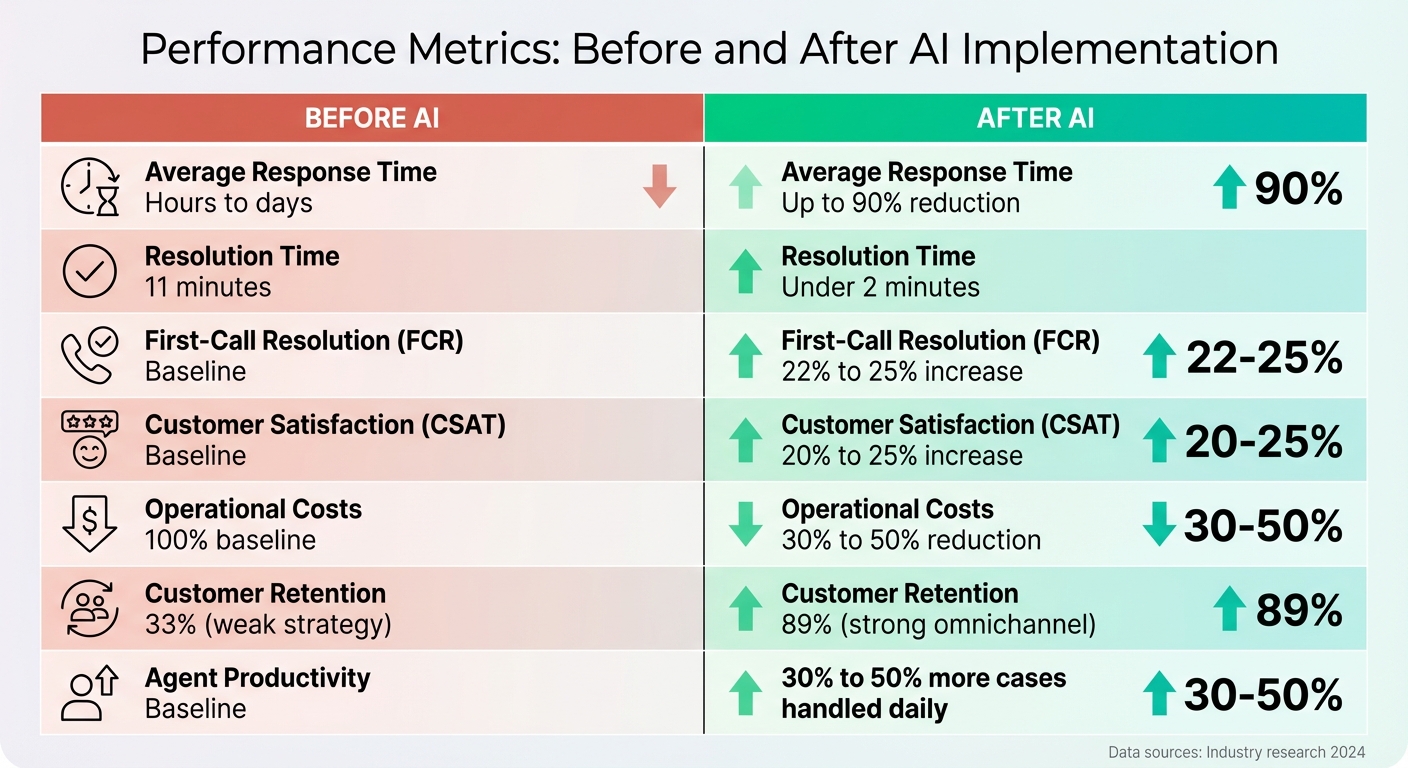
AI Impact on Customer Service: Before vs After Performance Metrics
After understanding how AI addresses key support challenges, let’s dive into the benefits it brings to businesses.
Better Customer Satisfaction and Loyalty
AI takes customer experiences to the next level by retaining context across multiple channels. Imagine a customer starting with an email, moving to chat, and then switching to a phone call - AI ensures they don’t need to repeat their issue. This seamless experience is critical, especially when 72% of customers expect personalized service.
Personalization doesn’t just make customers happy - it drives results. Satisfaction improves by 20%, and 80% of businesses see better retention rates. AI’s real-time sentiment analysis can detect frustration early, adjusting its approach or escalating to a human agent before small problems snowball into major complaints. Personalized interactions alone can lower churn rates by 14%, and when combined with predictive analytics, that figure jumps to 25%.
Here’s a real-world example: In 2024, a German media company used a generative AI-powered assistant for product recommendations. The AI delivered tailored suggestions 10 times faster than before, boosting customer satisfaction by 15%. Similarly, an Asian bank incorporated AI for intent recognition and sentiment analysis. Over a year, they reduced service interactions by 40% to 50% while doubling the use of self-service channels.
Lower Costs and Better Efficiency
AI doesn’t just improve service - it also slashes costs. By automating up to 85% of customer queries with chatbots, businesses can cut customer service expenses by 30% to 50%. Routine inquiries, which often eat up 25% of labor costs, can now be handled automatically.
AI also helps employees focus on high-value tasks. Service teams often lose over 40% of their time on repetitive, low-priority work, but AI can eliminate this inefficiency. When used as a co-pilot tool, it boosts agent productivity by 14%. Advanced AI systems can independently resolve up to 93% of support tickets, while ticket summarizers speed up resolution times by 38%. Plus, response times can be cut by as much as 90%.
"AI is reshaping customer service into a strategic advantage... shifting it from a cost center into a proactive customer engagement strategy." – IBM Think
Training costs also drop significantly. AI provides real-time guidance and pulls relevant knowledge base articles during interactions, cutting new agent training expenses by 30%. These cost savings lead to clear, measurable improvements in performance.
Performance Metrics: Before and After AI
The following table captures the transformative impact of AI on customer service metrics:
| Metric | Before AI | After AI |
|---|---|---|
| Average Response Time | Hours to days | Up to 90% reduction |
| Resolution Time | 11 minutes | Under 2 minutes |
| First-Call Resolution (FCR) | Baseline | 22% to 25% increase |
| Customer Satisfaction (CSAT) | Baseline | 20% to 25% increase |
| Operational Costs | 100% baseline | 30% to 50% reduction |
| Customer Retention | 33% (weak strategy) | 89% (strong omnichannel) |
| Agent Productivity | Baseline | 30% to 50% more cases handled daily |
These numbers show how AI transforms customer support into a streamlined, efficient, and customer-centric operation. Whether it’s faster response times or lower operational costs, the benefits are hard to ignore.
Getting Started: AI Implementation for SMEs
AI can transform how small and medium-sized enterprises (SMEs) operate. To start, focus on integrating AI into your current workflows in practical, manageable steps.
Finding AI Tools on AI for Businesses
Begin by identifying your biggest operational challenges. Are response times too slow? Is your team bogged down with repetitive tasks? Pinpointing these pain points will help you choose tools that address your specific needs. Platforms like AI for Businesses simplify this process by offering a curated selection of AI tools tailored for SMEs and growing companies. This saves you from the hassle of endless comparisons.
For example, if you’re looking for AI-powered chatbots to handle routine customer inquiries, tools like Writesonic can help you create effective conversational interfaces quickly. If organizing support documentation is a struggle, Rezi can streamline your information management. Many tools on the platform offer free trials or affordable plans, like Pro subscriptions starting at $29/month, so you can test them before committing to a larger investment.
Get your support team involved from the start. Their input ensures the tools you choose address real challenges and increases the likelihood of adoption. This also helps avoid spending on features your team won’t use.
Once you’ve identified the right tools, the next step is to create a plan for integrating them into your day-to-day operations.
Creating an AI Integration Plan
Set clear, measurable goals before you invest in any tools. For instance, aim to cut response times by 50% or boost first-call resolution rates by 20%. These targets will help you track the return on your investment and ensure you’re implementing AI with purpose, not just for the sake of technology.
When evaluating tools, make sure they integrate seamlessly with your existing systems, such as your CRM and communication platforms. Avoid creating isolated data silos by choosing solutions that include features like Natural Language Processing (NLP), predictive analytics, and sentiment analysis. These capabilities can even detect customer frustration early, giving you a chance to address issues proactively.
Start small with a pilot program. Test the tool with a limited customer segment before rolling it out across your entire operation. This approach allows you to evaluate its effectiveness and troubleshoot any issues without disrupting your whole system.
Finally, ensure your team is equipped to use these tools effectively, and establish metrics to monitor their impact.
Training Staff and Tracking Results
The success of AI hinges on how well your team uses it. Train your staff to work alongside AI using a "human-in-the-loop" approach, where employees review and refine AI outputs. As noted by BCG:
"Employees may become supervisors of AI, guiding and scaling its impact".
This means teaching your team when to trust AI’s recommendations and when to step in with human judgment. Focus on developing soft skills like empathy and critical thinking - while AI can handle routine tasks, complex or sensitive issues still require a personal touch.
"AI should enhance, not replace, human support. It's best used for routine tasks, while complex, emotional or sensitive cases use human interaction." – IBM
Track key performance metrics from day one. Keep an eye on response times, resolution rates, customer satisfaction scores, and agent productivity. Establish a feedback system so your team can report errors or biases in the AI, allowing for continuous improvement. Companies that effectively integrate AI often see a 17% boost in customer satisfaction and a 38% reduction in call handling times. Document your successes and challenges - this information will be invaluable as you expand your AI efforts.
Conclusion
AI is reshaping how small and medium-sized enterprises (SMEs) approach customer support. By breaking down data silos, offering instant 24/7 assistance, and enabling proactive service, it tackles long-standing challenges in omnichannel support. A strong omnichannel strategy not only solves these issues but also boosts customer retention - a critical driver of sustainable business growth.
This improved retention directly impacts the bottom line. AI brings measurable financial benefits. Take Booksy, for example - it saves $600,000 annually by automating 70% of its customer tickets. Similarly, Klarna's AI assistant managed the workload of 700 agents in just its first month and is on track to generate $40 million in additional profits by 2024. These examples highlight how AI delivers both operational efficiency and significant revenue growth.
For SMEs, the path forward is clear: set specific goals and choose the right tools. Whether your priority is cutting response times, scaling support without hiring more staff, or providing personalized service at scale, AI makes it all achievable - and affordable. With solutions ready to integrate into your existing systems, AI empowers businesses to enhance data integration, deliver real-time support, and engage customers proactively, as explored throughout this article.
Ready to transform your customer support? Visit AI for Businesses to discover tailored AI solutions for SMEs - starting at just $29/month. The real question isn't whether AI can improve your support but how soon you'll adopt it to stay ahead of the competition.
FAQs
How does AI unify customer data across multiple channels?
AI takes the hassle out of managing customer data by pulling information from multiple sources - websites, mobile apps, social media, emails, phone calls, and even in-person interactions - and organizing it into one unified profile. By using identifiers like email addresses, phone numbers, or device IDs, it merges fragmented records automatically, cutting out the need for manual effort.
Once the data is consolidated, AI ensures it stays current by updating it in real time. This means businesses always have access to the most up-to-date customer information. It also solves the problem of data silos, where agents often lack a full picture of previous interactions, leaving customers frustrated by having to repeat themselves. On top of that, AI enriches these profiles with predictive insights, helping businesses spot potential issues, suggest next steps, or deliver tailored offers through channels like email, SMS, or chat.
For companies looking to adopt these tools, platforms such as "AI for Businesses" provide ready-made solutions to simplify data integration and enable smooth, proactive customer support across every touchpoint.
What are the cost advantages of using AI in customer support?
Using AI in customer support offers a practical way for businesses in the U.S. to cut costs without sacrificing service quality. Tools like virtual agents and chatbots can handle routine questions instantly and work around the clock. This reduces the need for large support teams and lowers labor expenses, all while keeping service consistent.
AI also boosts efficiency by resolving issues on the first contact more often and cutting down the time it takes to handle each interaction. These improvements mean fewer tickets need to be escalated, which helps bring down the cost per interaction. Plus, AI makes it easier to handle spikes in customer inquiries during busy times without needing to spend significantly more.
For small and medium-sized businesses, affordable, ready-to-use AI tools - like chatbots or smart routing systems - can seamlessly integrate with existing customer service platforms. This means they can enjoy the cost savings of AI-powered support without needing to make a big upfront investment.
How does AI improve customer support response times and satisfaction?
AI is transforming customer support by slashing response times and boosting satisfaction through advanced features like natural language processing (NLP). With NLP, AI systems can interpret slang, handle typos, and understand varied sentence structures, delivering instant replies or directing inquiries to the appropriate human specialist. This means fewer delays, more accurate responses, and less frustration for customers.
Another game-changer? AI tools can remember past interactions, so customers don’t have to repeat themselves - a small touch that makes a big difference. On top of that, features like sentiment analysis allow AI to pick up on frustration or dissatisfaction, ensuring issues are escalated to a human when needed. These capabilities not only improve first-contact resolution rates but also create a smoother, more efficient support experience.
For small and medium-sized businesses, AI tools are a cost-effective way to enhance customer support without hefty IT investments. By automating routine queries, teams can focus their energy on more complex, high-priority tasks, making the whole operation run more efficiently.